
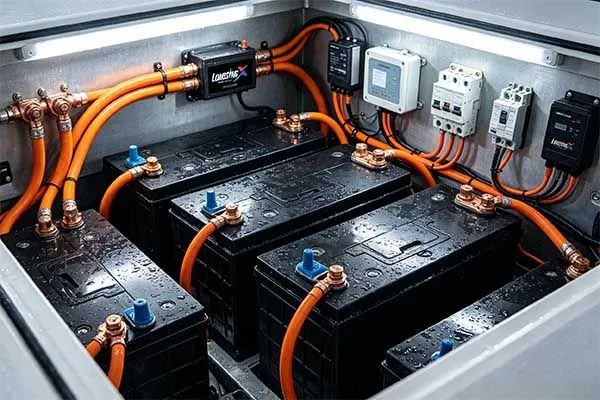
Facing constant vibration and high humidity, standard power sources degrade rapidly on the water.
A sudden electrical failure mid-voyage risks navigation and safety. Upgrading to specialized marine battery systems guarantees resilient power, ensuring your vessels operate smoothly regardless of harsh ocean conditions.
Highly efficient marine battery systems serve as the foundational energy storage unit designed to withstand extreme aquatic environments.
They provide initial cranking amps for engines, deep discharging for house loads, and dedicated voltage for propulsion, answering the critical demand for uninterrupted, safe marine power operations.
Long Sing Energy Electric Marine Battery Systems Datasheet
| Model | Nominal Ah | Nominal CCA | Real Ah (C20) | RC (min.) | CCA (-18°C) | CA (25°C) | L (mm) | W (mm) | H (mm) | TH (mm) |
|---|---|---|---|---|---|---|---|---|---|---|
| 24D* | 80 | 670 | 80 | 140 | 670 | 800 | 260 | 172 | 200 | 227 |
| 27D | 90 | 720 | 90 | 170 | 720 | 900 | 305 | 171 | 200 | 226 |
| 31D | 115 | 800 | 106 | 192 | 760 | 950 | 330 | 174 | 219 | 245 |
| 24 | 81 | 760 | 81 | 139 | 760 | 800 | 260 | 172 | 200 | 227 |
| 27 | 83 | 760 | 83 | 152 | 750 | 800 | 305 | 171 | 200 | 226 |
| 31 | 112 | 960 | 100 | 210 | 960 | 1000 | 330 | 174 | 219 | 245 |
*Note: The letter “D” in a model means Dual Purpose, combining engine starting and deep-cycle power for accessories.
To properly conquer these formidable environmental challenges, engineers must carefully deploy advanced internal chemistries and robust structural frameworks within marine battery systems that secure continuous mobility.
Table of Contents
- 1. What Is a Marine Battery System?
- 2. How Do Marine Battery Systems Work?
- 3. How Does The Battery Management System (BMS) Integrate With Marine Protocols?
- 4. How To Accurately Size And Select A Marine Battery System?
1. What Is a Marine Battery System?
Marine battery systems are purpose-built energy storage units that deliver reliable power in the demanding conditions found at sea. They include battery cells, a management system, thermal regulation, and sealed housing.
Unlike standard automotive batteries, a marine boat battery must resist salt spray corrosion, absorb continuous vibration, and operate across wide temperature ranges — all while meeting strict maritime safety standards such as IEC 62619[1] and UN38.3.
What type of battery is a marine battery?
Four chemistries dominate the boat battery market today: flooded lead-acid, AGM (Absorbed Glass Mat), gel, and lithium iron phosphate (LiFePO4). Each brings a different balance of cost, weight, cycle life, and maintenance demands, and the right choice depends on your vessel type, duty cycle, and budget.
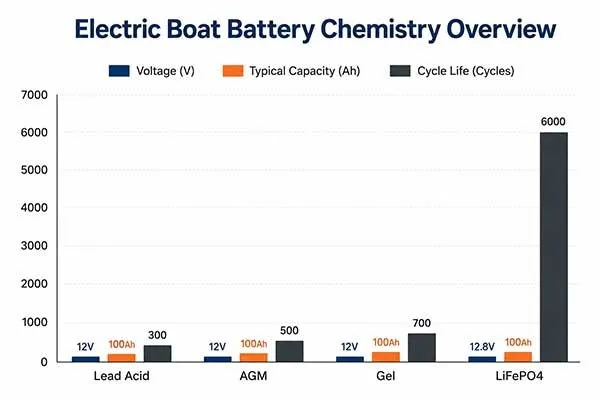
Flooded lead-acid batteries use a liquid electrolyte and need regular water topping. They cost the least upfront but deliver only 300–500 cycles at 50% depth of discharge and weigh roughly 30 kg per kilowatt-hour. They vent hydrogen gas during charging, which demands well-ventilated battery compartments — a design constraint that is hard to meet on smaller boats.
AGM marine battery designs seal the electrolyte inside fiberglass mats. This eliminates spills, cuts maintenance to near zero, and allows installation in any orientation — a clear advantage on boats with tight, irregularly shaped compartments. An agm marine battery typically delivers 500–800 cycles at 50% DOD and handles moderate vibration, making it a popular boat battery choice for mid-range recreational and light commercial applications.
Tips: Salt Corrosion Failure
Salt-air intrusion is the #1 cause of early marine battery failure in open-hull boats. Even “sealed” AGM batteries can corrode terminal connections within 12 months if exposed to salt spray. LiFePO4 in sealed housings eliminates the vented-hydrogen corrosion cycle entirely.
Gel batteries suspend the electrolyte in fumed silica. They handle deep discharge well but charge slowly and are sensitive to overcharging. They suit low-power house loads rather than propulsion duty.
Marine LiFePO4 battery chemistry stands out for demanding applications. With 3,000–5,000 cycles, roughly one-third the weight of lead-acid, and excellent thermal stability, lithium battery for marine use adoption is accelerating across Europe. These packs maintain a flat voltage curve throughout discharge, so onboard electronics see consistent voltage from full charge to near-empty — a key advantage for navigation and communication equipment that cannot tolerate voltage sag.
For a balcony solar brand evaluating cross-market opportunities, these advanced marine battery systems demonstrate how high-density cell architecture effectively translates from stationary balconies to dynamic, high-impact aquatic environments.
| Feature | Flooded Lead-Acid | AGM Marine Battery | Gel | LiFePO4 |
|---|---|---|---|---|
| Cycle Life (80% DOD) | 300–500 | 500–800 | 500–1,000 | 3,000–5,000 |
| Weight (per kWh) | ~30 kg | ~25 kg | ~25 kg | ~10 kg |
| Maintenance | High (water topping) | Low | Low | None |
| Charge Efficiency | ~80% | ~85% | ~85% | ~98% |
| Vibration Resistance | Low | Moderate | Moderate | High |
| Upfront Cost | Lowest | Moderate | Moderate | Highest |
| 10-Year Total Cost | High | Moderate | Moderate | Lowest |
Starting Battery vs Deep Cycle vs Dual Purpose Battery
Marine batteries are classified by function, and this distinction matters directly when you design an electric boat propulsion battery setup or plan your house loads.
Starting batteries deliver short, high-current bursts to crank engines. They use thin plates to maximize surface area and cold-cranking amps[2] but degrade rapidly under deep cycling. Using a starting battery for house loads will destroy it within months.
A deep cycle marine battery uses thicker plates built to discharge 50–80% of capacity repeatedly. It powers trolling motors, onboard electronics, navigation systems, and house loads. A deep cycle marine battery in LiFePO4 chemistry delivers over 3,000 full cycles at 80% DOD — far beyond any lead-acid deep cycle alternative — and weighs less than half as much per kilowatt-hour.
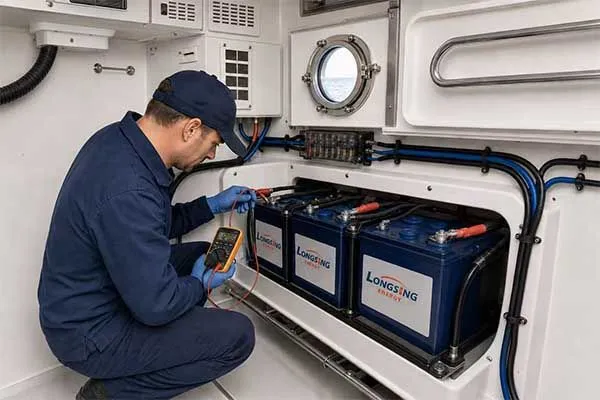
Dual-purpose batteries attempt both roles. They handle moderate starting loads and moderate cycling but excel at neither. For serious boat batteries in commercial or recreational vessels, separating starting and deep cycle functions into dedicated banks is the stronger engineering choice. This separation also simplifies BMS configuration and improves fault isolation.
The shift toward marine electrification[3] is driving demand for larger deep cycle marine battery banks, higher system voltages, and smarter management. European builders now routinely specify 48V or higher for electric propulsion, with separate low-voltage banks for house loads. The European Union’s push toward zero-emission inland waterway and short-sea vessels is accelerating this transition further.
Need Battery That Survives Salt, Shock & 3,000+ Cycles?
LiFePO4 cells rated IP67, pre-tested for vibration and salt-spray — ship-ready in 15 days.
2. How Do Marine Battery Systems Work?
Marine battery systems operate as part of a larger electrical architecture.
In a traditional setup, the engine drives an alternator that charges the battery bank through a regulator or smart charger. The bank then supplies all onboard loads — propulsion, navigation, lighting, and HVAC.
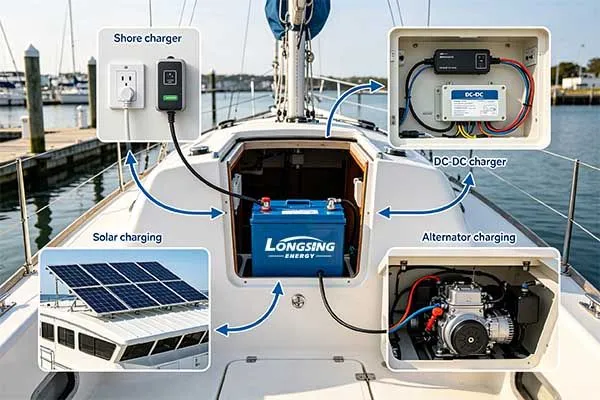
In fully electric or hybrid vessels, the architecture scales up significantly with high-voltage propulsion banks, DC-DC converters, inverters, and shore-power charging[4] interfaces. Every connection, fuse, and contactor must meet marine-grade specifications to ensure safety and reliability.
Electric Boat System Architecture & Voltage Configurations
A modern electric boat battery uses modular architecture that scales from small leisure craft to commercial ferries.
Cells connect in series and parallel to hit the target voltage and capacity. Cells form modules; modules form packs; packs form the complete system. This layered approach lets engineers scale from a 5 kWh fishing boat bank to a 2 MWh ferry system using the same fundamental building blocks.
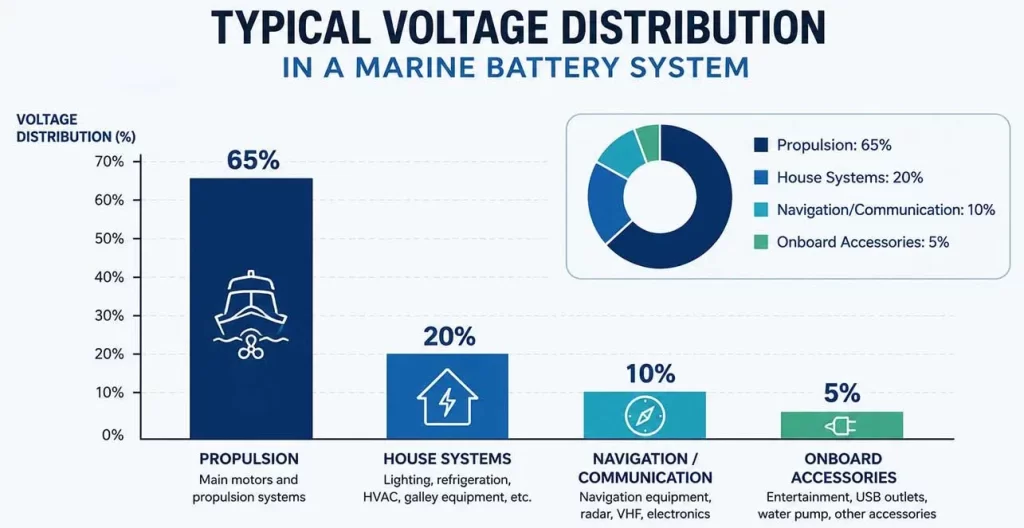
A typical electric vessel battery pack for a mid-size boat runs at 48V nominal (low voltage) or 350–800V (high voltage). A 48V system suits boats under 50 kW; anything above typically requires high-voltage architecture to keep current manageable and cable cross-sections practical. Higher voltage means lower current for the same power, which reduces copper weight and resistive losses — both critical concerns on a weight-sensitive vessel.
The high-voltage bus includes several key components: a precharge circuit with a current-limiting resistor to prevent inrush damage to capacitors, main contactors rated for the operating voltage that provide safe connect and disconnect under load, a DC fuse sized for fault interruption, and a high-voltage junction box (HV box) that distributes power to the propulsion inverter and auxiliary DC-DC converters.
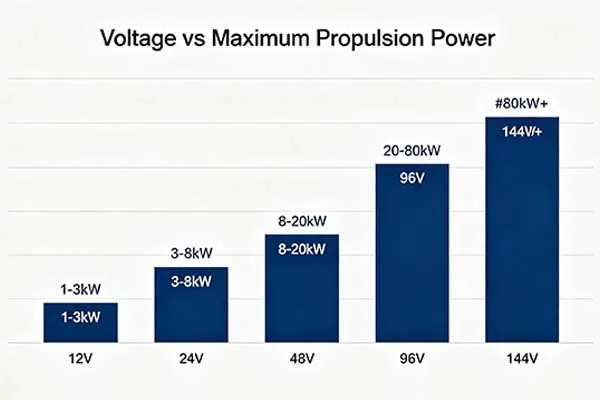
Active liquid cooling — using glycol-water loops or direct refrigerant circuits — keeps cells within the optimal 15–35°C operating window. This is critical when engine rooms reach 60°C while the water outside sits at 5–10°C in northern European waters.
As our chief engineer Jack Song notes, during a recent highly demanding hybrid ferry project in Norway, we engineered a custom marine battery pack to secure strict DNV compliance[5] and survive brutal Salt Spray (ASTM B117, 720 Hours) testing.
This 57.6V 310Ah LFP marine battery system design faced extreme, highly contrasting water temperatures—a suffocatingly hot engine room hitting 53°C contrasting sharply with the freezing 4°C cold water outside the hull. We integrated advanced liquid cooling plates and a customized MPPT solar access point that standard installations often omit, ensuring stable power delivery and optimizing the vessel’s auxiliary renewable generation.
| Item | Before | After |
|---|---|---|
| Peak Temperature | 53°C | 41°C |
| Temperature Difference | 9.4°C | 2.6°C |
| DCIR Variation | ±13% | ±4% |
| Continuous Power Derating | Frequent | Not Observed During Validation |
Electric Propulsion vs. House Systems
Every vessel splits its electrical needs into two categories: propulsion and house loads. This is a non-negotiable safety practice within premium marine battery systems.
Propulsion systems draw high, sustained current. A 30-foot leisure electric boat might pull 20–50 kW continuously, while a commercial ferry can demand over 1 MW. These loads need dedicated high-voltage battery banks with appropriately rated BMS, active cooling, and safety interlocks that meet classification society rules[6].
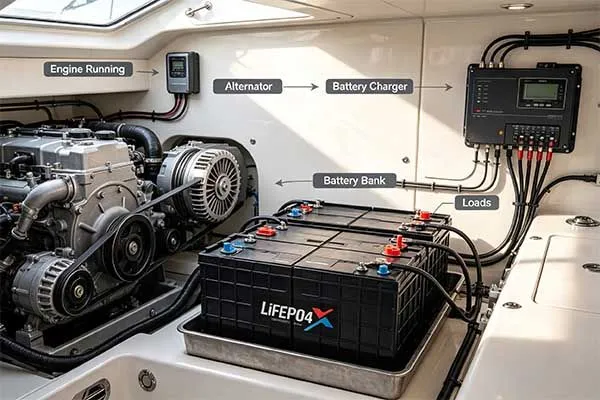
House systems power navigation, lighting, refrigeration, communication, comfort electronics, and HVAC. They run at 12V or 24V DC with much lower current draw. Lithium bass boat batteries and other small-craft house banks typically use compact 12.8V LiFePO4 modules that fit under seats or in side compartments.
A DC-DC converter bridges the two systems, stepping voltage down from the high-voltage propulsion bus to the low-voltage house bus. This eliminates the need for a separate battery chemistry for house loads and simplifies the overall system.
Unlike legacy boat batteries with basic voltage readouts, modern lithium house systems provide granular data — state of charge, current, temperature — through digital communication. Some builders add a bi-directional inverter to feed AC loads from the DC bus, enabling galley equipment, HVAC, and shore-power integration through a single power electronics platform.
This architecture reduces component count and simplifies wiring, which matters on a vessel where every kilogram and every cable run has a cost.
Optimize Your Boat Electrical Architecture
Reduce wiring losses and maximize runtime.
3. How Does The Battery Management System (BMS) Integrate With Marine Protocols?
The battery management system is the control center of modern marine battery systems. It monitors individual cell voltages, pack temperatures, and state of charge in real time. It balances cells during charging to prevent drift, disconnects loads during overcurrent or thermal fault conditions, and communicates critical data to the vessel’s wider control network.
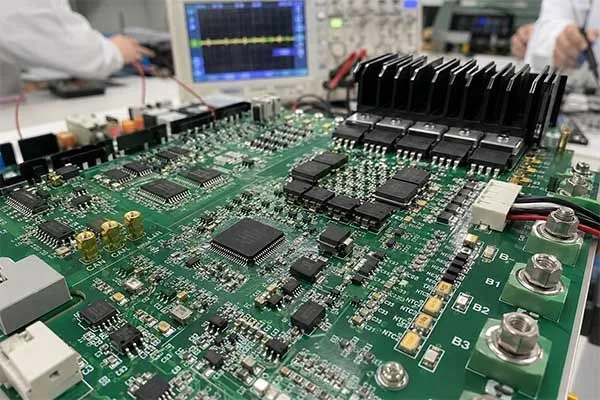
A BMS that is underspecified or poorly configured turns even the highest-quality cells into a safety liability. For marine applications, the BMS must also handle salt-air corrosion on connectors, vibration-induced intermittent connections, and electromagnetic interference from propulsion drives.
Marine Communication Protocols: CAN Bus, NMEA 2000, and Smart App Integration
A modern electric boat battery must communicate with chargers, motor controllers, display screens, and sometimes remote fleet monitoring platforms. Three protocols handle this, and choosing the right combination depends on your vessel’s complexity.
CAN Bus (Controller Area Network) is the backbone of high-voltage battery communication. It moves real-time data — cell voltages, pack current, temperatures, fault codes — between the BMS and the motor controller, charger, and DC-DC converter at 250–500 kbps. Most BMS platforms use CAN 2.0B with 29-bit identifiers, and we follow the same standard in our lithium boat battery systems to ensure compatibility with third-party motor drives and chargers from major European suppliers.
NMEA 2000[7] bridges the battery system with the vessel’s marine electronics network. Built on the CAN physical layer with a standardized application protocol, NMEA 2000 lets chartplotters, multifunction displays (MFDs), and engine monitors read battery state of charge, voltage, current, and temperature without custom integration code.
This protocol is essential for ABYC compliant marine electrical systems, which require integrated monitoring across all critical power sources on board. In practice, it means the helmsman sees battery status on the same screen as navigation and engine data — a significant safety and convenience improvement.
Smart App Integration via Bluetooth Low Energy (BLE) or Wi-Fi gives installers and end-users direct access to battery data on a phone or tablet. The app displays individual cell voltages, pack temperature, cycle count, charge/discharge history, and fault logs — data that previously required a laptop with proprietary software. During commissioning, this speeds up verification; during operation, it enables quick troubleshooting without opening the battery enclosure.
| Protocol | Physical Layer | Baud Rate | Primary Use Case | Key Standard |
|---|---|---|---|---|
| CAN Bus | Twisted Pair | 250–500 kbps | BMS ↔ Motor Controller / Charger | CAN 2.0B, SAE J1939 |
| NMEA 2000 | CAN-based Twisted Pair | 250 kbps | Battery ↔ Marine Displays / MFD | IEC 61162-3 |
| BLE / Wi-Fi App | Wireless | — | Installer ↔ BMS for commissioning and monitoring | Bluetooth 5.0+, IEEE 802.11 |
A small fishing boat with a basic boat battery setup may only need BLE app access for occasional checks. A yacht or commercial vessel with multiple battery banks, redundant chargers, and engine monitoring requires full CAN and NMEA 2000 integration.
As a marine lithium battery supplier, we configure the BMS communication layer to match each customer’s system architecture from the first prototype — ensuring no integration surprises during commissioning or sea trials.
BMS That Speaks NMEA 2000, J1939 & CAN
Pre-configured marine BMS with active balancing, SOC ±1% accuracy.
4. How To Accurately Size And Select A Marine Battery System?
Sizing marine battery systems correctly starts with a thorough load analysis. You need the total power demand of every onboard system — propulsion, house loads, safety equipment, and a reserve margin.
Undersizing leads to range anxiety and premature cell degradation from frequent deep cycling; oversizing adds unnecessary weight, cost, and complexity. Getting the right answer requires a structured approach grounded in your actual operational profile.
How to Choose the Right Marine Battery System?
Different vessel types impose very different demands on battery selection.
A fishing boat running a trolling motor for six hours has fundamentally different requirements than a patrol boat that needs burst power for pursuit speeds and fast turnaround charging. Most off-the-shelf boat batteries come in standard BCI group sizes that limit installation flexibility, which is why many professional builders turn to custom solutions.
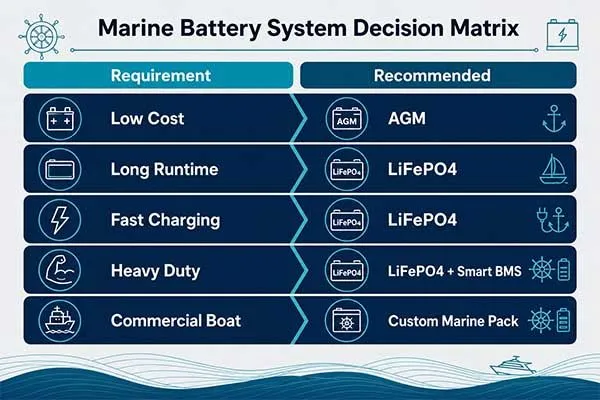
Electric Boat Battery Capacity Calculator — A Practical Framework
Before contacting any electric boat battery manufacturer, run this basic capacity calculation:
Usable Capacity (kWh) = Average Power Draw (kW) × Required Runtime (h) ÷ Depth of Discharge (%)
Example: A leisure electric boat battery drawing 10 kW average for 4 hours at 80% DOD needs: 10 × 4 ÷ 0.8 = 50 kWh. Add a 20% safety margin for real-world conditions — temperature effects, cell aging over time, sea state, and headwind resistance — and you arrive at 60 kWh of total installed capacity.
This essential digital tool meticulously models exact amp-hour loads—such as radar arrays, continuously running bait pumps, and high-draw propulsion motors—against your required offshore runtimes. Using the calculator prevents costly undersizing that leads to premature battery death.
Matching Battery Systems to Vessel Types
| Vessel Type | Typical Capacity | Voltage Range | Chemistry | Key Requirement |
|---|---|---|---|---|
| Fishing Boat | 5–20 kWh | 12–48V | LiFePO4 | Long runtime, vibration resistance |
| Sailboat | 10–40 kWh | 24–48V | LiFePO4 | Cycle life, weight savings |
| Yacht | 50–200 kWh | 48–400V | LiFePO4 / NMC | High power, redundancy |
| Commercial Vessel | 200–2,000 kWh | 400–800V | LiFePO4 | Classification compliance, cycle life |
| Patrol Boat | 50–300 kWh | 350–800V | NMC | High discharge rate, fast charge |
| Offshore Platform | 100–500 kWh | 48–400V | LiFePO4 | Extreme environment reliability |
| Electric Boat | 20–1,000 kWh | 48–800V | LiFePO4 / NMC | Energy density, full integration |
Custom marine battery pack solutions matter because no two boats share the same hull geometry, weight distribution, cooling access, or regulatory class. Working with a LiFePO4 marine battery OEM partner who handles electrical, mechanical, and thermal engineering in-house means the pack fits your hull rather than forcing a standard enclosure into an irregular space.
Selecting the right marine boat battery for your specific mission profile reduces integration risk, shortens commissioning time, and lowers total cost of ownership over the vessel’s lifetime.
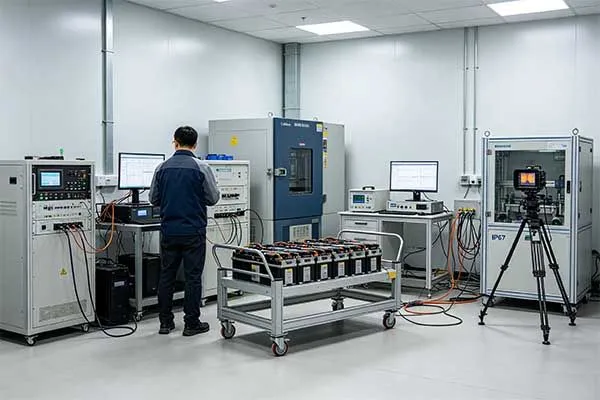
For larger marine energy storage applications — such as hybrid ferries, offshore platforms, or fleet charging depots — containerized solutions may be a better architectural fit.
Choose a marine lithium battery supplier with proven classification experience — DNV, Lloyd’s Register, Bureau Veritas — to reduce project risk. Ask for reference projects, third-party test reports, and certification documents before committing.
A reliable marine battery pack manufacturer partner will support you from initial design through homologation[8], sea trials, and long-term after-sales service across your target markets.
Free Battery Sizing Worksheet
Input hull data, route distance, and loads — get kWh and voltage in minutes.
Conclusion
Navigating the complexities of marine electrification requires a deep understanding of energy density, harsh environmental endurance, and advanced digital integration.
Modern marine battery systems transcend basic power storage, acting as intelligent hubs that guarantee safety, longevity, and high-performance propulsion on the water. Whether integrating a robust marine boat battery for a small leisure craft or deploying high-voltage modules for commercial ferries, prioritizing a sophisticated BMS and proven chemistry is non-negotiable.
Investing in specialized marine battery systems ultimately secures your vessel’s operational reliability and future-proofs your maritime adventures.
Frequently Asked Questions
Click to explore more information about Electric Marine Battery
Q: What is a marine battery?
A: A marine battery is a battery specifically designed for boats and marine equipment. It provides reliable starting power, deep-cycle energy storage, or both, while resisting vibration, moisture, and harsh marine environments.
Q: What’s the difference between a marine battery and a regular battery?
A: Marine batteries are built to withstand vibration, corrosion, and repeated deep discharges, while regular automotive batteries are mainly designed to deliver high starting current and are not intended for frequent deep cycling.
Q: What is the best battery for marine use?
A: LiFePO4 marine batteries are widely considered the best choice for most electric boats because they offer long cycle life, fast charging, lightweight construction, and maintenance-free operation.
Q: What marine batteries last the longest?
A: High-quality LiFePO4 marine batteries typically last the longest, often exceeding 4,000–6,000 charge cycles with proper battery management, significantly outperforming AGM and lead-acid batteries.
Q: Where is the best source for marine batteries?
A: The best source is an experienced OEM marine battery manufacturer like Long Sing Energy that provides certified LiFePO4 battery solutions, engineering support, customization, and dependable global supply.
Reference:
[1]Read the official IEC 62619 battery safety standard.↪
[2]Learn how cold-cranking amps affect engine starting performance.↪
[3]Learn about marine electrification and stay updated on the latest technologies.↪
[4]Explore modern shore-power charging solutions for electric boats.↪
[5]Learn about DNV compliance requirements for marine battery systems.↪
[6]Review classification society rules governing marine battery safety and certification.↪
[7]Learn how NMEA 2000 integrates battery information into marine electronics.↪
[8]Learn about the homologation process for advanced battery systems.↪
Keep reading on Energy Storage System
- Scalable Energy Storage Systems: Sustainable Lithium-Ion Solutions for Grid and Industrial ESS
- Wall Mounted Solar Battery System: What Are the Real Installation Challenges?
- How Does a LiFePO4 Stackable Battery System Work: Technical Guide
- AC Coupling vs DC Coupling Plug-In Balcony Solar Battery Storage System for Higher Efficiency?
- Grid-Connected BESS Container for Utility Substations: Design, Integration and Cost Analysis