
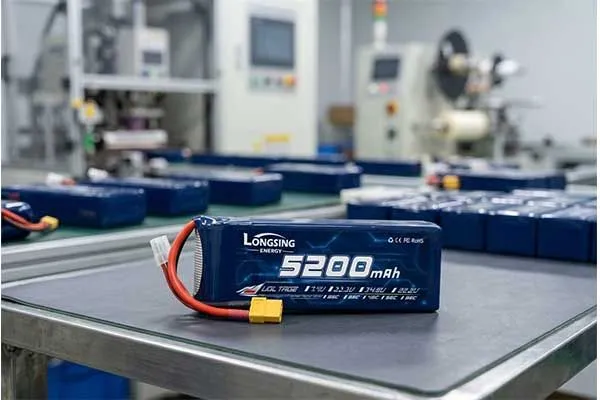
Key Takeaways
- A drone battery usually lasts 20 to 45 minutes per flight, and an Industrial UAV flies 25 to 55 minutes without payload.
- The pack itself lasts 150 to 800 cycles, depending on chemistry, charge rate, temperature, and storage voltage.
- Flight time equals usable watt-hours divided by average watts. Weight, reserve, cold, and aging cut the spec-sheet number by 20% to 40%.
- Charge at 0.5C to 1C, stay between 5 °C and 40 °C, and store packs at 3.80 to 3.85 V per cell.
- Size the pack from the mission. Higher Wh/kg beats higher Ah, because extra mass raises hover power faster than it adds energy.
- Ask an OEM for sample-to-lot data on capacity, resistance, and cycle life before you commit to volume.
A drone that lands before completing its mission wastes time, increases operating costs, and limits commercial value.
However, choosing a larger battery does not always improve drone battery life, because additional weight increases power demand. Engineers need to match usable energy, propulsion load, and battery performance to achieve reliable flight time.
A drone battery typically supports approximately 20–45 minutes of flight in many consumer and FPV applications. High-energy lithium-ion battery packs used in fixed-wing or VTOL drones can extend flight times to more than two hours, while racing quadcopters may typically deplete their batteries in less than ten minutes.
However, optimized multirotor platforms can achieve longer flight times, and fixed-wing UAVs[1] can remain airborne for several hours, depending on their design, payload, and operating conditions.
Actual endurance depends on aircraft design, payload, wind, battery chemistry, and the flight profile.
Better results start with engineering, not guesswork. The sections below show how to calculate flight time, charge safely, and size replacement batteries for drones that match your payload.
Table of Contents
- How to Calculate LiPo Battery Flight Time?
- How to Charge a Drone Battery?
- How to Size a Drone Battery Pack for Payload and Flight Time?
- OEM Drone Battery Pack Design and Validation
1. How to Calculate LiPo Battery Flight Time?
Engineers can estimate drone flight time by dividing the battery’s usable energy by the aircraft’s average electrical power consumption. Battery capacity alone does not determine endurance because voltage, discharge limits, propulsion efficiency, and payload affect the energy available during flight.
The basic calculation is:
Battery energy can be estimated from nominal voltage and rated capacity:
Enominal = Vnominal X CAh
For a 6S LiPo battery rated at 22.2 V and 5 Ah:
Enominal = 22.2 X 5 = 111Wh
If the design allows 80% of nominal energy to be used, the estimated usable energy becomes:
Eusable = 111 X 0.80 = 88.8 Wh
If the drone consumes an average of 250 W, the estimated flight time is:
This estimate assumes that the battery can deliver the required power and that the selected usable-energy fraction is achievable under the actual operating conditions. It does not replace flight testing.
What Determines Drone Battery Life?
Drone battery life depends on battery energy, aircraft mass, propulsion efficiency, operating conditions, and battery condition. These factors determine both the energy available for flight and the rate at which the aircraft consumes it.
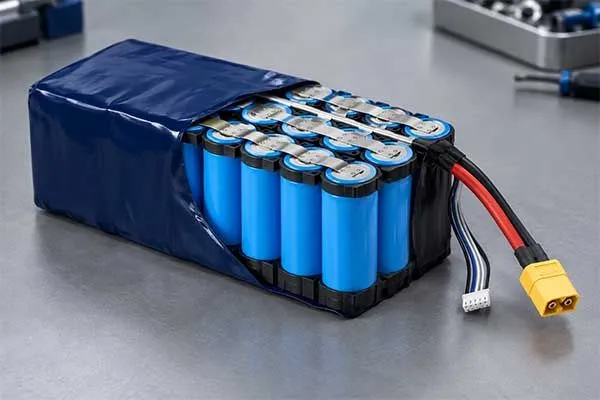
High-energy-density lithium-ion packs can extend UAV endurance in compatible battery-electric UAVs, while specialized solid-state lithium-metal batteries may support longer flight times in advanced platforms.
Battery Capacity, Voltage, and Chemistry
Battery capacity, measured in ampere-hours (Ah) or milliampere-hours (mAh), indicates how much electric charge a battery can deliver. Watt-hours[2] provide a more useful measure of energy because they account for voltage.
A drone lithium ion battery may use cylindrical or pouch cells, while many high-performance LiPo packs use pouch-format cells. Both designs require careful matching to the aircraft’s voltage, current, and mechanical requirements.
| Battery specification | Engineering impact |
|---|---|
| Capacity (Ah) | Determines rated charge capacity |
| Nominal voltage (V) | Helps determine available energy |
| Continuous discharge rating | Indicates supported sustained current under specified conditions |
| Internal resistance | Influences voltage sag and heat generation |
| Battery mass | Changes total aircraft mass and propulsion demand |
| Cycle life | Affects replacement frequency and operating cost |
For example, a 6S drone battery contains six cells connected in series. A conventional LiPo configuration has a nominal voltage of approximately 22.2 V, with a fully charged voltage of 25.2 V when each cell is charged to 4.2 V. The aircraft’s electronic speed controllers and other components must support the actual voltage range.
Why Aircraft Weight and Flight Conditions Matter
A larger battery increases energy storage, but it also increases takeoff weight. A multirotor must generate additional thrust to support that weight, which increases electrical demand. The relationship between mass and power is not fixed because propeller size, motor efficiency, flight speed, and aerodynamic design influence the result.
Wind[3], repeated acceleration, hovering, and aggressive maneuvering can also increase energy consumption. A fixed-wing Industrial UAV may achieve greater endurance than a multirotor because its wings generate lift without requiring continuous rotor thrust to support the aircraft.
Need a Pack Sized to Your Real Power Draw?
We model your mission profile and deliver flight-validated energy data, not datasheet guesses.
Case Study: A German OEM’s Endurance Problem
A drone OEM engineer in Germany contacted us after a frustrating experiment. His industrial UAV — a 12 kg quadcopter for power-line inspection — flew 34 minutes on a 6S 16 Ah LiPo pack weighing 2.35 kg. He swapped in a 6S 22 Ah pack (3.4 kg), expecting roughly 37% more endurance from 37% more capacity. The aircraft delivered only 8% more: 36.7 minutes.
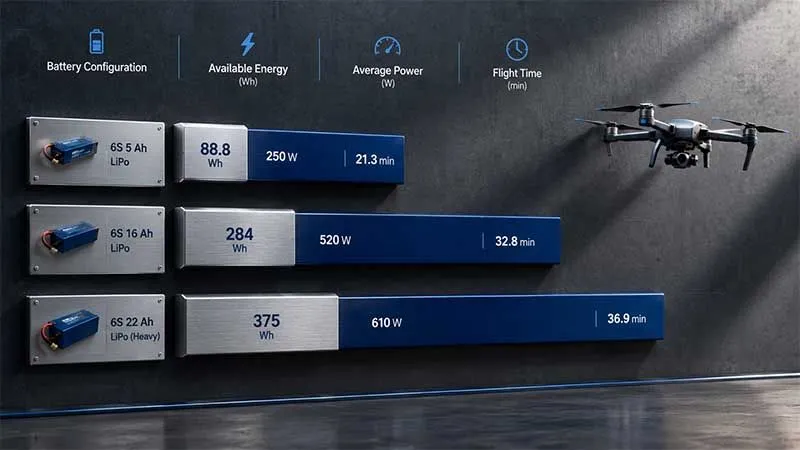
Our team traced the cause through a load-duration test. We logged current draw at hover before and after the swap: average power rose from 520 W to 610 W because the heavier aircraft demanded more thrust per motor. The calculation confirmed it — 284 Wh ÷ 520 W ≈ 32.8 min versus 390.7 Wh ÷ 610 W ≈ 38.4 min. Extra capacity had paid a weight tax.
Pro Tips
Before specifying any replacement pack, log 60 seconds of hover current at full mission weight with a power analyzer. That single measurement anchors the entire sizing calculation — our German OEM case proved that a 17% rise in hover power can erase a 37% increase in capacity.
The engineering tradeoff resolved toward gravimetric energy density, not raw capacity. We proposed a custom custom drone battery pack: a 6S4P assembly of high-energy NMC 21700 cells, 20 Ah nominal, weighing 2.6 kg at roughly 240 Wh/kg versus the LiPo’s 151 Wh/kg. Verified results after integration: 47 minutes of real flight time (+38% over baseline), hover power of 545 W, and 800 cycles to 80% capacity — cutting cost per flight hour from about $1.10 to $0.42.
The lesson generalizes: the longest drone battery life comes from energy density matched to the airframe, not from the biggest pack that fits the bay.
2. How to Charge a Drone Battery?
A drone battery should be charged with a compatible charger that supports its chemistry, cell count, voltage limits, and required charging current. LiPo batteries generally require a balance charger that monitors individual cell voltages and prevents unsafe overcharging[4].
For a conventional LiPo cell rated at 3.7 V nominal, the normal full-charge voltage is 4.2 V per cell. A 6S pack therefore reaches 25.2 V when fully charged. Other lithium-ion chemistries may use different voltage limits, so engineers must follow the cell manufacturer’s specifications rather than applying LiPo settings to every battery.
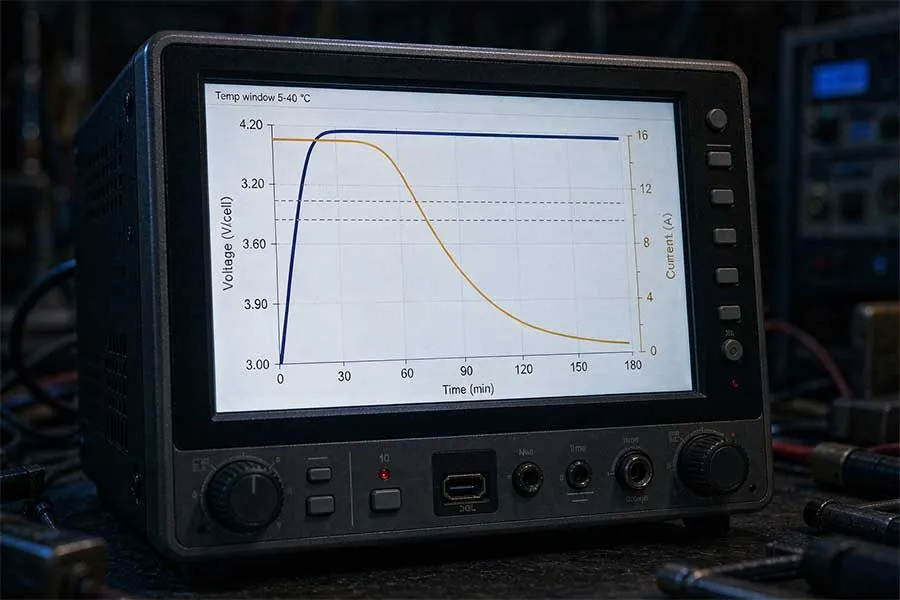
Recommended Charging Procedure
- Inspect the pack. Check for swelling, damaged insulation, loose connectors, corrosion, and signs of impact or overheating. Do not charge a damaged battery.
- Confirm the chemistry and cell count. Select the correct charging profile and verify the pack’s voltage configuration.
- Set the charging current. Use the cell manufacturer’s permitted charge rate. A 5 Ah battery charged at 1C would use a nominal charging current of 5 A, provided the manufacturer allows that rate.
- Connect balance leads when required. Confirm that the charger can monitor individual cells and identify abnormal voltage differences.
- Control temperature and surroundings. Charge in a suitable, monitored area away from combustible materials, following applicable fire-safety procedures.
- Check the completed charge. Review the final cell voltages and inspect the pack before returning it to service.
How Charging Affects Battery Lifespan
Frequent high-current charging, elevated temperature, deep discharge, and prolonged storage at full charge can accelerate battery aging. However, the effect depends on the cell design, operating limits, and charging conditions.
Actually, to extend drone battery lifespan, operators should follow the manufacturer’s charging limits, avoid excessive heat and deep discharge, and store packs at the recommended state of charge.
A battery management system (BMS), where appropriate, can monitor voltage, current, and temperature. However, a BMS does not replace a compatible charger or safe charging procedures.
For commercial fleets, charging policy should also reflect mission requirements. A battery that must be ready for an urgent inspection may justify a faster approved charging profile, while a fleet with predictable schedules may benefit from lower charging stress and longer service life.
3. How to Size a Drone Battery Pack for Payload and Flight Time?
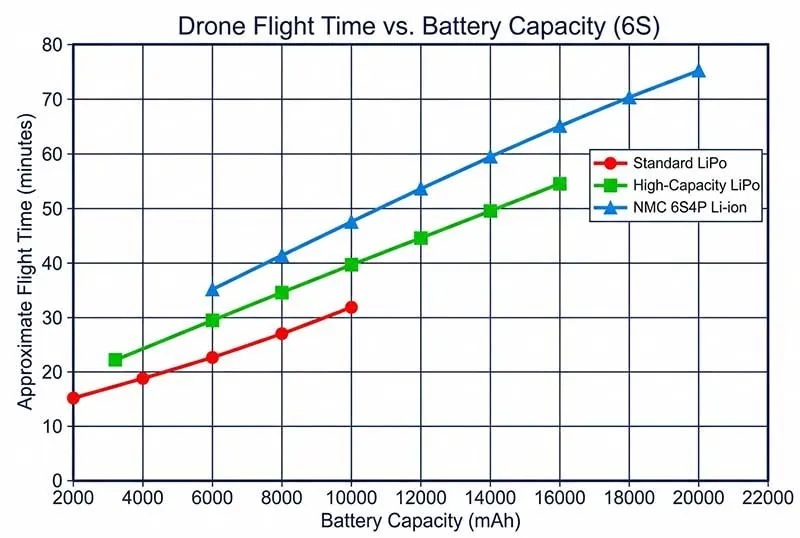
Engineers should size a drone battery pack by calculating the mission’s energy requirement, checking the maximum current demand, and confirming that the aircraft can carry the battery without losing acceptable flight performance. The correct pack is the lightest configuration that meets the required endurance, voltage, power, and safety margins.
Step 1: Establish the Mission Requirements
Before selecting cells, engineers should define:
- Required flight duration and landing reserve.
- Aircraft mass without the battery.
- Payload mass and expected changes between missions.
- Average and peak electrical power.
- Maximum continuous and transient discharge current.
- Operating temperature, vibration, and environmental exposure.
- Available battery space, connector type, and mounting limits.
These inputs establish the actual design constraints. An inspection drone that carries a thermal camera may require a different pack from an FPV drone designed for short bursts of high power.
Step 2: Calculate the Required Battery Energy
The theoretical energy requirement is:
Erequired = P average X tmission
If the aircraft requires 300 W for a 25-minute mission:
If the design uses 80% of nominal battery energy, the nominal battery energy requirement becomes:
At a nominal voltage of 22.2 V, the theoretical capacity requirement is:
This result suggests a pack near 7 Ah, but it does not prove that such a pack will meet the mission requirement. The selected pack must also satisfy mass, current, voltage, thermal, and reserve constraints.
Step 3: Check Current and Discharge Capability
Average current can be estimated as:
At 300 W and 22.2 V, the estimated average current is approximately 13.5 A. However, the pack must also support peak current during takeoff, acceleration, and demanding maneuvers.
A 7 Ah battery with a nominal 10C discharge rating would theoretically support 70 A under the rating’s stated conditions. Engineers must still verify the manufacturer’s continuous and peak limits, thermal behavior, voltage sag, connector rating, and wiring capability. A C-rating alone does not establish real-world performance.
Step 4: Balance Energy Against Weight
The longest battery life drone is not necessarily the aircraft with the largest battery. A better design uses energy efficiently and keeps battery mass within the aircraft’s performance limits.
| Design variable | Potential benefit | Engineering trade-off |
|---|---|---|
| Higher capacity | More stored energy | More mass and potentially higher propulsion demand |
| Higher energy-density cells | More energy per unit mass | May involve different discharge, thermal, or cycle-life limits |
| Lower-resistance cells | Reduced voltage sag and resistive heating | Cell cost and availability may increase |
| Improved propeller efficiency | Lower power demand for the same flight task | May require propulsion or frame changes |
| Reduced payload mass | Lower power demand | May reduce mission capability |
Step 5: Compare Mission Cost and Cycle Life
A pack with the lowest drone battery price may not deliver the lowest cost per flight. Operators should consider service life, usable energy, charging time, replacement frequency, and the cost of a failed mission before you update drone battery.
A simplified energy-through-life calculation is:
Elifetime = Eusable per cycle X Ncycles
For example, a battery that supplies 120 Wh of usable energy per cycle for 300 cycles would deliver 36 kWh over those cycles. A different pack that delivers 140 Wh per cycle for 200 cycles would deliver 28 kWh.
These are hypothetical comparisons, not guaranteed cycle-life outcomes. Actual results depend on discharge depth, temperature, charge rate, cell aging, and the manufacturer’s end-of-life criteria.
For an operator, the relevant measure is often the cost per successful mission rather than the initial drone battery price. A slightly more expensive pack can offer better value if it improves flight completion rates and reduces replacement frequency.
Design recommendation
Keep battery mass between 30% and 40% of all-up weight on multirotors. Above that band, each added amp-hour raises hover power faster than it adds usable energy — the classic weight tax that turns a capacity upgrade into a two-minute disappointment
Troubleshooting Drone Battery Problems: Failure Modes and Solutions
Drone battery problems often appear as reduced flight time, unexpected low-voltage warnings, overheating, or sudden power loss. Engineers should identify whether the cause lies in battery degradation, electrical resistance, charging errors, excessive load, or the aircraft’s power system before replacing the pack.
Common Failure Modes
| Symptom | Possible cause | Recommended engineering response |
|---|---|---|
| Flight time gradually decreases | Capacity fade or increased aircraft load | Measure discharged energy and compare it with baseline data |
| Voltage drops sharply under load | High internal resistance, weak cells, or excessive current | Log cell voltage and current during a controlled load test |
| One cell reaches its voltage limit early | Cell imbalance or a damaged cell | Inspect individual cell voltages and evaluate pack condition |
| Battery temperature rises excessively | High current, poor thermal management, or internal damage | Stop operation if unsafe and investigate the thermal profile |
| Pack swells or leaks | Cell damage, gas generation, or abuse | Remove the battery from service and follow safe handling procedures |
| Charger stops prematurely | Cell imbalance, connection problems, or charger fault | Inspect connections and verify charger compatibility |
Distinguish Capacity Fade From Voltage Sag
Capacity fade reduces the total energy a battery can deliver as it ages. Voltage sag occurs when terminal voltage drops under load because of internal resistance and other electrochemical effects.
A pack can retain much of its original measured capacity but still fail a demanding mission if its voltage falls below the aircraft’s operating limit at peak current. Conversely, a pack may maintain stable voltage during a short test while delivering less total energy than expected.
Engineers should therefore perform both a capacity test and a load test when evaluating an endurance problem. The capacity test measures delivered ampere-hours or watt-hours under defined conditions, while the load test reveals voltage behavior, heating, and current capability.
When evaluating UAV battery life, measure both remaining capacity and voltage stability under load; either limitation can prevent the aircraft from completing its intended mission.
Establish Practical Replacement Criteria
A replacement decision should follow measurable acceptance criteria rather than a fixed age alone. Relevant criteria include remaining capacity, internal resistance, cell imbalance, temperature rise, physical condition, and the battery’s ability to complete the required mission.
The manufacturer and aircraft OEM should define the relevant thresholds for each pack design. A battery that fails a safety or electrical limit should not remain in service simply because its measured capacity appears acceptable.
Need Custom Battery Sizing & Test Reports?
Access our payload-to-runtime validation data, lead times, and engineering specs to build your ideal battery pack.
4. OEM Drone Battery Pack Design and Validation
OEM battery pack development requires more than selecting a cell with sufficient capacity. The pack must meet the aircraft’s electrical, mechanical, thermal, environmental, and production requirements while delivering consistent performance across manufactured units.
For commercial drone programs, a qualified manufacturer supports cell selection, pack configuration, connector integration, protection design, and validation planning. The final design should reflect the aircraft’s actual mission profile rather than a capacity target considered in isolation.
Define the Pack Architecture
The engineering team should establish the series and parallel cell configuration, nominal voltage, maximum charge voltage, usable energy, continuous current, peak current, and physical envelope.
The cell format also affects the design. Cylindrical cells can offer mechanical robustness and standardized dimensions, while pouch cells can support compact packaging and flexible form factors. Prismatic cells may be suitable for applications that benefit from a rigid cell structure, although their dimensions and mass must fit the aircraft.
For an appropriate drone battery pack, engineers should also assess connector retention, vibration resistance, insulation, wiring losses, thermal paths, and the consequences of a pack fault.
Validate Performance Under Realistic Conditions
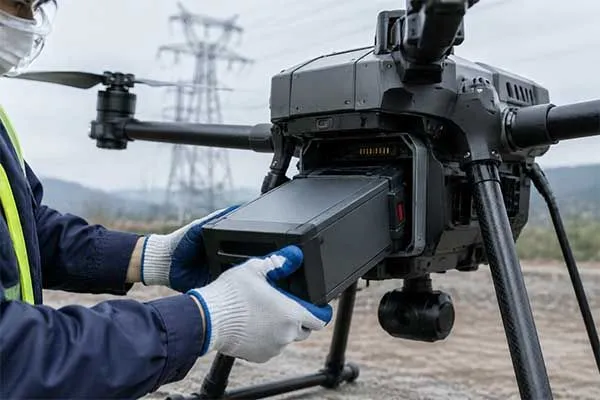
A suitable validation program should test the battery in the intended aircraft or a representative electrical and mechanical setup. Bench tests alone cannot fully predict flight endurance because aircraft mass, propulsion efficiency, airflow, and control behavior affect the result.
A validation matrix may include:
| Validation activity | Measurement or inspection | Purpose |
|---|---|---|
| Capacity test | Delivered Ah and Wh | Verify usable energy |
| Load test | Current, voltage sag, and temperature | Confirm power capability |
| Flight endurance test | Flight duration and landing reserve | Verify mission performance |
| Environmental test | Performance at defined temperatures | Establish operating limits |
| Mechanical test | Vibration, shock, and retention | Evaluate installation durability |
| Protection test | Response to specified fault conditions | Verify required protective functions |
| Cycle-life test | Capacity retention and resistance changes | Assess aging behavior |
The test plan[5] should define the sample size, acceptance limits, equipment calibration, test conditions, and reporting format before testing begins. Results should include both passing and failing samples rather than relying only on the best-performing unit.
Demonstrate Consistency From Samples to Mass Production
A successful prototype does not automatically establish production consistency. Cell variation, weld quality, connector resistance, wiring layout, assembly pressure, and protection-circuit tolerances can affect the performance of finished packs.
A robust production process should establish traceability for cells and critical components[6], document assembly parameters, inspect electrical connections, and perform defined end-of-line tests. Engineers should also use a controlled bill of materials and formal change management to prevent unapproved component substitutions.
Audit Our Validation Data & Buyer Specs
Get instant access to sample reports, MOQ details, production lead times, and global certification compliance (UN38.3, CE, UL).
A suitable customer-facing statement is:
Our sample-to-production validation process compares prototype and production-intent battery packs against the same approved specifications. The process evaluates capacity, voltage behavior under load, electrical resistance, temperature rise, protection functions, and mechanical integrity. Production acceptance criteria are defined before release, and traceable test records support verification of each required characteristic. Any design or component change that could affect performance triggers an engineering review and appropriate revalidation.
This statement describes a validation framework, not a claim that a particular production program has already passed it. Any published yield rate, test result, certification, or production-consistency figure should be supported by actual records.
For a manufacturer such as Long Sing Energy, this engineering approach provides a basis for discussing battery pack requirements with drone OEMs. Product-specific performance claims should be linked to documented test data, agreed operating conditions, and the configuration actually supplied.
Frequently Asked Questions
Click to explore more information about Drone Battery
Q: What type of battery is best for drones?
A: LiPo batteries are widely used in multirotor drones because of their high discharge rates and power-to-weight ratio. Li-ion batteries can offer higher energy density and longer flight times for suitable designs. The best choice depends on flight duration, payload, peak current, weight, and operating conditions.
Q: What is the formula for calculating drone flight time?
A: A practical estimate is: Flight Time (minutes) ≈ Usable Battery Capacity (Ah) ÷ Average Current Draw (A) × 60. For example, a 10 Ah battery with 20 A average current draw provides approximately 30 minutes of theoretical flight time before accounting for reserve capacity and real-world losses.
Q: What batteries do military drones use?
A: Military drones may use LiPo or Li-ion battery packs, depending on mission requirements. LiPo packs support high-power takeoff and maneuvering, while Li-ion packs can prioritize energy density and endurance. Larger platforms may use other power systems based on payload, range, and mission duration.
Q: What is the longest-lasting drone battery?
A: There is no single longest-lasting drone battery for every application. High-energy-density Li-ion packs can extend flight time in compatible drones, especially fixed-wing and long-endurance platforms. Actual endurance depends on battery capacity, aircraft efficiency, payload, weather, and power consumption.
Conclusion
Drone battery endurance depends on usable energy, aircraft mass, power consumption, battery condition, and mission requirements. Engineers can estimate flight time using watt-hours and average power, but realistic load and flight tests are essential before approving a battery upgrade.
A well-sized pack balances energy density, discharge capability, thermal performance, cycle life, and total mission cost. For commercial UAV programs, controlled OEM validation and production traceability help ensure that the selected battery delivers consistent, safe, and measurable performance throughout its service life.
Reference: