
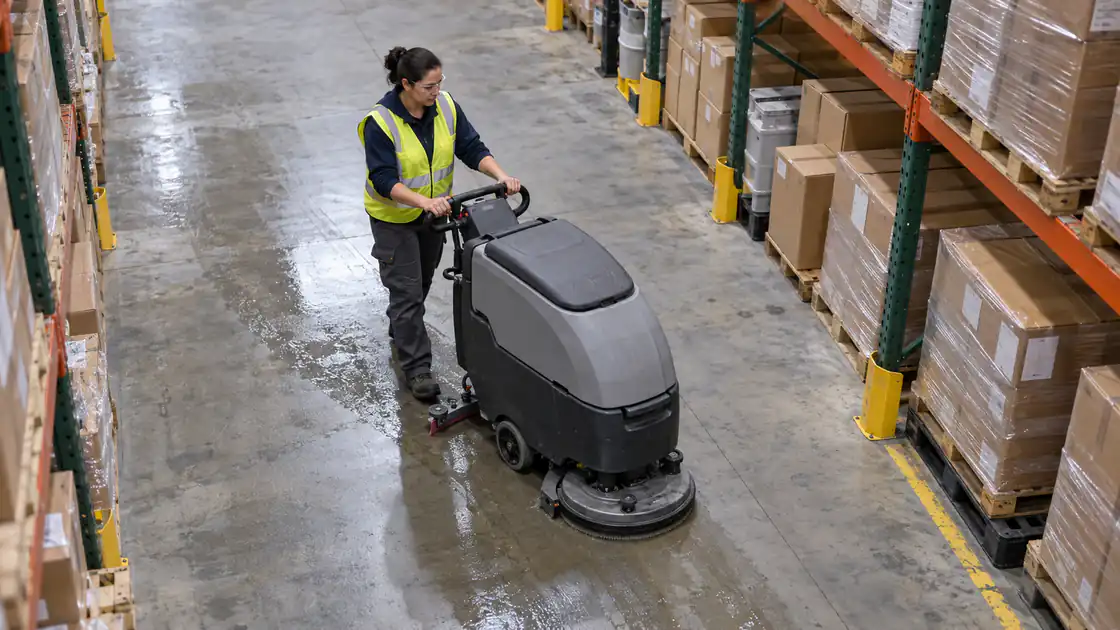
In a warehouse, supermarket, airport, hospital or factory, a floor scrubber usually has a fixed cleaning window. If it stops early, an operator waits and cleaning can spill into customer or production hours.
Battery problems appear as short runtime, long charging or reduced end-of-shift performance. A larger Ah rating is not a reliable cure.
A floor scrubber lithium battery must support the full load, fit the voltage window and compartment, match the charging strategy, and tolerate a wet, vibration-prone environment.
A floor scrubber lithium battery can improve uptime in the right application, but lithium is not automatically the best choice for every machine. The decision should follow the duty cycle, electrical architecture, operating environment and total fleet economics.
Featured Snippet: How Do You Select a Floor Scrubber Lithium Battery?
A floor scrubber lithium battery should be selected from the voltage window, average energy demand, peak current, runtime, charging schedule, battery compartment and operating environment. OEMs must also verify the charger, BMS, wiring, connectors, fuses, machine stability and safety requirements before replacing lead-acid.
Table of Contents
- How Does a Floor Scrubber Use Battery Power and What Determines Runtime?
- How Do LiFePO4, Lead-Acid, 24V and 36V Systems Compare?
- How Should Charging, BMS and Mechanical Protection Be Engineered?
- What Must OEMs Check Before a Lead-Acid-to-Lithium Conversion?
1. How Does a Floor Scrubber Use Battery Power and What Determines Runtime?

A scrubber dryer battery does not feed one steady load. It supplies several systems whose demand changes during the cleaning route.
Traction, Brush and Vacuum Motors Create Different Loads
The main loads normally include:
- The traction motor, which draws more current during acceleration, ramp climbing and tight manoeuvres
- The brush or pad motors, whose load changes with down pressure, pad type, floor texture and debris
- The vacuum motor, which may operate through most of the cleaning cycle
- Pumps, actuators, valves, displays, sensors, controllers and lighting
Equipment manuals commonly rate these functions separately. Values from one model should never be copied into another battery calculation.
The battery sees short peaks when motors start together, the machine climbs a ramp, or a brush meets high resistance. Cable, connector and cell resistance create voltage sag.
If the controller or BMS reaches its low-voltage threshold, scrubbing may stop while the pack still contains energy. This load profile belongs in every industrial cleaning machine battery specification.
Runtime is mainly an energy problem. Starting, climbing and high brush resistance are also power-delivery problems.
How to Calculate Floor Scrubber Battery Runtime
Start with energy rather than Ah:
Required battery energy (Wh) = average machine power × operating hours ÷ usable energy ratio
When sizing a floor scrubber lithium battery, average power should come from a measured duty cycle covering travel, scrubbing, turning, idle periods, ramps and accessories. The usable energy ratio is the permitted portion of nominal pack energy.
Then allow for conversion losses, ageing, temperature, manufacturing variation and route variability. Separately verify continuous current and short peaks without excessive voltage sag, heat or BMS trips.
Illustrative example—not a customer case: Assume measured average machine power is 1.2 kW, the required cleaning time is five hours, and the engineering team chooses a usable energy ratio of 0.80 for the model.
1,200 W × 5 h ÷ 0.80 = 7,500 Wh
The starting point is 7.5 kWh of nominal energy. Engineers must still validate peak current, temperature, end-of-shift voltage, charger losses and ageing margin.
IEC 62885-9 includes methods for determining the maximum net runtime of commercial floor-treatment machines. 【1】 This reinforces why controlled machine testing is more meaningful than an Ah-only comparison.
2. How Do LiFePO4, Lead-Acid, 24V and 36V Systems Compare?
A floor scrubber lithium battery based on LiFePO4 can suit high-utilisation fleets, but chemistry alone does not guarantee a good result. Cells, BMS logic, charger calibration, enclosure and machine integration determine actual performance.
LiFePO4 vs Lead-Acid for Floor Cleaning Machines
| Decision Factor | LiFePO4 Pack | Lead-Acid Battery |
|---|---|---|
| Usable energy | Can be engineered for a broad usable SOC window | Sensitive to discharge rate and selected depth of discharge |
| Voltage stability | Relatively flat discharge profile; SOC is harder to infer from voltage alone | Falls more noticeably under load and as SOC declines |
| Charging | May accept higher charge power and partial charging when cells, BMS, charger and thermal design permit | Usually includes a longer finishing or absorption stage; the profile must match flooded, AGM or gel construction |
| Weight | Usually lower for comparable usable energy | Heavier; the mass may be part of the machine’s intended stability or traction design |
| Maintenance | No watering, but connectors, mounting and diagnostics still require inspection | Flooded types require watering and cleaning; AGM or gel removes watering |
| Cold-temperature limits | Charging must be blocked or limited outside the cell supplier’s approved range | Available capacity and charge acceptance also decline in cold conditions |
| Initial cost | Commonly higher because the pack includes cells, BMS, protection and integration work | Commonly lower and widely available in standard form factors |
| Lifecycle considerations | Can suit frequent cycling and planned opportunity charging; actual life depends on temperature, current, SOC window and cell quality | Can remain economical in low-use fleets with correct charging, maintenance and recovery time |
Keeping lead-acid can be reasonable for infrequent use, reliable overnight charging, machines that rely on battery mass, or fleets standardised around existing service skills.
LiFePO4 becomes more attractive when downtime is expensive, machines cycle frequently, operators cannot reliably maintain flooded batteries, or shifts benefit from partial charging.
Compare usable shift energy, conversion cost, maintenance labour, replacement planning and operational risk—not chemistry reputation alone. For a broader comparison, see LONGSING’s lead-acid vs lithium-ion battery guide.
24V or 36V: Nominal Voltage Is Only the Starting Point
When a floor scrubber lithium battery replaces lead-acid, the nominal voltage label does not establish compatibility. A 24V lead-acid system and a 24V LiFePO4 battery pack can have different fully charged voltage, discharge curve and low-voltage behavior. The same caution applies to a 36V lithium battery pack.
Before selecting from LONGSING’s 24V- and 36V-class battery pack options, confirm:
- Maximum charge voltage and charger control profile
- Minimum machine operating voltage and controller cut-off
- Continuous and peak current, including duration and repetition
- BMS trip thresholds and recovery behavior
- Cable gauge, fuse rating, connector family and polarity
- Battery-discharge indicator or communication requirements
- Compartment dimensions, restraint and service access
A gauge calibrated for lead-acid voltage may misread the flatter LiFePO4 discharge curve, so SOC indication also requires validation.
32700 Cylindrical or Prismatic LiFePO4 Cells?
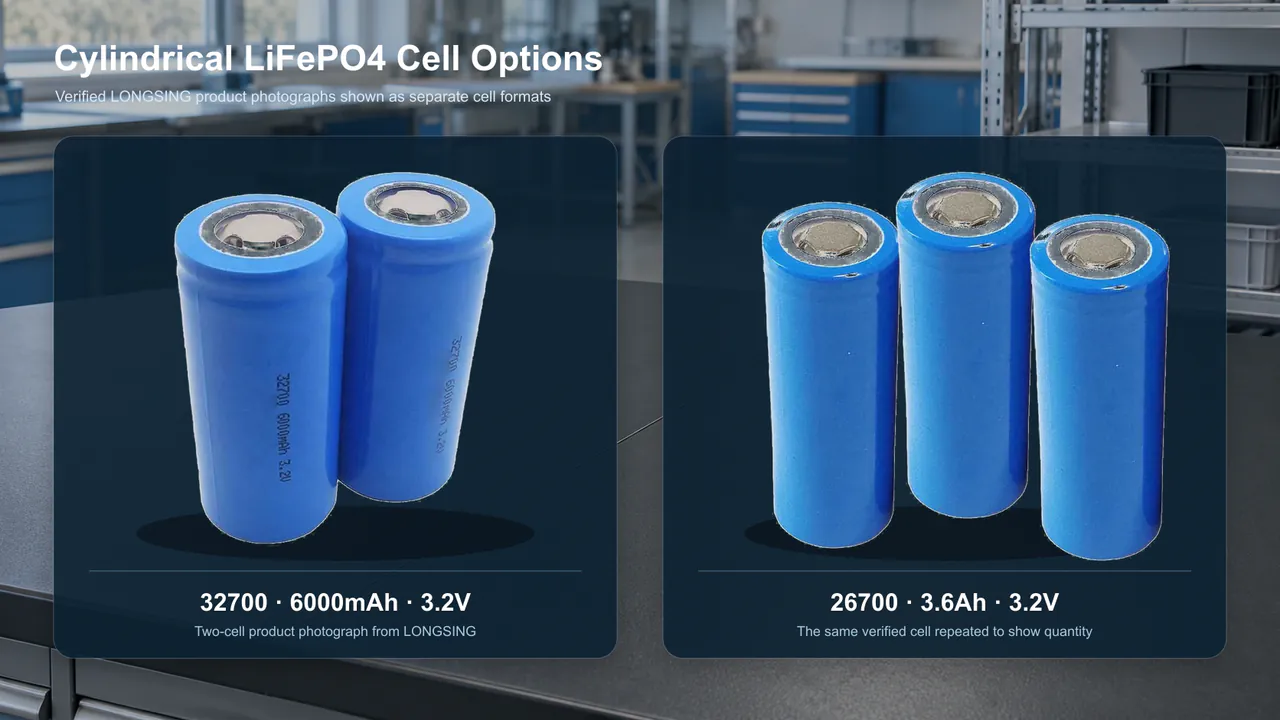
32700 cylindrical LiFePO4 cells provide layout flexibility and modular construction. Their larger cell count can increase welding, inspection and current-sharing requirements. LONGSING’s 32700 LiFePO4 cell shows a representative format.
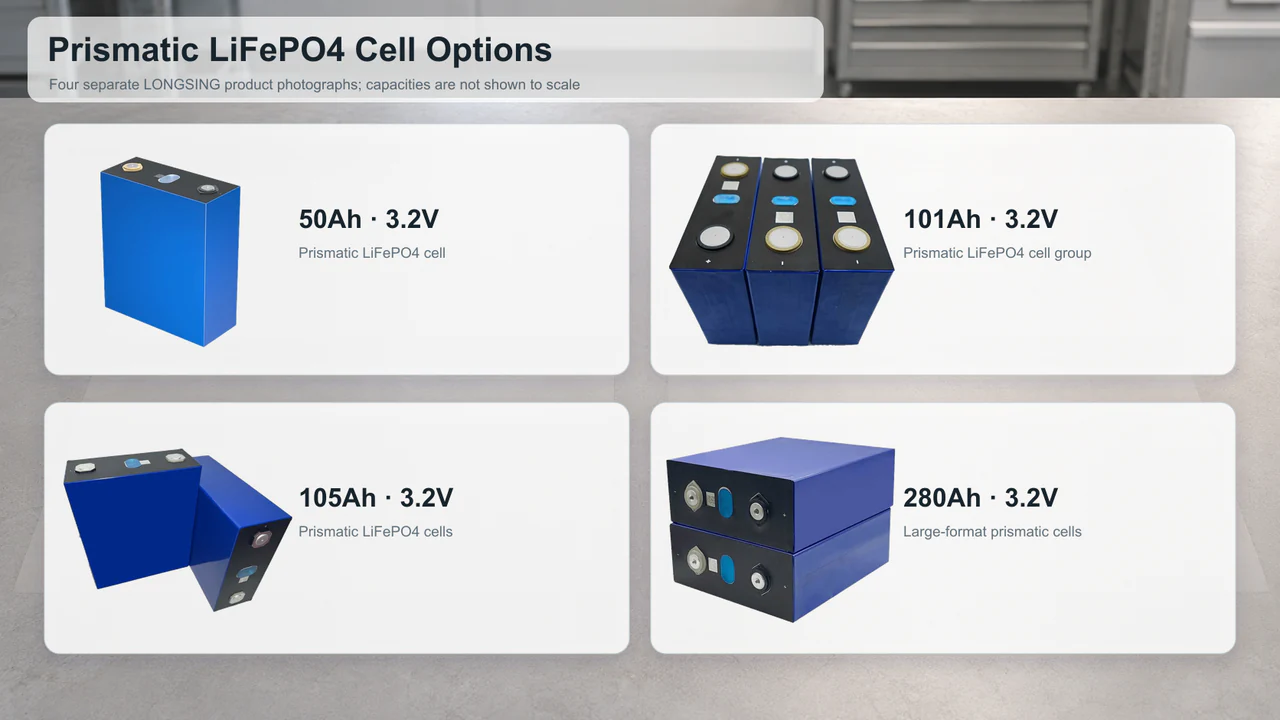
Prismatic LiFePO4 cells can suit higher-capacity packs with fewer connections. Compression, terminal loading, busbars, swelling allowance and service clearance still require engineering. See LONGSING’s LiFePO4 prismatic cell range for starting points.
Neither format is universally safer or better. Select the cell from the current profile, pack geometry, thermal path, manufacturing process, validation plan and supply continuity.
3. How Should Charging, BMS and Mechanical Protection Be Engineered?
Fast charging a floor scrubber lithium battery is useful only when the battery, charger, wiring, connector, machine and facility supply are treated as one system.
Fast Charging and Opportunity Charging

Opportunity charging adds energy during lunch, a shift change or another planned pause.
Battery charger compatibility is a system requirement, not a connector check. A partial-charging strategy must be approved for the selected cells, BMS, charger and machine operating plan.
Charge rate is limited by:
- Permitted cell charge current
- Cell temperature and SOC
- BMS settings
- Charger output and control behavior
- Connector and cable ratings
- Enclosure heat rejection
A high-power charger cannot safely override these limits. The BMS should reduce or stop charging outside the validated range, and the charger must respond correctly.
For a fleet, confirm the supply can support several chargers. Fixed charge-time claims require capacity, starting SOC, temperature and charger power.
What the Smart Battery Management System Must Monitor
Core BMS functions normally include:
- Individual cell or parallel-group voltage
- Charge and discharge current
- Temperature at representative cell and power-component locations
- Overcharge, over-discharge, overcurrent and short-circuit protection
- SOC estimation appropriate to LiFePO4’s flat voltage curve
- Fault logging and controlled recovery behavior
Add CAN, RS485 or Bluetooth only when required. Define message IDs, scaling, update rates, alarms and fail-safe behavior before production.
A BMS cannot compensate for unsuitable cells, an undersized connector, poor busbar design or weak mechanical restraint.
Mechanical Design for Wet and Demanding Environments
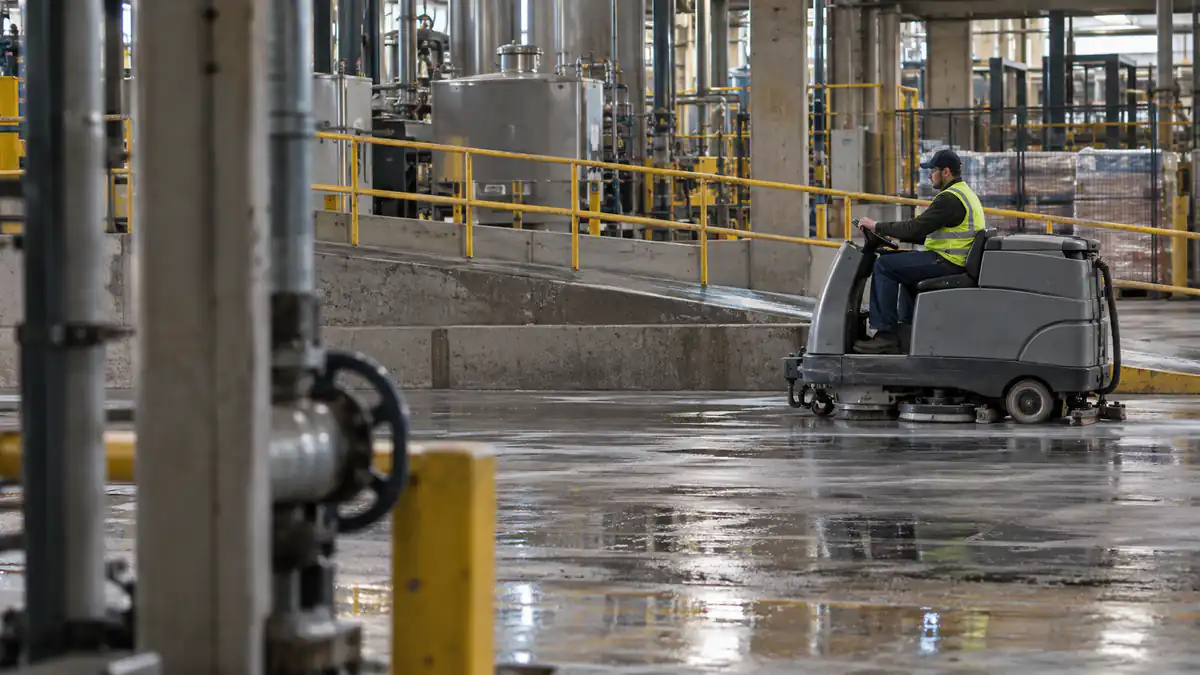
Scrubbers operate near water, detergent, dirt and vibration. The floor scrubber lithium battery also experiences impacts, harness wear and connector corrosion.
The design should address:
- Pack restraint and lifting points
- Protected cable and fuse clearance
- Short-circuit prevention
- Connector orientation and strain relief
- Drainage and sealing strategy
- Heat rejection during charging and discharge
- Service and replacement access
- The effect of battery mass on wheel loading and centre of gravity
Do not assign an IP rating from appearance. The claimed enclosure configuration needs validation.
IEC 60335-2-72 addresses commercial floor-treatment machines, including battery-operated equipment and built-in chargers. 【2】 The OEM should confirm the applicable edition, national deviations and complete certification route for each market.
4. What Must OEMs Check Before a Lead-Acid-to-Lithium Conversion?
Selecting a floor scrubber lithium battery for a lead-acid to lithium conversion is an integration project, not a battery swap.
Lead-Acid Replacement Checklist
Before approving a conversion, review:
- Original nominal, maximum and minimum machine voltage
- Measured continuous current and worst credible peak current
- Compatibility of the original charger; replace it if its profile is not approved
- Compartment dimensions, restraint, lifting and terminal clearance
- Weight, centre of gravity, traction and stability changes
- Connector, cable gauge, fuse and disconnect ratings
- Controller undervoltage threshold and restart behavior
- Battery gauge or SOC display compatibility
- Charge-area power and operating procedures
- Required safety, transport and market certifications
UN 38.3 transport compliance is not end-product safety approval. 【3】
Depending on application and market, IEC 62619 for industrial secondary lithium batteries may also be relevant, while machine-level requirements remain separate. 【4】 Confirm the compliance path with a qualified certification body.
Information an OEM Should Send to the Battery Supplier
| Input | Information to Provide |
|---|---|
| Electrical window | Nominal, maximum charge and minimum operating voltage |
| Load data | Average, continuous and peak power/current, including peak duration |
| Runtime target | Cleaning hours, route pattern and end-of-shift reserve |
| Charging | Available time, opportunity-charging plan, onboard/offboard charger and facility supply |
| Mechanical | Compartment drawing, mounting, terminals, connector, cable exit, weight limits and service access |
| Environment | Charge/discharge temperature, humidity, vibration, shock, water and detergent exposure |
| Controls | SOC display, wake/sleep logic, CAN, RS485 or other protocol definitions |
| Compliance | Target countries, machine category, transport route and certification requirements |
| Commercial | Annual demand, sample quantity, validation stages and production schedule |
Measured data is better than a catalogue description. If load logging is unavailable, provide motor ratings, controller limits, route conditions and operating video so the supplier can define a measurement plan.
Where LONGSING Fits
LONGSING can evaluate custom lithium battery pack designs at 24V and 36V, match cylindrical or prismatic cells, coordinate the BMS, charger and connector, and support enclosure design, samples and production validation.
No existing pack automatically fits every floor scrubber. Confirm feasibility, performance and compliance for the actual machine and market.
Review Your Floor Scrubber Battery Requirements
Send the machine voltage range, average and peak load, target runtime, battery-compartment drawing and charging window for an engineering feasibility review.
5. Conclusion
The right floor scrubber lithium battery is the one that completes the route, handles the peak load, charges within the available window and integrates correctly with the machine.
Ah is only one input. Voltage limits, usable energy, current, thermal behavior, BMS logic, wiring, enclosure and machine stability must be resolved together.
Developing or converting a commercial cleaning machine?
For a practical battery evaluation, prepare:
- Machine voltage limits
- Average and peak load data
- Target runtime
- Battery-compartment drawing
- Charging time and charging scenario
- Environmental and communication requirements
- Target markets and project schedule
Contact LONGSING about a custom lithium battery pack with these inputs. The first engineering response should identify missing information and integration risks—not simply quote a larger Ah number.
Frequently Asked Questions About Floor Scrubber Lithium Batteries
Click to explore more information about floor scrubber battery design.
Q: How long should a floor scrubber battery last per charge?
A: Long enough to complete the route with a suitable reserve. Calculate from measured average power and operating hours, then validate on the actual floor. Surface resistance, brush pressure, ramps, temperature and ageing can change runtime; no universal hour figure is responsible.
Q: Can a lead-acid floor scrubber use a lithium battery?
A: Yes, if the voltage window, peak current, charger, gauge, wiring, connector, fuse, compartment, weight distribution and compliance requirements are compatible. Reuse the charger only when its complete profile is approved for the lithium pack.
Q: Is LiFePO4 suitable for commercial cleaning machines?
A: It can be. LiFePO4 offers stable voltage, useful cycle performance, reduced weight and no electrolyte watering. Suitability still depends on cells, BMS and charger integration, thermal limits and machine-level validation.
Q: Can a floor scrubber lithium battery be opportunity charged?
A: It can when the cells, BMS, charger, wiring, connector and thermal design are rated and validated for the intended partial-charge schedule. The allowed charge rate may change with temperature and SOC.
Q: What information is needed to design a custom floor scrubber battery?
A: Provide the machine voltage limits, average and peak loads, runtime, charging window, compartment drawing, mounting and connector details, environmental exposure, communication requirements, target markets, certification expectations, annual quantity and project timing. Actual current logs improve sizing accuracy.
References: