

Electric roller skates have a battery packaging problem that larger electric vehicles do not face to the same degree: there is very little space available, and additional battery mass is carried close to the rider.
More energy can help extend operating time. But adding cells also adds weight and takes up space that may already be needed for the enclosure, wiring, BMS and mechanical protection.
Power demand creates another constraint. Steady cruising is only part of the load profile. Starting, accelerating and climbing can pull considerably more current for short periods.
For an OEM, the useful question is therefore not simply “How large should the battery be?”
It is how much energy can be installed without making the skate too heavy or bulky, while still providing enough current for the motor and controller.
Featured Snippet: What Determines Electric Roller Skates Battery Range?
Electric roller skates battery range depends on available battery energy and the vehicle’s actual energy consumption. Battery Wh provides a starting point, but rider and system weight, speed, acceleration, hills, rolling resistance, drivetrain efficiency, temperature and voltage under load all affect how far the skates can travel.
Table of Contents
- Why Electric Skates Are Difficult Battery-Packaging Applications
- What Actually Controls Electric Roller Skates Battery Range?
- Peak Load Is Different from Battery Capacity
- Where 21700 Cells Fit into the Design
- Battery Weight and Pack Position Matter
- Compact Packs Still Need Mechanical and Thermal Margin
- BMS Protection Has to Match the Load Profile
- What an OEM Should Define Before Battery Development
- Example: 43.2V 10Ah 21700 Battery Pack
- Conclusion
- Frequently Asked Questions
- References
1. Why Electric Skates Are Difficult Battery-Packaging Applications
An e-bike usually gives engineers several practical battery locations: a downtube, seat tube, rear rack or dedicated frame compartment.
Electric roller skates offer far less freedom.
The battery may need to sit directly on the skate, inside a compact enclosure or elsewhere on the rider with a power connection to the drive system. Each arrangement changes the weight distribution, cable routing and mechanical requirements.
The pack is also relatively close to the source of road vibration and impact.
This makes several constraints interact very quickly.
| Design Factor | Why It Matters on Electric Roller Skates |
|---|---|
| Available volume | The battery competes with motors, structure, electronics and mounting hardware |
| Battery weight | Additional mass is noticeable close to the rider’s feet |
| Current demand | Acceleration and climbing can create short high-load periods |
| Pack shape | A technically suitable cell may still be difficult to package |
| Vibration and impact | Connections and cell retention have to survive repeated mechanical loading |
| Thermal space | Compact enclosures leave less room for spacing and heat dissipation |
| Cable routing | Particularly important if the battery is separated from the skate |
This is different from simply selecting a battery from voltage and Ah.
The electrical architecture has to work inside the mechanical product.
For a broader discussion of voltage, series/parallel configuration and general pack validation, see LONGSING’s existing article on micromobility battery pack design for electric roller skates.
2. What Actually Controls Electric Roller Skates Battery Range?
Battery energy is normally a better starting point for range analysis than Ah alone.
The basic relationship is:
Wh = Nominal Voltage × Ah
For example, the current LONGSING electric roller skates battery is specified at:
43.2V × 10Ah ≈ 432Wh
That tells us its nominal stored energy.
It does not tell us how many kilometres or miles the skates will travel.
Why the Same Wh Can Produce Different Range
Two electric skate systems using batteries with similar energy ratings can still return different results.
A heavier rider needs more energy during repeated acceleration and climbing. A route with frequent starts will have a different demand profile from steady operation on flat pavement.
Motor and controller efficiency matter as well.
So do wheel losses, road surface, speed and temperature.

Battery behaviour under load adds another variable. As discharge current increases, pack voltage can fall below its open-circuit or low-load value. If the voltage reaches the controller or BMS lower limit during a high-load event, the system may stop using the remaining stored energy even though the battery is not literally empty.
For a useful range estimate, engineers should therefore look at the complete duty cycle.
| Variable | Possible Effect on Energy Consumption |
|---|---|
| Rider and vehicle mass | Changes acceleration and climbing demand |
| Average speed | Changes motor operating point and losses |
| Frequent acceleration | Increases high-power operation |
| Hills | Adds sustained mechanical load |
| Road surface | Changes rolling resistance |
| Motor/controller efficiency | Determines how much electrical energy becomes useful mechanical output |
| Temperature | Can change cell resistance and available energy |
| Battery condition | Capacity and resistance change with use and age |
| Voltage sag | Can bring the system closer to its cutoff voltage |
| BMS/controller limits | Determine how much of the nominal energy can actually be used |
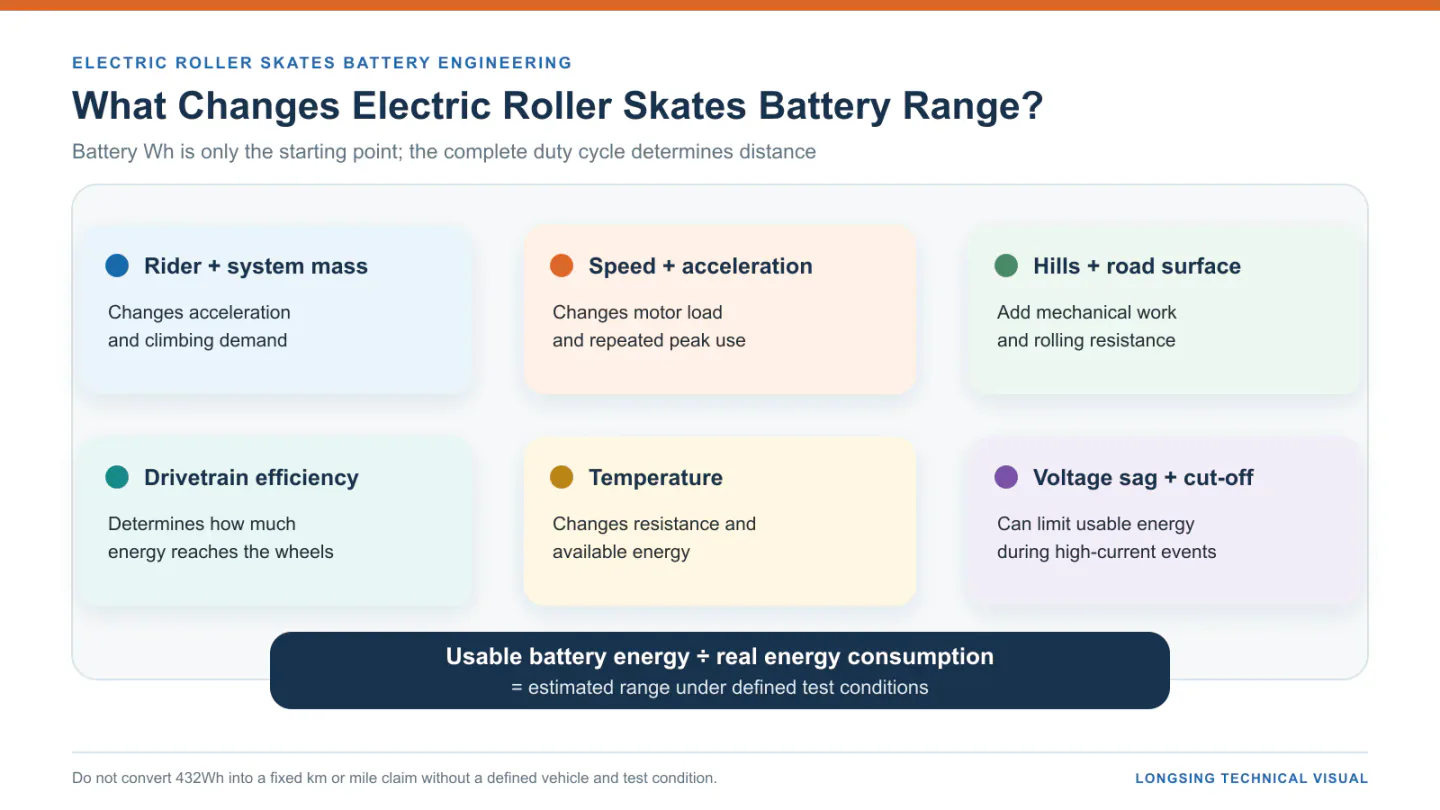
This is why a claim such as “432Wh provides 20 km” would not be appropriate without a defined vehicle and test condition.
Rated Energy Is Not Automatically Usable Energy
432Wh is a nominal energy figure.
The usable amount depends on the operating voltage window and the actual load.
For vehicle development, the more useful information is usually obtained by logging:
- pack voltage;
- current;
- temperature;
- speed;
- operating time;
- route or duty cycle.
That data gives the OEM a much better basis for comparing battery configurations than theoretical range alone.
3. Peak Load Is Different from Battery Capacity
A battery may have enough stored energy for the intended operating time but still be poorly matched to the vehicle’s power demand.
Electric skate loads are rarely constant.
Current rises when the motor needs additional torque, particularly during launch, acceleration or climbing.
This introduces a distinction that is sometimes missed during early product development:
Wh describes energy.
A and W describe how quickly that energy is being delivered.
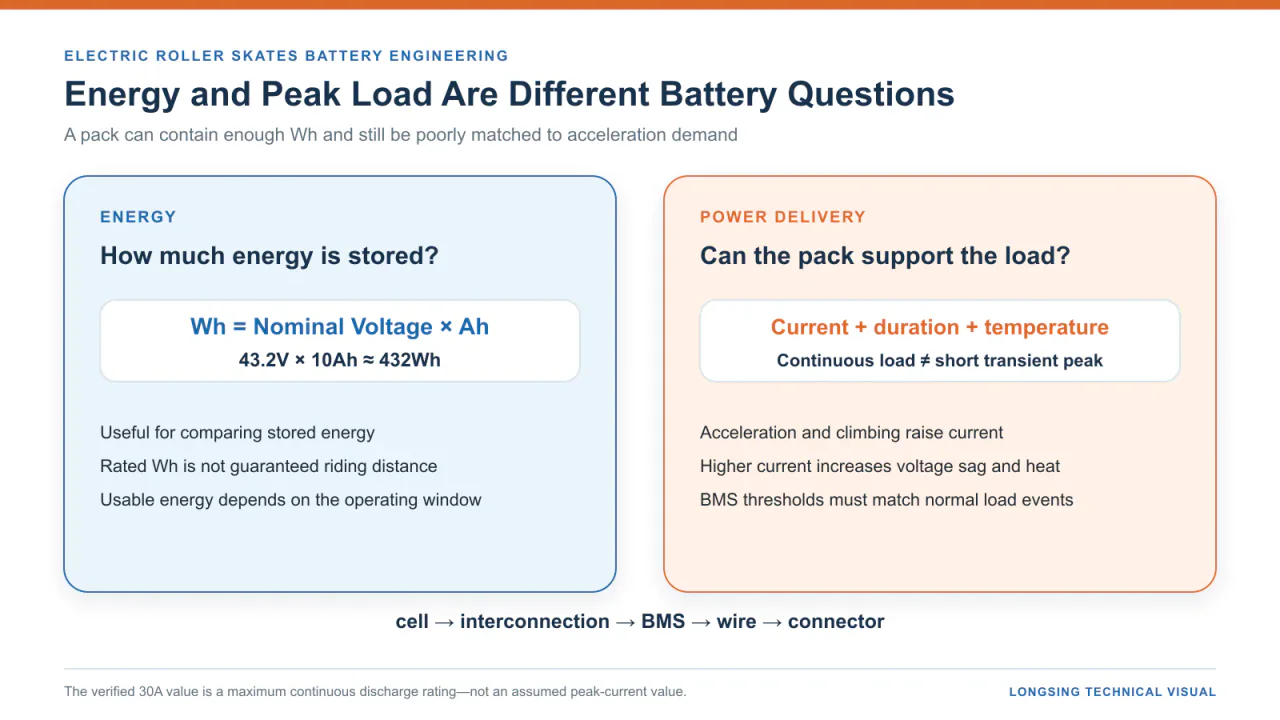
A larger Ah figure does not automatically mean the pack is suitable for a high-current motor system.
Continuous Current and Short Load Peaks
These should also be specified separately.
A maximum continuous discharge rating describes sustained operation under defined conditions.
A short-duration load peak is different. It needs at least two pieces of information:
current + duration
For example, saying a system needs a “high peak current” is not very useful to the battery engineer.
A current trace showing what happens during a 2-second acceleration is far more useful.
The current LONGSING 43.2V pack lists a maximum continuous discharge current of 30A. That figure should not be converted into an assumed peak-current rating.
Voltage Sag Becomes Important at Higher Current
Every part of the electrical path contributes some resistance:
cell → interconnection → BMS → wire → connector
When current rises, the voltage drop across that path also increases.
At pack level, this can affect:
- motor performance;
- controller input voltage;
- usable battery energy;
- heat generation;
- BMS behaviour.
That is why cell selection for a compact electric skate cannot be based on capacity alone.
Internal resistance and the current capability of the complete pack matter too.
4. Where 21700 Cells Fit into the Design
21700 describes a cylindrical cell format. It does not describe one specific chemistry or performance level.
For an electric skate project, the main reason to consider a 21700 lithium-ion battery architecture is packaging.
A suitable 21700 model may provide enough energy and current per cell to reach a project target with fewer physical cells than a smaller-cell architecture.
That can reduce the number of:
- individual cells;
- parallel connections;
- weld points;
- cell holders.
But fewer cells do not automatically mean a smaller pack.
The 21700 format has a larger diameter than 18650, which can make it more difficult to fit into narrow or irregular spaces.
This matters on a skate, where a few millimetres may decide whether a cell arrangement fits around the structural parts of the product.
The practical comparison is therefore not:
21700 vs 18650 — which is better?
It is:
Which cell and layout meet the required Wh and current inside the available volume and weight limit?
LONGSING’s separate 18650 vs 21700 vs prismatic cells article covers cell-format selection in more detail. For this application, there is no need to repeat that comparison here.
5. Battery Weight and Pack Position Matter
Battery weight becomes more noticeable when that weight moves with the rider’s foot.
This puts pressure on designers to avoid adding cells simply to increase a headline capacity number.
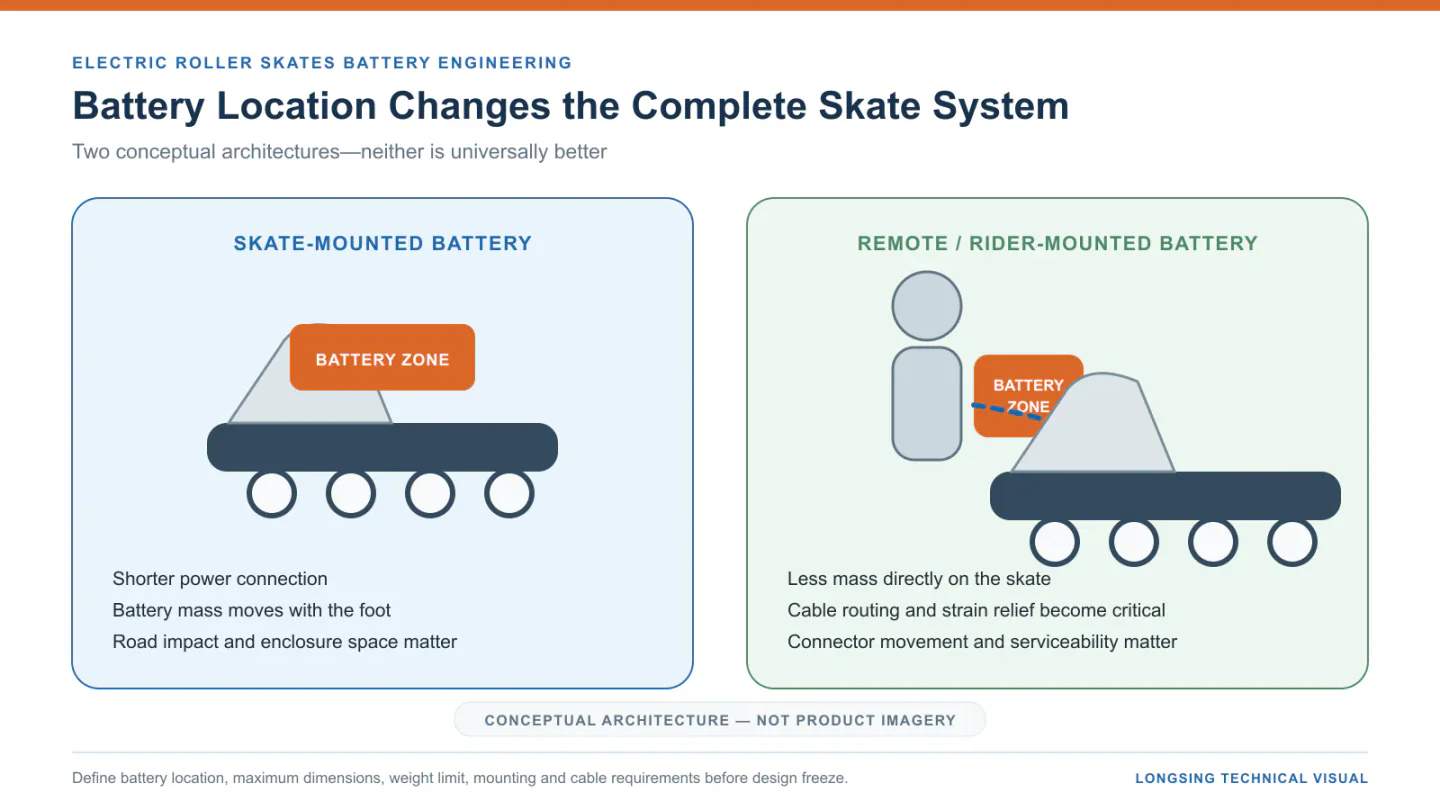
Pack location also changes the design.
Battery Mounted on the Skate
A skate-mounted battery can keep the electrical system compact and shorten the power connection between the battery and drive system.
The drawback is straightforward: the battery mass becomes part of the skate assembly.
The enclosure also has to fit around the mechanical structure while remaining protected from road impact and movement.
Battery Located Elsewhere on the Rider
Moving some battery mass away from the skate can reduce weight at the foot, but it introduces other engineering questions.
Cable routing becomes more important.
So does strain relief.
Connectors need to tolerate repeated movement without creating an unreliable contact point.
A removable battery may also require a different mechanical locking and user-interface design.
Neither arrangement is universally better.
The correct choice depends on the product concept.
The Cells Are Only Part of the Pack Volume
Another common mistake is designing the enclosure around cell dimensions alone.
A production battery still needs room for some combination of:
- cell holders;
- insulation;
- interconnections;
- BMS;
- wiring;
- connectors;
- protection material;
- structural support;
- enclosure walls;
- assembly clearance.
For compact mobility products, those details should be included early in the CAD process.
Waiting until the motor and enclosure geometry are already fixed can leave the battery team with an electrical specification that is impossible to package cleanly.
6. Compact Packs Still Need Mechanical and Thermal Margin
Saving space is useful until the pack becomes too difficult to protect or cool.
Electric skate batteries can be exposed to repeated road vibration and shock. Internal parts therefore need to remain restrained during use.
The concern is not limited to the cells.
Mechanical loading can also affect:
- welds and busbars;
- wiring;
- connectors;
- insulation;
- BMS mounting;
- cable exits.
An enclosure should be designed around the real mounting condition and expected load rather than around a generic idea of “vibration resistance.”
Water and Dust Exposure
Outdoor use also means the enclosure specification should be defined clearly.
IEC 60529 provides the IP Code used to classify enclosure protection against solid objects and water. [4]
An OEM that requires an IP rating should define the required level and validate the finished construction accordingly.
Calling a pack “waterproof” without a defined test condition is not enough.
Heat Inside a Small Enclosure
Higher current means higher electrical losses.
A simplified resistive relationship is:
Heat loss ∝ I²R
This makes repeated high-current operation important even if the average current over a complete ride is relatively low.
Cell resistance, interconnections, BMS components and connectors can all contribute heat.
A compact enclosure may also have limited surface area or airflow available for removing that heat.
The thermal review therefore needs to use the actual load profile and final pack geometry.
7. BMS Protection Has to Match the Load Profile
The BMS is part of the protection system, but it cannot correct an unsuitable battery architecture.
Typical functions may include:
- overvoltage protection;
- undervoltage protection;
- overcurrent protection;
- short-circuit protection;
- temperature monitoring;
- cell balancing where required.
The thresholds matter.
If the overcurrent setting is too close to a normal acceleration event, the battery may shut down during ordinary use.
If protection limits are set too high, the rest of the pack may have insufficient margin.
For that reason, BMS settings should be reviewed together with the cells, motor controller, conductors, connector and expected operating temperature.
Cell consistency is another separate issue.
Differences in capacity and resistance can cause one series group to reach a limit earlier than another. LONGSING’s battery cell matching article covers capacity, OCV and resistance matching in more detail.
8. What an OEM Should Define Before Battery Development
For electric roller skates, a useful battery RFQ should contain more than voltage and capacity.
| OEM Input | Why the Battery Engineer Needs It |
|---|---|
| Nominal system voltage | Defines the basic series architecture |
| Maximum charging voltage | Must match charger and pack limits |
| Minimum system voltage | Helps coordinate BMS and controller cutoff |
| Required energy in Wh | Gives a more useful range target than Ah alone |
| Typical duty cycle | Helps estimate realistic energy use |
| Continuous current | Defines sustained load requirements |
| Transient current and duration | Important for acceleration and climbing |
| Maximum battery dimensions | Determines feasible cell layout |
| Maximum battery weight | Prevents capacity from increasing at the expense of handling |
| Battery location | Changes packaging and cable requirements |
| Mounting method | Affects vibration and structural design |
| Connector and cable requirement | Influences current path and voltage drop |
| Charging method | Defines charger and BMS requirements |
| Operating temperature | Relevant to cell selection and protection settings |
| Water/dust exposure | Defines enclosure validation targets |
| Shock/vibration condition | Guides mechanical validation |
| Target market | Helps identify applicable standards and regulations |
One of the most useful items is the current profile.
Motor wattage alone often does not show what the battery experiences during actual acceleration.
9. Example: 43.2V 10Ah 21700 Battery Pack
LONGSING currently lists a 21700-based electric roller skates battery with the following specifications:
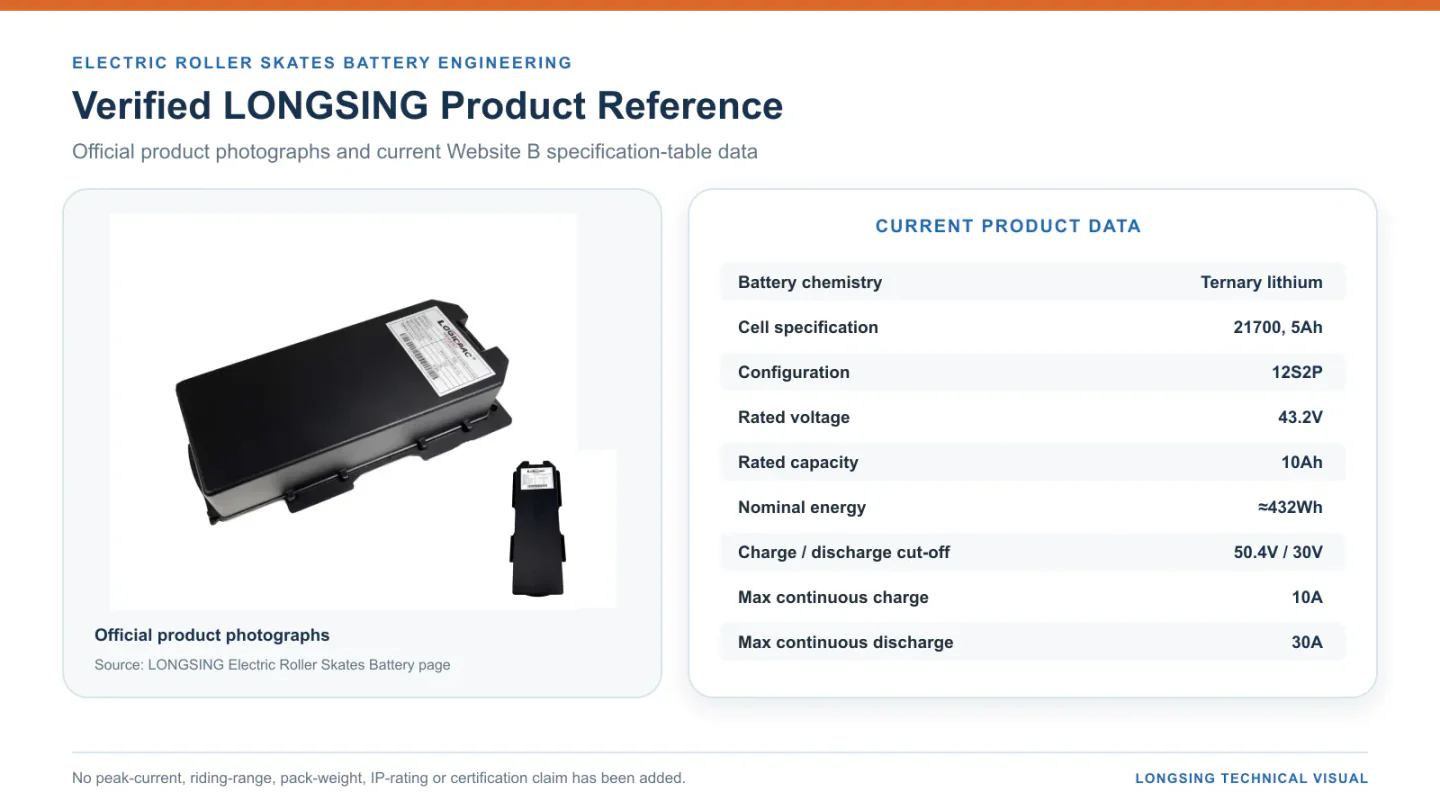
| Specification | Current Product Data |
|---|---|
| Battery chemistry | Ternary lithium |
| Cell specification | 21700, 5Ah |
| Configuration | 12S2P |
| Rated capacity | 10Ah |
| Nominal energy | ≈432Wh |
| Rated voltage | 43.2V |
| Charge cut-off voltage | 50.4V |
| Discharge cut-off voltage | 30V |
| Maximum continuous charge current | 10A |
| Maximum continuous discharge current | 30A |
The nominal-energy calculation is straightforward:
43.2V × 10Ah ≈ 432Wh
For an OEM, however, the more important question is what those figures mean inside the actual skate.
The 43.2V system has to match the controller voltage window.
The battery’s 30A maximum continuous discharge rating has to be compared with the real continuous load.
Transient acceleration demand still needs to be checked separately because the published specification does not provide a separate peak-current value.
Mechanical fit also remains project specific.
The pack dimensions, mounting position, weight limit, connector, thermal conditions and final vehicle validation determine whether this architecture is suitable for a particular electric skate.
This example should therefore be treated as a reference architecture, not a universal battery specification.
Standards to Check During Product Validation
Applicable standards depend on the final product classification and target market.
UL 2271 covers battery energy-storage assemblies for light electric vehicle applications. [1]
UL 2272 addresses electrical systems for personal e-mobility devices, including the battery system, charger and associated electrical components. Whether it applies to a specific electric skate product should be confirmed against the finished product and market requirements. [2]
For lithium-battery transportation, manufacturers should also review the UN Manual of Tests and Criteria, subsection 38.3. [3]
For the U.S. market, the CPSC’s June 2026 proposal concerning lithium-ion batteries and electrical systems in micromobility products is another development to monitor; it was published as a proposed rule for public comment, not a blanket certification statement for every product. [5]
Projects intended for the EU should evaluate the applicable requirements under Regulation (EU) 2023/1542 according to the battery category and finished product. [6]
These references are part of product validation. They should not be treated as automatic certification claims for a battery simply because the application falls within micromobility.
10. Conclusion
An electric roller skates battery is constrained by more than capacity.
There is only so much energy that can be added before the resulting weight and volume begin to work against the product itself. At the same time, reducing the pack too aggressively can leave insufficient energy or current capability for the intended duty cycle.
That is why electric roller skates battery range should be evaluated together with the load profile and mechanical design.
For a 21700-based pack, the key questions are practical ones:
Does the cell layout fit?
Can the pack supply the continuous and transient load?
What happens to voltage during acceleration?
How much battery mass can the product tolerate?
And can the enclosure provide enough mechanical and thermal margin?
Those answers should be established at system level before the pack architecture and enclosure geometry are frozen.
Discuss Your Electric Roller Skates Battery Requirements
For an electric roller skate project, provide the target voltage, required energy, current profile, battery dimensions, weight limit, charging method and operating conditions.
LONGSING can evaluate a suitable rechargeable lithium-ion pack architecture for prototype development and OEM integration. Its light electric vehicle battery packs provide useful starting points, but final suitability still depends on vehicle-level engineering and validation.
Contact LONGSING about a custom electric roller skates battery with the electrical load profile and mechanical envelope. The goal of the first review is to identify the feasible architecture and missing validation inputs—not simply to increase Ah.
Frequently Asked Questions About Electric Roller Skates Batteries
Click to explore more information about electric roller skates battery range and pack design
Q: What type of battery is used in electric roller skates?
A: Rechargeable lithium-ion packs are commonly evaluated because they can combine useful energy and current capability in a compact package. The final cell chemistry, format and series/parallel architecture should follow the voltage, load profile, installation space, battery weight target, charging method and operating environment of the skate.
Q: How much battery capacity do electric roller skates need?
A: There is no universal Ah value. Engineers should begin with required usable energy in Wh, based on the intended duty cycle, then verify continuous current, acceleration peaks, voltage sag, temperature, battery dimensions and allowable mass. Ah is meaningful only together with pack voltage.
Q: How is electric roller skates battery range calculated?
A: Electric roller skates battery range is estimated from usable battery energy and the vehicle’s energy consumption over a representative route. Rider and vehicle mass, speed, acceleration, hills, rolling resistance, drivetrain efficiency, temperature, voltage sag and BMS or controller limits all affect the result. A fixed distance should not be claimed without defined test conditions.
Q: Is a 21700 battery suitable for electric roller skates?
A: It can be when the selected cell and layout meet the required energy and current inside the available volume and weight limit. The 21700 format may reduce physical cell count, but its larger diameter can be harder to arrange in a narrow or irregular enclosure. Cell format alone does not guarantee range, power or safety.
Q: What does 12S2P mean in an electric skate battery?
A: A 12S2P pack uses 12 series groups, with two cells connected in parallel in each group. The series arrangement establishes the pack voltage, while the parallel cells contribute capacity and current capability. The complete design still needs suitable cells, interconnections, BMS settings and mechanical protection.
Q: Why do electric roller skates need a high-discharge battery?
A: Starting, accelerating and climbing can demand much more current than steady cruising. The battery must support those loads without excessive voltage sag, heat or unwanted BMS shutdown. Continuous current and short transient current should be specified separately, including the duration of the transient event.
Q: What BMS functions are important for electric roller skates?
A: Depending on the pack, relevant functions may include overvoltage, undervoltage, overcurrent and short-circuit protection, temperature monitoring and cell balancing. Protection thresholds must match the cells, controller, conductors, connectors and load profile. A BMS does not replace suitable cells or sound mechanical and thermal design.
Q: Can an electric roller skates battery pack be customized?
A: Yes. An OEM can define voltage, required Wh, continuous and transient current, battery dimensions, weight limit, mounting, connector, charging method, temperature and environmental exposure. A custom pack should then be validated with the actual motor, controller, charger and final vehicle.