
Charging sessions eat into schedules, and thick copper cables add weight, cost, and heat to every vehicle or storage container. A high voltage battery system solves both problems, since raising voltage moves the same power through less current, less copper, and less waste heat.
A high voltage battery system, sometimes shortened to HV battery on a datasheet, is a lithium-ion pack generally wired above 60V DC and often reaching 400V to 800V, that connects many cells in series[1] so the pack delivers a given power level at a lower current than a low voltage battery.
Both high voltage lithium ion battery and high voltage LiFePo4 battery storage chemistries follow this same series-string logic. Lower current allows thinner cables, faster charging, less resistive heat, and a lighter high voltage battery pack.
This is why builders of electric mobility equipment, energy storage systems, and heavy machinery increasingly specify high voltage batteries over traditional low voltage designs.
The engineering behind a high voltage battery system touches cell matching, safety interlocks, and thermal layout. Long Sing Energy breaks each piece down below, starting with any high voltage battery for fast charging duty and the physics behind it.
Table of Contents
- Why Do High Voltage Batteries Charge Faster?
- How to Design a Safer High Voltage Battery Pack?
- How to Select a High Voltage Battery?
1. Why Do High Voltage Batteries Charge Faster?
High voltage batteries charge faster because their higher operating voltage allows the charger to deliver more power (Power = Voltage × Current[2]) without excessively increasing current. Lower current reduces heat generation, minimizes energy loss, and improves charging efficiency.
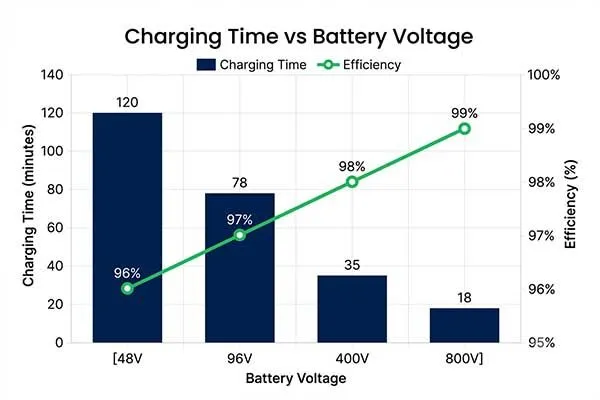
Combined with advanced battery management systems (BMS), optimized cell chemistry, and effective thermal control, high voltage battery packs can safely accept higher charging power, significantly reducing charging time while maintaining battery performance and lifespan.
High Voltage vs High Current Charging
Charging power equals voltage times current, so a charger can reach a target power by pushing more current or by raising voltage and holding current steady. Current is what generates heat, since resistive loss[3] in a cable rises with the square of current: doubling current quadruples heat in the same cable, while doubling voltage at constant current adds no heat at all.
That is why engineers favor high voltage battery architecture over high current architecture whenever a high voltage battery system needs to charge quickly without oversized cabling. A fast charging lithium battery built for a recreational vehicle or light electric vehicle nearly always lands in the high voltage bracket once its target charge time drops below an hour.
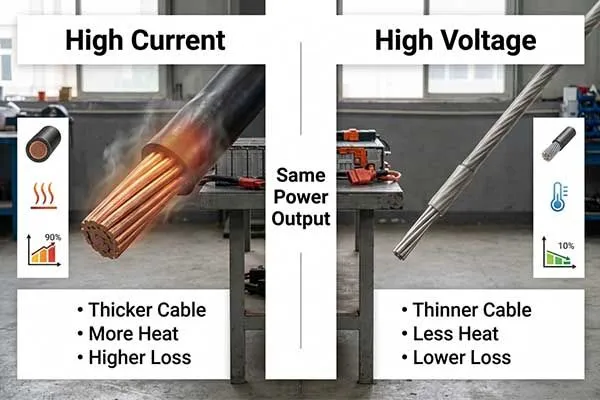
The table below shows the difference for a 150kW charging session.
| Pack Voltage | Current at 150kW | Relative Cable Copper Needed | Relative Resistive Loss |
|---|---|---|---|
| 400V | 375A | Baseline | Baseline |
| 800V | 187.5A | ~45-50% less | ~75% less |
The cable savings scale with current, but the loss savings scale with the square of current, which is why a jump from 400V to 800V does more than double the benefit a person might expect from voltage alone.
In practice, high voltage battery charging speed depends as much on the charger’s own thermal design as on the pack’s chemistry, and every well-engineered high voltage battery system treats charger and pack as one thermal circuit rather than two separate problems.
Tips
Fast charging failures are often caused by excessive current rather than high voltage. Poor thermal management accelerates lithium plating, increases impedance, and shortens battery life.
High Voltage Battery vs Low Voltage Battery
A low voltage battery, generally under 60V DC, suits smaller tools and short cable runs where current stays low by design.
A high voltage li ion battery becomes the better choice once a system needs to move real power over any meaningful distance, since low voltage vs high voltage battery comparisons almost always come down to how much copper and cooling a low voltage design needs to move the same energy.
Power tools stay low voltage because their cables are short and their duty cycles are brief. Electric mobility platforms, recreational vehicle house banks, and containerized energy storage systems[4] trend high voltage because their cable runs are longer and their charge or discharge power is far higher. That tradeoff is the core design decision behind every high voltage battery system on the market today.
| Item | Low Voltage | High Voltage |
|---|---|---|
| Voltage | 48V | 800V |
| Current | 250A | 15A |
| Heat Generation | High | Low |
| Cable Size | 50mm² | 16mm² |
| Efficiency | 92% | 98% |
Deep Dive into Fast Charging Thermal Dynamics
Industrial fast charging demands a rigorous understanding of thermodynamic boundaries. When a high voltage li ion battery undergoes high-rate charging, internal resistance generates heat. If the system relies on high current, this heat generation accelerates exponentially, leading to localized hotspots[5] and accelerating battery fast charging failure.
By raising the operating voltage, the high voltage lithium ion battery maintains an optimal thermal equilibrium.
| System Metric | Low Voltage System (48V) | High Voltage System (800V) | Engineering Impact |
|---|---|---|---|
| Current at 160 kW | 3,333 A | 200 A | 94% reduction in operating current |
| Cable Cross-Section | 240 mm² x 4 paths | 35 mm² single path | Reduces copper weight and installation complexity |
| Thermal Loss Formula | I²R (Very High) | I²R (Extremely Low) | Minimizes cooling demands and HVAC power draw |
This thermodynamic advantage allows systems to implement advanced fast charging battery technology without risking thermal runaway and improve the charging efficiency. Operators can maintain peak charging rates for longer durations, maximizing asset availability in demanding commercial environments.
Cut Charging Downtime by 70%
Slash thermal losses with high-voltage efficiency.
2. How to Design a Safer High Voltage Battery Pack?
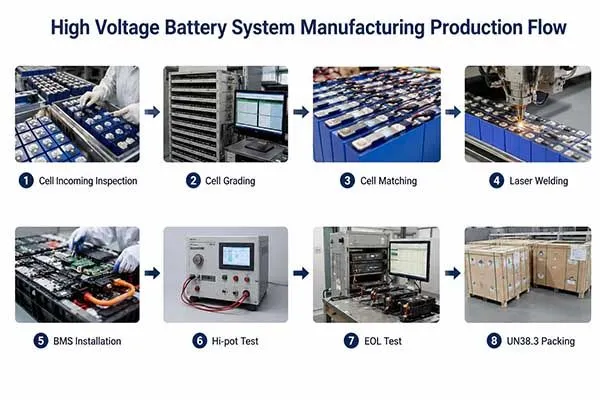
A safer high voltage battery system starts with cells sorted into tight matched groups, then assembled with laser-welded connections, insulation-tested at production line level, and monitored by a battery management system that enforces both software limits and hardware interlocks.
High voltage battery safety components, including a high-voltage interlock loop[6] and a mechanical safety disconnect, back up the software limits with a physical layer no firmware bug can bypass, the standard most commercial high voltage battery buyers now expect.
Tips
High voltage isn’t inherently more dangerous. Proper insulation, BMS protection, and isolation design determine overall battery safety—not voltage alone.
BMS Strategies for Fast Charging
Good high voltage battery design starts on the cell line, where every cell is capacity – and internal-resistance – sorted before it ever touches a busbar.
Cell matching[7] groups cells within a tight capacity and impedance band, because a mismatched cell in a long series string ages faster, drifts out of balance, and eventually limits the whole string’s usable capacity. Datasheets that abbreviate the term as HV battery are describing this exact same series-string architecture.
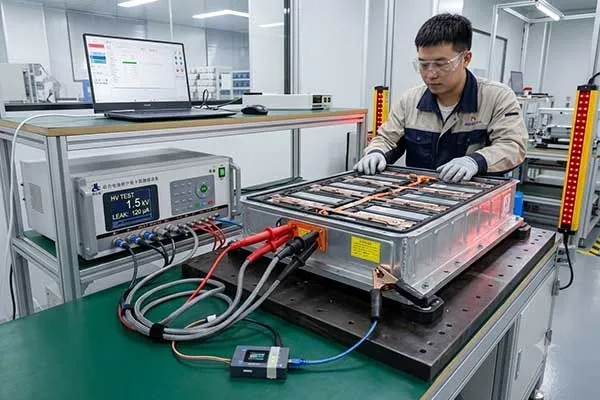
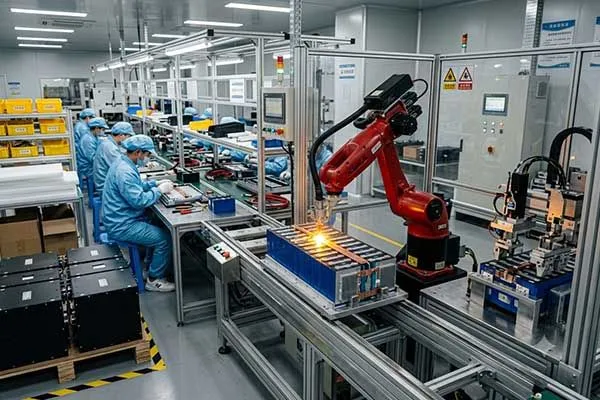
Laser welding then joins grouped cells into modules with a repeatable, low-resistance bond, and every module goes through insulation-resistance (Hi-pot) testing before the next station. End-of-line testing checks capacity, internal resistance, and voltage balance across the full fast charging battery pack, and the battery management system is calibrated against that data so its state-of-charge readings start accurate rather than drifting.
Why Can’t Batteries Charge Infinitely Fast?
Charging speed is limited by ion diffusion, heat dissipation, and electrochemical stability—not charger power alone.
Two hardware layers sit underneath the software. A high-voltage interlock loop, or HVIL, is a low-voltage signal wire routed through every high-voltage connector and cover; if a connection opens, the loop breaks and the system forces the main contactors open before anyone can reach a live terminal.
A mechanical safety disconnect[8], or [8]马上到!, is a separate physical plug or key-operated switch that splits the pack into two halves in series, dropping any exposed section below a hazardous voltage even with the contactors closed. The interlock catches an accidental opening during operation; the disconnect gives a technician a deliberate way to de-energize the pack for service.
Thermal and fire design follow the same layered logic. Cooling plates run between modules, mica or ceramic-fiber fire barriers slow propagation if one cell goes into thermal runaway, and vented gas is routed through a dedicated channel toward a pressure-relief port rather than into the next module.
Independent certification confirms these choices hold up under abuse testing, which is what separates a certified high voltage battery system from a pack that has only been through design simulation.
| Standard | What It Covers |
|---|---|
| IEC 62619 | Safety of lithium cells and batteries for industrial use |
| UL 1973 | Stationary and light electric rail battery safety |
| UN38.3 | Transport safety testing for lithium batteries |
| IEC 61508 | Functional safety of electronic safety-related systems |
| IEC 62477 | Safety requirements for power electronic converter systems |
| ISO 6469 | Electric road vehicle safety, including high voltage battery safety |
Real Industrial Applications
High voltage battery architecture shows up well beyond passenger vehicles.
Heavy engineering machinery, including electric excavators and wheel loaders, needs power without cables thick enough to limit the boom’s range of motion. A high voltage li ion battery suits that duty cycle far better than a low voltage pack, since burst hydraulic loads reward low resistive loss more than raw capacity.
Agricultural tractors face the same problem across even longer implement cables, since a tractor’s PTO and hydraulics draw heavy current in short, repeated bursts through a working day.
Containerized, liquid-cooled energy storage systems reach the same conclusion by a different path: a 20-foot or 40-foot container packs enough cells that a low voltage bus would need impractically thick copper, so nearly every commercial containerized high voltage battery system on the market runs at high voltage, often built around high voltage LiFePo4 battery storage modules whose stability suits a sealed box that may not see a technician for years.
Long Sing Energy supplies cells and packs into all three categories, and as a high voltage battery system manufacturer, the company sees these cable and cooling tradeoffs from both the cell side and the container integration side.
3. How to Select a High Voltage Battery?
Selecting a high voltage battery system starts with matching pack voltage to the application’s power target, then checking that the supplier’s cell matching, certification record, and BMS architecture line up with the duty cycle in question.
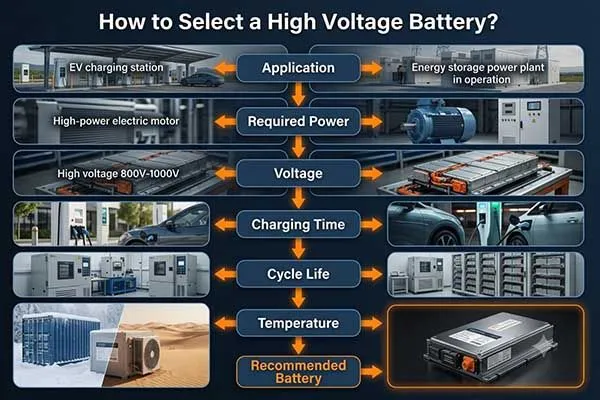
A higher voltage battery is not automatically right for every application, since small tools rarely justify the added complexity, but for any electric mobility, energy storage, or heavy equipment platform moving real power, total cost of ownership almost always favors a well-engineered high voltage battery pack. An HV battery quoted without a certification list attached is not ready for a commercial fleet or storage buyer.
The high voltage battery advantages that matter most for a fleet or storage buyer are lower copper cost, lower resistive loss, and a smaller cooling system, all of which show up directly in the return-on-investment math below. Buyers shopping for a high voltage battery for fast charging duty should ask a supplier for cell matching tolerances and interlock design before comparing price per kWh.
ROI Analysis
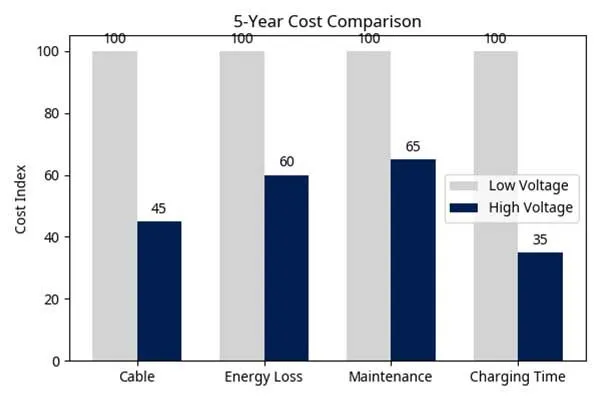
The financial case for a high voltage battery system starts with a chain of physics: raising voltage lowers current for the same power, lower current allows a thinner cable, and less current also means less resistive loss and less waste heat to manage.
Each link in that chain shows up as cash. Copper is priced by weight, so a cable sized for half the current uses roughly half the copper for the same length. Less heat means smaller cooling fans, lighter connectors, and fewer thermally-stressed components to replace over the years.
A compact high voltage battery charger also fits into a smaller enclosure than the low-voltage equivalent, since a high voltage charger moves the same power at a lower current and needs less copper and airflow inside its own housing. Any high voltage li ion battery bought for fast-charging duty should be judged on this same tradeoff before price enters the conversation.
The 400V vs 800V Battery comparison below models a fleet fast-charging scenario, comparing a 400V and an 800V system delivering the same 150kW, over a 20-year service life, assuming daily 30-minute charging sessions and a European commercial electricity price near €0.20 per kWh.
| Metric | 400V System | 800V System | 20-Year Difference |
|---|---|---|---|
| Charging current | 375A | 187.5A | ~50% lower |
| Estimated cable resistive loss per session | ~7.0kW | ~1.8kW | ~5.2kW saved per session |
| Estimated energy saved over 20 years | – | – | ~19,000kWh |
| Estimated electricity cost saved over 20 years | – | – | ~€3,800 |
| Cable and connector replacement cycles | Every ~4 years | Every ~8 years | 2 fewer replacements |
These figures are an engineering estimate built from stated assumptions, not a guaranteed result for any one site, since cable length, ambient temperature, and local electricity pricing all shift the outcome.
The savings apply whether the pack uses NMC or high voltage LiFePo4 battery storage chemistry, since the current-voltage relationship driving them is independent of cell chemistry. Even so, the direction holds across almost every fast charging battery technology deployment this size: a high voltage battery system spends less on copper up front and less on electricity and replacement parts over its life.
Maximize Your System ROI
Thinner cables, lower losses, minimal maintenance.
Engineering Experience
A French electric vehicle brand approached Long Sing Energy earlier this year through a technical inquiry, and their first question was how the company handles cell inconsistency inside a high voltage battery system’s long series string.
The answer: capacity and internal-resistance sorting, grouping cells within roughly ±2% capacity and 3mΩ internal resistance before module assembly, since a wider spread shows up as premature imbalance a few hundred cycles later.
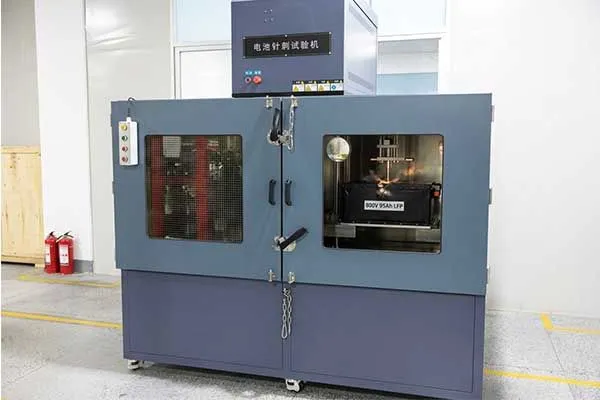
Their second question covered battery safety and protection board parameters. Battery fast charging failure in the field usually traces back to a hot connector or an imbalanced string, not the cells themselves, so the engineering team shared the failure analysis behind the BMS design: overcurrent protection trips at 1.5C sustained and 3C for pulses under 5 seconds, overvoltage cutoff sits at 4.25V per cell with a secondary hardware cutoff independent of the main processor, and nail-penetration testing on the qualified cell showed no fire and no explosion, with peak surface temperature staying under 85°C during the event.
The brand’s EV battery pack design brief specified an 800V pack built and tested inside a 40-minute cycle time. Long Sing Energy’s chief engineer, Jack Song, and sales manager, Luke Liu, worked with the line to break that target into stages: automated cell matching and sorting, roughly 10 minutes per string; laser welding of busbars and module interconnects, about 12 minutes; insulation-resistance (Hi-pot) testing, close to 8 minutes; and BMS calibration with end-of-line testing, the remaining 10 minutes, for a total close to 40 minutes per pack on the production line.
Tips
Hi-pot insulation testing verifies electrical isolation between high-voltage circuits and the enclosure, helping prevent leakage current and ensuring compliance with international safety standards.
The finished sample shows what a high voltage lithium ion battery built to this exact process looks like once matched, welded, and tested.
| Parameter | Sample Pack Value |
|---|---|
| Nominal voltage | Approx. 800V (250S configuration) |
| Chemistry | LFP, high voltage battery for fast charging |
| Rated capacity | 75kWh |
| Charging Rate | 2C |
| Max charge current | 250A |
| 10-80% charge time | ~18 minutes |
| Cell matching tolerance | ±2% capacity, ≤3mΩ internal resistance |
Conclusion
A high voltage battery system trades current for voltage, and that trade pays off as thinner cables, lower resistive loss, and faster charging across electric mobility, energy storage, and heavy equipment applications.
Getting there safely depends on cell matching, hardware interlocks like HVIL and MSD, layered thermal design, and certification to standards buyers already trust. Selected correctly, a well-built high voltage battery system lowers both upfront copper cost and long-term operating cost.
Frequently Asked Questions
Click to explore more information about High Voltage Battery System
Q: What is an HV battery?
A: A high-voltage (HV) battery is a battery system with a nominal voltage typically above 60V DC. It combines multiple battery cells and modules managed by a Battery Management System (BMS) to deliver higher power, faster charging, and improved efficiency for electric vehicles, energy storage systems, industrial equipment, and commercial applications.
Q: What is the highest voltage battery you can get?
A: Commercial high-voltage lithium battery systems commonly range from 96V to over 1,500V depending on the application. Utility-scale energy storage and electric vehicle platforms typically use hundreds of volts, while custom industrial battery systems can be configured to meet specific voltage requirements.
Q: How long does a high voltage battery last?
A: A quality LiFePO4 high-voltage battery typically lasts 10–15 years or more than 6,000 charge cycles under proper operating conditions. Actual lifespan depends on temperature, charging habits, discharge depth, and the effectiveness of the Battery Management System.
Q: What are the types of HV batteries available?
A: Common HV battery types include LiFePO4, NMC (Nickel Manganese Cobalt), LTO (Lithium Titanate), and lead-acid systems. LiFePO4 is widely preferred for energy storage because of its excellent safety, long cycle life, and thermal stability.
Q: Can a small battery have a high voltage?
A: Yes. A physically small battery pack can provide high voltage by connecting multiple cells in series. While the voltage increases, the available energy and current output still depend on the battery’s capacity and design.
Q: What are the differences between high voltage and low voltage batteries?
A: High-voltage batteries deliver the same power with lower current, reducing cable size, heat generation, and transmission losses. Low-voltage batteries are generally simpler and more economical for small devices but are less efficient for high-power applications.
Q: Why do you need high-voltage batteries?
A: High-voltage batteries improve power efficiency, support fast charging, reduce electrical losses, and enable compact system designs. They are widely used in electric vehicles, renewable energy storage, UPS systems, industrial equipment, and commercial energy applications.
Reference:
[1]Learn how battery packs are connected in series for higher voltage.↪
[2]learn to calculate the Ohm’s Law behind charging power.↪
[3]Understand why resistive loss creates joule heating with current squared.↪
[4]Explore large-scale battery storage technologies of containerized battery energy storage system.↪
[5]Explore research on battery thermal distribution about localized hotspots.↪
[6]Learn how the high-voltage interlock loop (HVIL) improves operator safety.↪
[7]Discover why cell matching extends battery pack lifetime.↪
[8]See why a mechanical safety disconnect is essential for maintenance safety.↪