
Battery buyers are being asked harder questions than “How many watt-hours does it have?” In August 2026, the Australian government directed the Australian Competition and Consumer Commission to develop a nationally consistent safety standard for e-bikes and e-micromobility devices. The announcement is a policy and standards-development step, not proof that a completed national standard is already in force. [1]
Elsewhere, the pressure is already more concrete. Great Britain’s statutory guidelines tell producers, importers, and distributors to address cell voltage, pack current, cell temperature, charge and discharge limits, charger compatibility, impact, vibration, and water exposure. [2] In the United States, the Consumer Product Safety Commission published a proposed mandatory micromobility battery rule in June 2026; as of October 2026, it remains a proposal rather than a final federal rule. [3]
For an OEM, this changes the design review. The useful question is no longer whether the pack contains a recognizable cell or a smart BMS. It is whether the battery, charger, and bicycle still behave safely when current, temperature, vibration, water exposure, and foreseeable misuse occur together.
E-bike battery safety is a system property.
Start with the bicycle, not the cell catalog. Define the voltage window, continuous and peak current, charging behavior, temperature range, mounting loads, ingress exposure, and target-market tests. Then select the cells, topology, BMS, charger, connectors, and enclosure around those limits. A component datasheet cannot validate the finished electrical system.
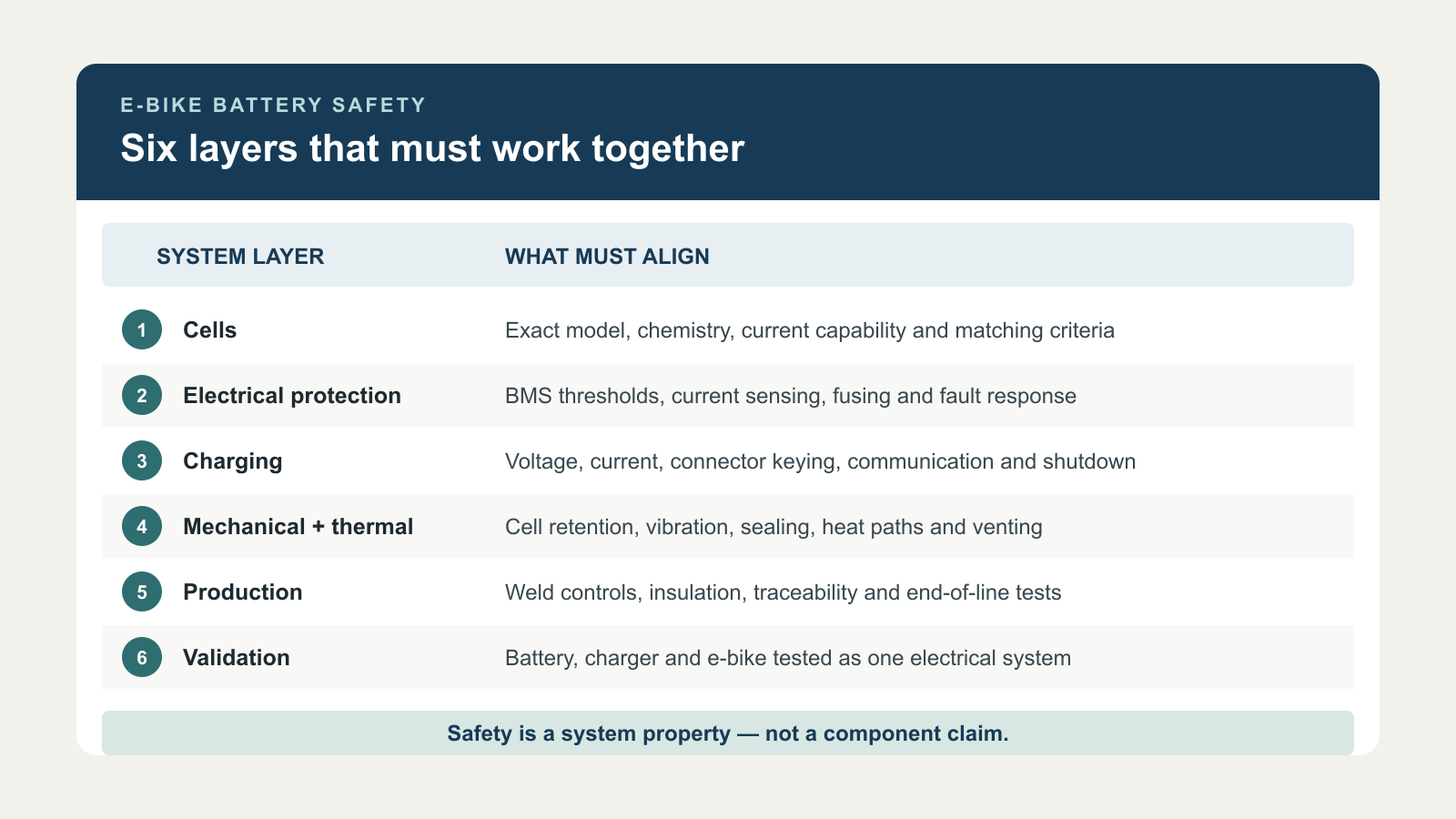
Table of Contents
1. Why E-Bike Battery Safety Is Entering a New Phase
Capacity, range, mass, and price still matter, but they no longer close the purchasing discussion. Market access increasingly depends on evidence tied to the exact product: traceable identities, technical files, credible test reports, controlled charger pairings, and proof that production units remain consistent with the evaluated design.
A test report is useful only when its scope matches the product being sold. Cell model, pack configuration, BMS hardware and firmware, charger, connectors, enclosure, and critical materials all affect that scope. An undocumented substitution can weaken the link between a production battery and the configuration that was evaluated.
This is why compliance planning belongs near the start of development. A requirement discovered after tooling may force changes to the cell, BMS, charger, enclosure, labels, or documentation—and then require another round of testing.
Requirements can also differ inside one country. New York City, for example, requires accredited-laboratory certification to UL 2849 for powered bicycles and UL 2271 for their storage batteries. [8] Freeze the target countries, cities, sales channels, product classification, and launch date before design approval. This article discusses engineering and standards at a general level; it is not legal advice, and each target market needs a current regulatory check.
2. Thermal Runaway Is Usually a Chain of Failures
Thermal runaway begins when heat-producing reactions inside a cell accelerate faster than the cell can reject heat. Hot gases, flammable material, and ejecta may then heat neighboring cells and create a pack-level cascade. The UK guidance explicitly connects the risk with poor design, poor manufacture, incompatible components, and operation outside safe design parameters. [2]
The initiating event may be an internal defect, hidden impact damage, water ingress, an external short, or charging beyond the cell’s permitted voltage or temperature range. Propagation becomes more likely when cells are tightly packed without an adequate heat path, temperature sensors miss the hottest region, or an enclosure directs hot ejecta toward adjacent cells. NASA and NREL battery-failure research similarly emphasizes that runaway behavior varies with cell type, format, state of charge, and trigger mechanism. [7]
Most pack failures are not one-event stories.
Electrical resistance can add another link. A weak weld, undersized conductor, worn connector, or uneven current path creates local heat under load. Poorly matched parallel cells can share current unevenly; a weak series group can reach its voltage limit before the rest of the pack. None of these conditions automatically causes a fire. Each one, however, reduces the margin available when another fault occurs.
Effective thermal runaway prevention therefore uses layers: a suitable cell operated within its limits, controlled interconnections, appropriate fusing and BMS thresholds, temperature sensing, a compatible charger, mechanical protection, and a pack layout that manages heat and venting. The basic electrochemical relationships are covered in LONGSING’s overview of how lithium-ion batteries work, but the safe operating envelope must come from the selected cell and finished-pack design.
3. 18650 vs 21700: Cell Format Is Not a Safety Rating
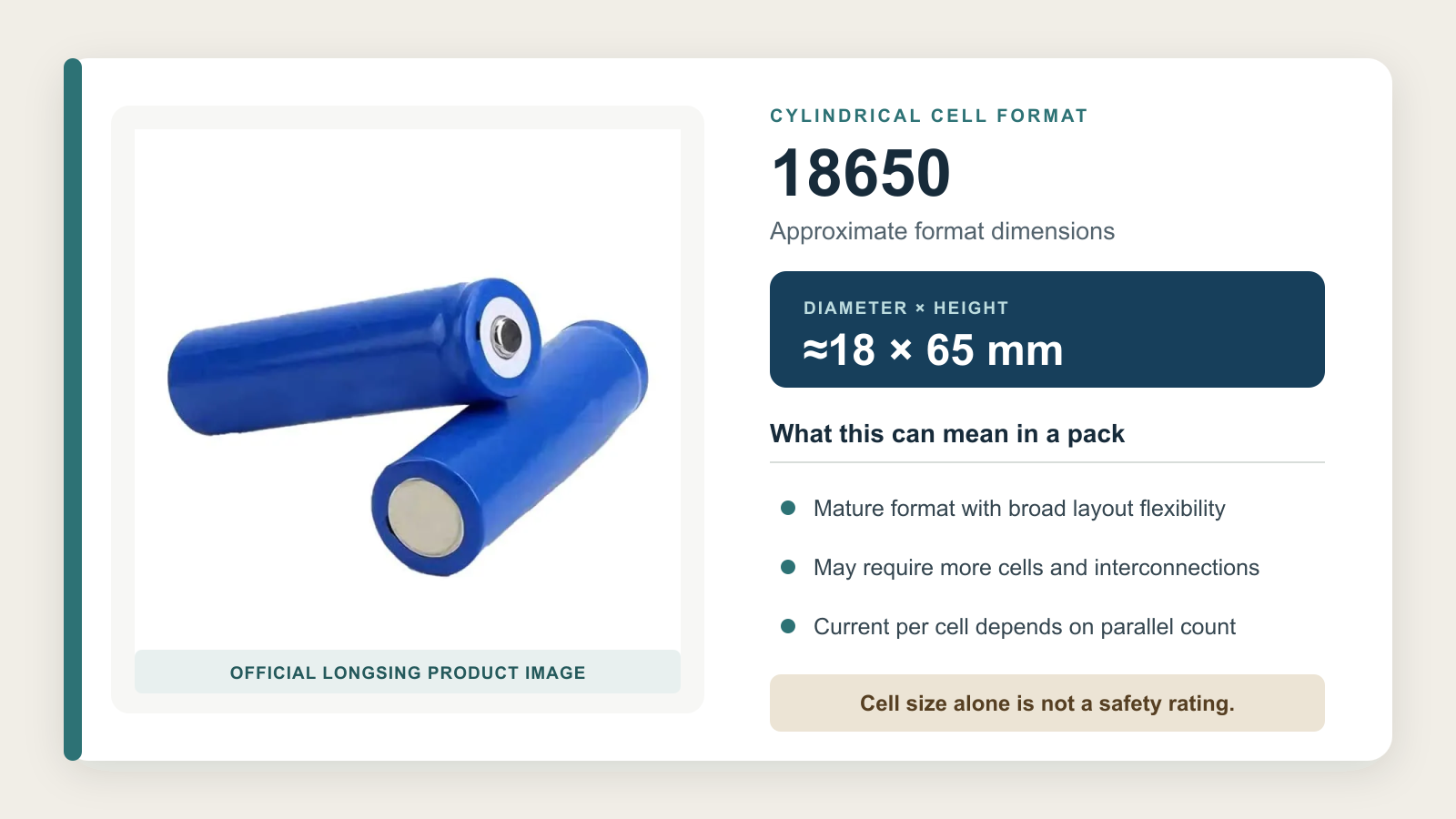
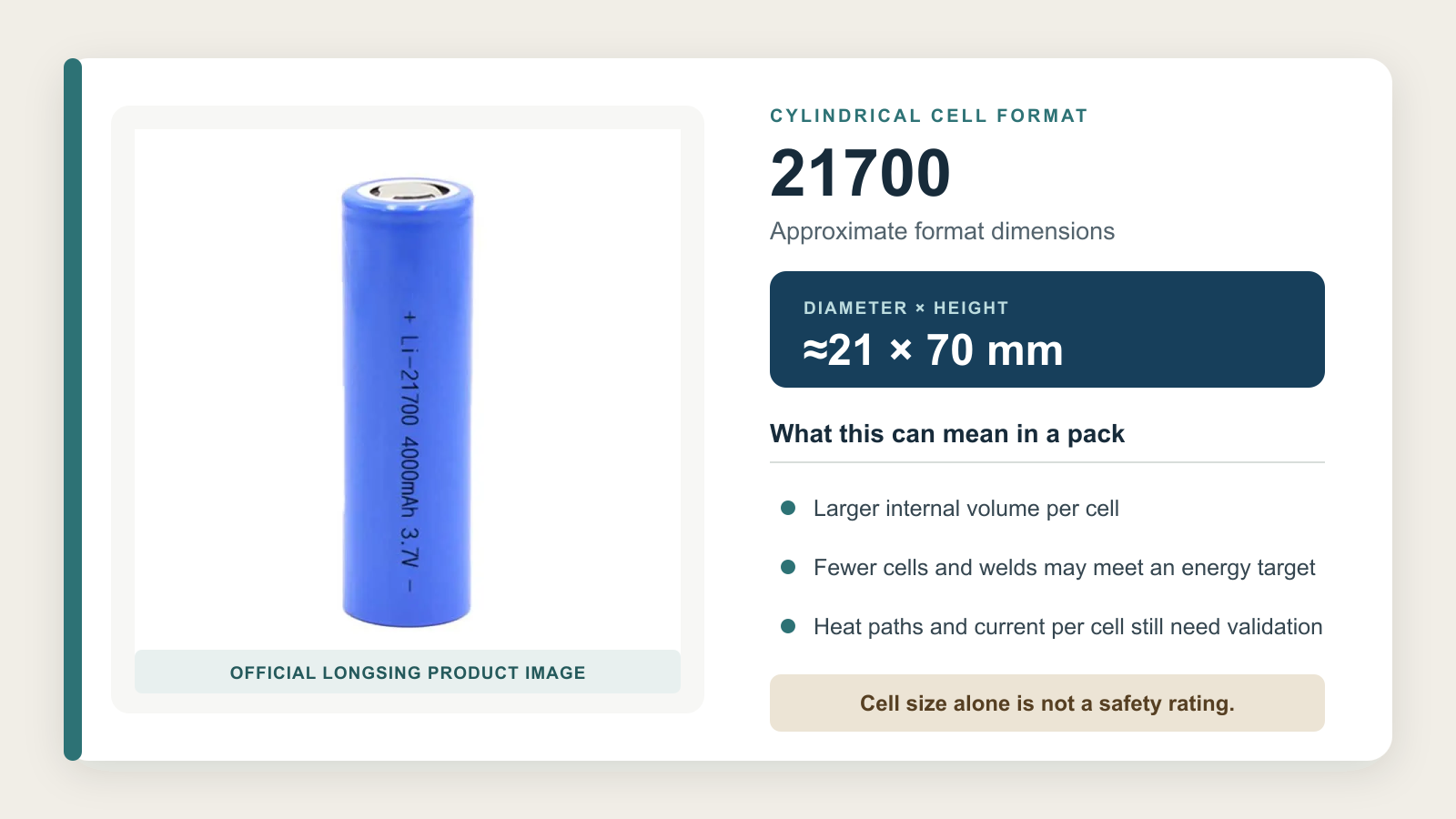
The terms 18650 and 21700 describe cylindrical dimensions, not chemistry, quality grade, discharge capability, or safety level. An 18650 battery cell is roughly 18 mm in diameter and 65 mm long; a 21700 format is roughly 21 mm by 70 mm. Either format can be made with different lithium-ion chemistries and electrode designs.
A 21700 cell is not inherently safer than an 18650 cell. Nor does choosing 18650 mean accepting obsolete or low-performance technology. The answer to an “18650 vs 21700 e-bike battery” comparison depends on the exact cell model, chemistry, current, series/parallel topology, thermal environment, and pack construction.
A higher-capacity cell may let the designer meet an energy target with fewer cells, welds, and interconnections. That can simplify assembly, but it also changes pack geometry, heat distribution, fault energy, and the current demanded from each cell. Conversely, a design with more parallel cells may lower current per cell while increasing connection count and sensitivity to uneven current sharing.
The 21700 battery format can fit some high-energy or high-power layouts efficiently, while 18650 may suit a mature mechanical envelope or a pack that benefits from a different cell count and heat-spreading pattern. Service strategy matters too: welded assemblies, replaceable modules, and enclosure access create different inspection and repair constraints. Format selection should follow modeled and tested system requirements, not a format-level safety claim.
4. What an Effective E-Bike BMS Should Monitor
An e-bike battery BMS has four basic jobs: measure, decide, act, and report. In a conventional series/parallel pack, it measures every series-group voltage, total pack voltage, charge and discharge current, and temperatures at locations chosen through thermal analysis and testing.
- Overcharge and over-discharge detection, with thresholds and delays matched to the cell and system
- Overcurrent and short-circuit response appropriate to expected peaks, wiring, switching devices, and fuse strategy
- Charge and discharge temperature limits, including low-temperature charging restrictions
- Cell-group balancing selected for the expected imbalance, duty cycle, and service life
- Charger identification, communication, or charge permission where the architecture requires it
- Fault recording, state reporting, and diagnostic access where required by the product or service model
The protection concept must also define what happens after a limit is detected. Switching devices have voltage, current, temperature, and failure-mode constraints. Reset rules matter. A short-circuit response that is fast enough for one design may nuisance-trip on another motor controller’s inrush current, while a delay chosen only to avoid nuisance trips may leave a fault energized too long.
A BMS cannot compensate for unsuitable cells, poor mechanical design, weak interconnections, or an incompatible charger. It also cannot guarantee that thermal runaway will never occur. It is one protective layer whose sensors, algorithms, power devices, wiring, and failure responses must be verified in the finished e-bike battery pack.
5. Why Charger Compatibility Is Part of Battery Safety
E-bike charger compatibility is more than matching a plug. The charger’s maximum voltage and current must suit the pack configuration, cell limits, BMS components, wiring, and intended charging time. The connector pinout, polarity, current rating, touch protection, keying, and durability must also match.
Some systems need identification resistors, digital communication, or an explicit BMS charge-permission signal. The control sequence must define how the charger and BMS behave if a temperature limit is crossed, communication is lost, a cell group reaches its upper limit, or the output connector is disturbed. Testing should cover startup, normal termination, repeated reconnects, and representative faults.
Charging outside the permitted temperature range deserves particular attention. Ambient air may seem acceptable while cells remain cold after outdoor storage or become hot from a recent ride. Sensor placement and charge logic should address actual cell conditions rather than relying on room temperature alone.
Replacement chargers create a lifecycle risk. A connector that accepts a higher-voltage aftermarket charger invites foreseeable misuse, and a printed warning is a weak control if the wrong charger physically fits and begins charging. The UK guidelines specifically require protection against incompatible charging and information that helps users source a compatible charger. [2] Battery, BMS, charger, cable, and connector should be validated as one charging system.

6. Cell Matching and Pack Manufacturing
Battery cell matching reduces avoidable variation before assembly. Depending on the cell, architecture, and quality plan, engineers may compare measured capacity, open-circuit voltage, AC internal resistance or another resistance metric, and self-discharge behavior. Production-lot identity and storage history provide context that a single measurement cannot.
The acceptance bands should be set for the project. A universal matching tolerance would ignore cell chemistry, measurement method, equipment accuracy, pack topology, balance capability, load profile, and aging target. LONGSING’s battery cell matching overview explains why capacity, OCV, and ACIR reveal different aspects of cell consistency.
Matching does not rescue a weak production process. Weld energy, electrode cleanliness, strip material, tool wear, and fixture pressure affect interconnection consistency. Insulation rings, barriers, creepage and clearance, conductor routing, and protection against sharp enclosure features should be controlled through drawings, work instructions, inspection, and process validation.
End-of-line testing may include pack voltage, series-group readings, insulation checks where applicable, BMS communications, temperature inputs, charge/discharge switching, current sensing, and functional verification of the intended charger interface. Sampling, aging, audit tests, and traceability should reflect the risk and production volume. The goal is evidence that the production pack matches the evaluated design, not a final test that tries to detect every upstream defect.
7. Mechanical and Thermal Protection
An e-bike battery lives on a vibrating structure exposed to curbs, potholes, handling drops, dust, water, sunlight, and repeated connector cycles. Cell holders and compression features must retain cells without damaging sleeves or creating concentrated loads. The enclosure and mounting rails must resist expected impact while keeping the pack attached to the bicycle.
Ingress protection is a design system, not an enclosure label. Seals, fasteners, cable glands, drain paths, pressure equalization, connector caps, and manufacturing variation all affect water and dust resistance. Condensation and water trapped after washing can be as relevant as direct rain.
Internal wiring needs strain relief and abrasion control. High-current connectors should be evaluated for contact resistance, wear, contamination, partial engagement, and heating over life. A connector that passes initial inspection may still become a hot spot after thousands of removal cycles or repeated vibration.
Thermal design must consider cell-to-cell spacing, heat paths, insulating materials, vent direction, enclosure conductivity, and nearby bicycle components. Sensor placement should be based on predicted and measured hot locations during charging, sustained climbing, peak assist, and fault conditions. Actual cell temperature can differ substantially from ambient temperature because of internal resistance, solar heating, enclosure insulation, and heat from the controller or motor.
8. Certification Must Match the Target Market
E-bike battery certification is not a universal badge. Scope, product classification, edition, national adoption, marking, factory surveillance, and documentation can all matter. OEMs should agree on the target market and certification route before freezing cells, BMS hardware, charger, enclosure, and connectors.
In North America, UL 2271 is the Standard for Batteries for Use in Light Electric Vehicle Applications. UL 2849 is the Standard for Electrical Systems for eBikes and examines the electrical drive train, battery system, and charger system combination. [4] A cell test or UL 2271 battery evaluation does not by itself certify the complete e-bike electrical system to UL 2849. Likewise, installing a certified component does not automatically extend that certification to a modified final product.
For Great Britain, the OPSS guidance identifies BS EN 50604-1:2016+A1:2021, covering general safety requirements and test methods for secondary lithium batteries used in light electric-vehicle applications, and BS EN 15194:2017+A1:2023 for electrically power-assisted cycles. [2] The applicable designated standards, legislation, and current editions should be reconfirmed for the product’s placement date.
UN 38.3 addresses lithium cell and battery testing for transport classification. The current UN Manual of Tests and Criteria is Revision 8 with Amendment 1 published in 2025. [6] Passing the applicable UN 38.3 test sequence supports transport compliance; it is not a normal-use product safety certification and does not replace pack or e-bike system evaluation.
The EU adds a traceability dimension. From February 18, 2027, each light means of transport battery placed on the EU market or put into service must have a battery passport. The electronic record is expected to make identification, technical characteristics, performance, durability, repair, reuse, and recycling information more accessible, with the responsible economic operator maintaining the finished battery’s record. [5] This does not replace safety testing, but it makes disciplined product data and configuration control more visible.
9. What OEMs Should Give the Battery Supplier
A useful request for quotation describes the bicycle system and its operating limits, not just a nominal voltage and amp-hour target. The following inputs let the supplier identify conflicts early, estimate thermal and electrical stress, and propose a verification plan.
| OEM Input | Why the Battery Team Needs It |
|---|---|
| Nominal voltage and operating-voltage range | Defines series count, equipment ratings, controller interface and cutoff coordination. |
| Required usable energy | Sets the practical energy target after voltage limits, reserve, temperature and aging are considered. |
| Continuous and peak current | Drives cell choice, parallel count, conductors, switching devices, fusing and heat generation. |
| Peak duration and repetition | Separates a brief acceleration pulse from a sustained climbing or cargo-load requirement. |
| Motor and controller specifications | Reveals inrush, regenerative behavior, undervoltage limits, communications and fault interactions. |
| Pack dimensions and mass limit | Constrains cell format, arrangement, enclosure, mounting hardware, cooling paths and service access. |
| Operating, charging and storage temperatures | Defines cell eligibility, protection thresholds, materials, seals, charge limits and validation conditions. |
| Charging voltage and current | Must be compatible with series count, cell limits, BMS hardware, connector and charging-time target. |
| Charger identification or communication | Defines handshake, charge permission, fault behavior, replacement control and diagnostic needs. |
| Connector and pinout | Controls polarity, current path, signal contacts, keying, touch safety, sealing and mating life. |
| Enclosure and ingress requirements | Links the real exposure profile to seals, venting, drainage, materials and production tests. |
| Vibration and impact requirements | Guides cell retention, mounting rails, weld support, wire routing and mechanical validation. |
| Required BMS functions | Defines sensing, protection, balancing, communications, data logging and service behavior. |
| Lifecycle target and duty cycle | Provides the basis for energy margin, thermal loading, aging tests and warranty assumptions. |
| Target countries and sales channels | Determines market-specific law, standards, labels, languages and importer obligations. |
| Certification and documentation requirements | Aligns test samples, design freeze, technical files, traceability, change control and schedule. |
Unknown values should be marked as open items rather than replaced with optimistic assumptions. A custom e-bike battery pack cannot be specified responsibly if the peak-current duration, charger behavior, or mounting environment remains undefined.
10. Where LONGSING Fits
The useful starting question is not “Can you build a 48 V battery?” It is “What must this 48 V battery do on this bicycle, in this market, over its intended life?” LONGSING supports OEM and ODM battery-pack development from that application-level input rather than from a fixed catalog configuration.
The work can cover 18650 or 21700 cell selection, custom voltage and capacity, series/parallel design, cell matching, BMS integration, and charger and connector coordination. Mechanical development proceeds alongside it because available volume, mounting direction, sealing, vibration, cell retention, heat paths, sensor locations, and service access can change the feasible arrangement. LONGSING’s custom battery pack services support project-specific electrical, mechanical, and interface requirements from prototype through production.
The project still needs a named compliance owner and an agreed external test route. Supplying cells, a BMS, or a pack does not confer certification on the customer’s final e-bike. Certification belongs to the exact evaluated configuration and must be supported by the relevant documentation and authorized marking.
Conclusion
No single component closes the safety case. Cell characteristics, matching, BMS logic, charger control, interconnections, enclosure behavior, manufacturing discipline, and whole-system validation have to support one another. Treating one layer as a substitute for the rest leaves avoidable gaps.
Early specifications prevent late redesign. For a project review, send LONGSING the nominal and operating voltage, usable energy, continuous and peak current with duration, dimensional envelope, charger requirements, temperature ranges, target markets, and required certifications through the contact form. Those inputs give the engineering team a defensible starting point for cell selection and pack architecture.
Frequently Asked Questions About E-Bike Battery Safety
Click to explore more information about e-bike battery safety
Q: Are 21700 cells safer than 18650 cells for e-bikes?
A: No format is inherently safer. The numbers describe approximate cell dimensions, not chemistry or safety performance. A 21700 design may need fewer cells and welds for a given energy target, but each cell may store more energy and the pack will have different heat paths. Compare exact cell models, current per cell, spacing, interconnections, enclosure, protection settings and pack-level test results.
Q: Can a BMS prevent every e-bike battery fire?
A: No. A correctly engineered BMS can detect and respond to defined voltage, current and temperature conditions, but it cannot eliminate every internal cell defect, crush event, water path, weak weld or thermal propagation mechanism. Its sensors may also miss a local hot spot. The BMS must be combined with suitable cells, mechanical and thermal protection, controlled manufacturing, compatible charging and finished-system validation.
Q: Why does charger compatibility matter?
A: The charger defines the voltage and current applied while the pack may be unattended. The correct plug does not prove the correct electrical profile. Compatibility includes maximum voltage, current, polarity, pinout, identification or communication, temperature-dependent limits, termination and fault shutdown. Battery, BMS, charger, cable and connector should be tested together, including foreseeable use of replacements.
Q: What is the difference between UL 2271 and UL 2849?
A: UL 2271 applies to batteries for light electric vehicle applications. UL 2849 applies to the electrical system of an e-bike and evaluates the combination of battery, charger and electrical drive train. A battery certified to UL 2271 is therefore not the same as a complete e-bike system certified to UL 2849. The certification route must match the product and jurisdiction.
Q: Does UN 38.3 mean an e-bike battery is safe for normal use?
A: No. UN 38.3 is a transport-focused test regime for lithium cells and batteries. It addresses conditions such as altitude simulation, thermal cycling, vibration, shock, external short circuit, impact or crush, overcharge and forced discharge as applicable. Passing supports shipment under dangerous-goods rules, but it does not evaluate every normal-use hazard or certify the complete e-bike electrical system.
Q: What information is needed for a custom e-bike battery pack?
A: Provide nominal and operating voltage, usable energy, continuous and peak current, peak duration, motor and controller data, dimensions, mass limit, temperature ranges, charger details, connector and pinout, communications, ingress and vibration exposure, BMS functions, lifecycle target, target countries and certification needs. A physical bicycle interface drawing and realistic ride or load profile are especially useful.
Q: Should an e-bike use NMC or LiFePO₄?
A: It depends on the project. NMC cells can support compact, energy-dense packs; LiFePO₄ is often chosen for thermal stability and cycle-life potential, but usually requires a different volume and mass tradeoff for the same energy. Neither chemistry makes the pack safe by itself. Compare qualified cell models, current capability, cold-weather behavior, enclosure space, charging strategy and pack-level tests.
Q: Why does cell matching matter?
A: Cells with large differences in capacity, resistance, state of charge or self-discharge can reach operating limits at different times and share current unevenly. Matching helps the pack behave more predictably and reduces the burden on balancing. Criteria and tolerances must be defined for the selected cell, measurement method, pack topology, BMS, duty cycle and aging target.
References
[1] Australian Government, Ministers for the Department of Infrastructure. Stronger product safety standards for e-bikes. Media release, August 6, 2026. Official source ↗ ↪
[2] UK Office for Product Safety and Standards. Statutory guidelines on lithium-ion battery safety for e-bikes. Published December 12, 2024. Official source ↗ ↪
[3] U.S. Consumer Product Safety Commission. Statement on CPSC’s Proposed Lithium-ion Battery Safety Standard for Micromobility Products. June 22, 2026. Official source ↗ ↪
[4] UL Solutions. E-Bikes Certification: Evaluating and Testing to UL 2849. Accessed October 2026. Official source ↗ ↪
[5] European Commission, Directorate-General for Internal Market, Industry, Entrepreneurship and SMEs. Digital Product Passport for Batteries (Battery Passport). Accessed October 2026. Official source ↗ ↪
[6] United Nations Economic Commission for Europe. UN Manual of Tests and Criteria, Revision 8 (2023) and Amendment 1 to Revision 8 (2025). Official source ↗ ↪
[7] NASA Johnson Space Center and National Renewable Energy Laboratory. Battery Failure Databank. NASA Aerospace Battery Workshop, November 18, 2020. Official source ↗ ↪
[8] City of New York. Electric Bike, Scooter, or Storage Battery Sale Complaint. NYC311, accessed October 2026. Official source ↗ ↪