

An electric wheelchair battery pack needs enough stored energy to support the user’s daily mobility without making the battery unnecessarily heavy, bulky or difficult to charge.
Simply increasing Ah is not a complete solution.
A larger pack may provide more energy and reserve, but it can also increase removable-pack weight, enclosure volume and charging time. A smaller pack may improve portability, yet leave less range margin when the route includes ramps, repeated starts, outdoor surfaces or powered accessories.
For an OEM, the real design problem is therefore:
How much usable battery energy does the wheelchair actually need for a normal day, and what pack weight and charging routine can the product realistically support?
The central engineering trade-off is:
RANGE ↔ WEIGHT ↔ DAILY CHARGING
Featured Snippet: How Do You Choose an Electric Wheelchair Battery Pack?
An electric wheelchair battery pack should be selected from the wheelchair’s voltage window, usable energy requirement, real-world energy consumption, motor current, allowable battery mass and daily charging routine. A larger Ah rating can increase stored energy, but it does not guarantee a proportional increase in driving range. Terrain, total system mass, stop-start driving, temperature, battery aging and powered accessories all affect actual range.
Table of Contents
1. What Actually Determines Electric Wheelchair Range?
Range planning for an electric wheelchair battery pack should be treated as an energy-consumption problem rather than an Ah-to-distance conversion.
ISO 7176-4 defines a standardized method for determining the theoretical distance range of powered wheelchairs from measured energy consumption and the nominal energy capacity of the battery set. That distinction is important: battery capacity provides the available energy, while the wheelchair’s energy consumption determines how far that energy can take the chair. [1]
Battery Capacity Is Only the Starting Point
The first useful relationship is:
Nominal Battery Energy (Wh) = Nominal Voltage (V) × Capacity (Ah)
This is more useful than Ah alone because voltage and capacity both contribute to stored energy.
For example, two packs with the same Ah rating but different nominal voltages do not contain the same amount of energy.
However:
Nominal Wh is stored energy—not guaranteed driving distance.
The electric wheelchair battery pack still has to deliver that stored energy for propulsion, steering, braking control, seating adjustment and other electrical loads.
Usable Energy Is Smaller Than Nominal Energy
Not every nominal watt-hour is necessarily available to the wheelchair.
Usable energy depends on factors such as:
- Controller minimum operating voltage
- BMS undervoltage cutoff
- Battery chemistry and discharge curve
- Load-dependent voltage sag
- Temperature
- Battery aging
- Required operating reserve
A useful first-order model is:
Usable Energy ≈ Nominal Battery Energy × Usable Fraction
The usable fraction is not universal.
It should be determined from the actual battery, controller voltage limits and operating conditions.
This matters especially near the lower end of SOC. A battery may still contain electrochemical energy but be unable to deliver it above the controller’s minimum acceptable voltage under load.
Real-World Range Depends on Energy Consumption per Distance
Once usable battery energy is known, range can be estimated more meaningfully as:
Estimated Range ≈ Usable Battery Energy ÷ Energy Consumption per Distance
or:
Range ≈ usable Wh ÷ Wh/km
This is the core relationship OEMs should use when thinking about wheelchair range.
Battery Wh is not wheelchair range. It is only the energy available to the range equation.
What Determines Electric Wheelchair Range?
| Layer | Main Question | Key Inputs | Common Mistake | Engineering Output |
|---|---|---|---|---|
| 1. Battery Energy | How much nominal energy is stored? | Nominal voltage, Ah, cell configuration | Treating Ah alone as range | Nominal Wh |
| 2. Usable Energy | How much stored energy can the wheelchair actually use? | Controller voltage window, BMS cutoff, chemistry, temperature, aging, reserve | Assuming all nominal Wh is usable | Usable Wh |
| 3. Real-World Range | How far can the chair travel with that usable energy? | Wh/km, total mass, slopes, surfaces, stop-start behavior, speed, accessories | Converting battery Ah directly into miles or km | Expected range under a defined drive cycle |
For electric wheelchair battery pack sizing, this three-layer model is more useful than asking how many kilometers a specific Ah rating will provide.
Why Real-World Range Changes From One Route to Another
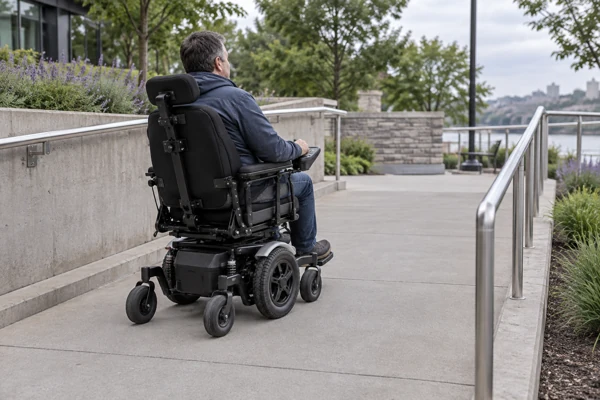
Wheelchair energy consumption changes with the route and operating pattern.
Important variables can include:
- User, chair and cargo mass
- Ramps and longitudinal slopes
- Surface rolling resistance
- Indoor versus outdoor use
- Repeated starts and stops
- Driving speed
- Tire condition
- Powered seating or other accessories
- Temperature
- Battery condition
Peer-reviewed electric-wheelchair research has used representative power and drive cycles across flat surfaces, longitudinal slopes and cross-slopes to estimate energy demand. In that study, uphill longitudinal slopes produced substantially higher mean power demand than flat operation. [4]
For battery sizing, the useful conclusion is:
Range should be evaluated against a representative wheelchair drive cycle, not a single idealized flat-floor condition.
Motor Rated Power Is Not the Same as Battery Energy Demand
Motor nameplate power is also not enough to calculate battery capacity.
Three different electrical quantities matter:
Average energy demand
Determines daily Wh consumption and therefore range.
Continuous power
Determines whether the pack can support sustained propulsion such as longer ramps.
Peak current / power
Determines whether the pack can support short high-torque events such as starting, acceleration, low-speed maneuvering or ramp entry.
A simplified loaded-voltage relationship is:
Vload ≈ VOC − I × Rtotal
where Rtotal includes more than the cells. It can include:
Cells → Interconnections → BMS → Cable → Connector → Controller
If the current rises and loaded voltage falls below the controller’s operating threshold, the wheelchair may experience reduced performance, undervoltage protection or shutdown even when substantial nominal capacity remains.
This is why an electric wheelchair battery pack specification should include both:
daily energy requirement
and
continuous / peak current requirement
when specifying an electric wheelchair battery pack.
2. How Should Battery Weight, Chemistry and Pack Architecture Be Balanced?
An electric wheelchair battery pack should provide enough usable energy without creating unnecessary mass, volume or integration complexity.
For folding and transportable wheelchairs in particular, battery weight is not only a range variable. It is part of the product’s portability architecture.
Battery Weight Is a Portability Constraint
Increasing battery energy generally requires more active material and therefore tends to increase pack mass and volume.
That can affect:
- Folding and lifting
- Vehicle transport
- Removable-pack handling
- Battery-compartment dimensions
- Mechanical mounting
- User or caregiver handling
The important engineering nuance is that a heavier battery does not automatically mean a dramatic loss of driving range.
Its propulsion impact depends on the complete wheelchair, user load, route and drive cycle.
For compact chairs, the more immediate question is often:
Can the required battery energy be packaged in a mass that is practical to remove, carry and integrate into the chair?
This is why maximizing battery capacity is not automatically the best product decision.
24V-Class Systems Are Common—but Voltage Must Follow the Controller
A 24V-class electric wheelchair battery pack architecture is common in powered mobility products, but it should not be treated as a universal wheelchair standard.
LONGSING Website B currently offers a 22.2V / 24V Battery Packs category for mobility and other rechargeable applications. Its published material describes a typical 6S lithium-ion architecture around 22.2 V nominal and approximately 25.2 V fully charged, while also noting that actual cutoff depends on the protection design.
That is one architecture—not a universal electric-wheelchair specification.
An OEM should provide:
- Nominal pack voltage
- Maximum charged voltage
- Minimum operating voltage
- Controller voltage window
- Undervoltage threshold
- Charger voltage
rather than simply specifying:
“24V battery.”
Changing chemistry can also change these voltage relationships.
NMC vs LiFePO₄ Is a System-Level Trade-Off
NMC and LiFePO₄ can both be relevant to rechargeable mobility systems, but they should not be ranked with a simple “better / worse” conclusion.
The U.S. Department of Energy describes NMC and LFP as major lithium-ion chemistries with different strengths, highlighting NMC’s energy-density advantage and LFP’s safety characteristics as important distinctions. [5]
For electric-wheelchair development, the practical comparison is:
| Battery Direction | Potential Advantage | Main Trade-Off to Evaluate |
|---|---|---|
| NMC / higher-energy Li-ion | Higher specific energy can help reduce pack mass and volume for a defined Wh target | Lifecycle, thermal behavior, power capability and protection still depend on the selected cell and pack |
| LiFePO₄ | Can be attractive when lifecycle and thermal-stability priorities carry greater weight | Lower specific energy may require more mass or volume for the same energy target |
| Other Li-ion architectures | May better fit specific voltage, geometry or power requirements | Must be evaluated against the complete wheelchair system |
This is particularly relevant for folding and travel chairs, where a few kilograms of removable battery mass can materially affect handling.
But chemistry selection is also an electrical decision.
Changing chemistry may change:
- Nominal cell voltage
- Series count
- Maximum pack voltage
- Discharge curve
- Charger requirements
- BMS thresholds
- SOC model
So:
NMC vs LiFePO₄ is a pack-architecture decision as well as a chemistry decision.
18650 vs 21700 Is a Pack-Level Question
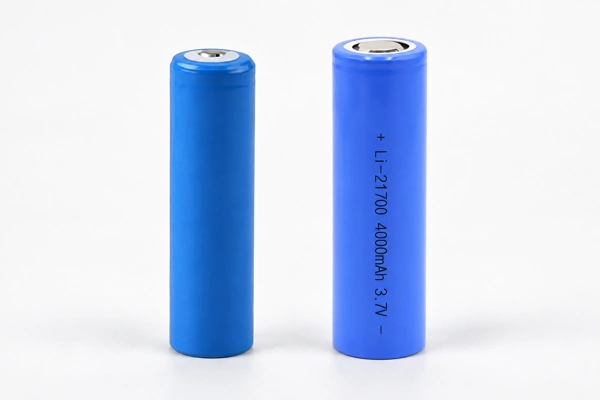
18650 and 21700 cells can both be used in custom lithium-ion pack development.
LONGSING’s current Website B product structure includes both 18650 batteries and 21700 batteries for custom rechargeable applications.
For a wheelchair pack:
18650 cells can provide:
- Smaller physical cell size
- Fine layout flexibility
- Flexible series / parallel packaging
21700 cells can potentially provide:
- More energy per physical cell, depending on model
- Fewer physical cells for a defined energy target
But a 21700 architecture does not automatically guarantee:
- Lower pack mass
- Better range
- Better lifecycle
- Simpler BMS
- Better thermal performance
These outcomes depend on the actual cell and pack design.
LONGSING’s existing 18650 vs 21700 vs Prismatic Cells article already covers the broader format trade-offs, so this wheelchair article should only use cell format as a supporting design decision rather than repeating that comparison.
Removable Batteries Change Both Mechanical and Electrical Design
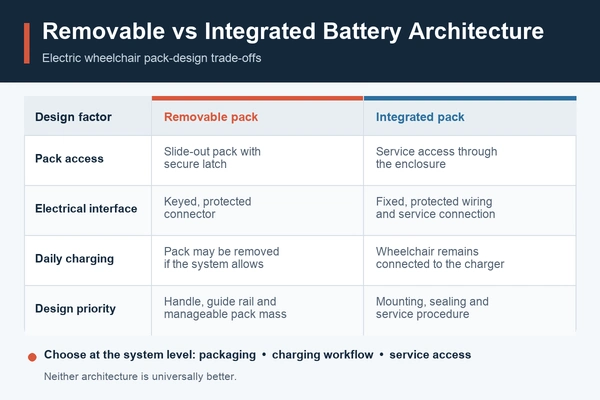
A removable electric wheelchair battery can serve several different purposes.
It may allow:
- Off-board charging
- Easier chair lifting or transport
- Battery removal before folding
- Spare-pack rotation
- Reduced charging downtime
But a removable pack also introduces new design requirements:
- Connector durability
- Mechanical latching
- Pack retention
- Short-circuit protection
- Pack identification where required
- Safe insertion and removal
- Off-board charger compatibility
This is why:
A removable wheelchair battery is a mechanical and electrical architecture—not simply a convenience feature.
For travel-oriented products, removability can also influence transport requirements, discussed later in this article.
3. How Should Daily Charging, BMS and SOC Be Designed?
An electric wheelchair battery pack should not be sized only for the longest theoretical distance the wheelchair might ever travel.
For many users and operating environments, the more useful question is:
How much energy does the chair need between realistic charging opportunities?
This is where range, battery mass and charging strategy come together.
Size the Pack Around Daily Energy, Not Maximum Possible Range
A practical first-order model is:
Daily Required Energy ≈ Daily Distance × Representative Wh/km + Accessory Energy
Then:
Required Pack Energy = Daily Energy + Reserve + Aging Margin
The reserve may need to cover:
- Route variation
- Unexpected additional travel
- Cold-weather performance reduction
- Battery aging
- Operational margin before low-SOC shutdown
The correct reserve is application specific.
It should not simply be added as a generic percentage without system validation.
Smaller and Larger Packs Create Different Charging Trade-Offs
The battery capacity that best fits a wheelchair is not always the maximum capacity that can physically fit.
| Design Direction | Potential Benefit | Main Trade-Off |
|---|---|---|
| Smaller pack | Lower mass, easier removal, potentially shorter charging time at the same charger power | Less reserve, potentially deeper daily cycling, greater dependence on reliable charging access |
| Larger pack | More reserve and potentially longer daily range | Higher mass, larger enclosure, potentially longer charging time at the same charger power |
| Spare removable pack | Can reduce charging downtime and increase availability | Adds cost, connector cycles, spare-pack logistics and pack-management requirements |
The correct choice depends on the expected daily route and charging opportunity.
Daily Charging Does Not Mean One Universal SOC Rule
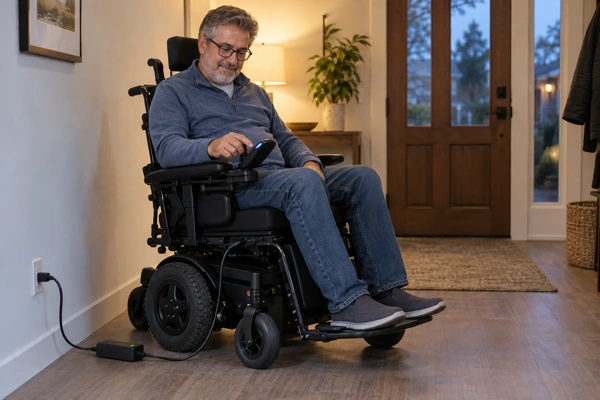
Lithium-ion battery aging is influenced by several operating variables, including:
- Temperature
- Charge / discharge C-rate
- Depth of discharge
- State of charge
A 2025 review in the Journal of Energy Storage identifies all four as important external contributors to lithium-ion aging. [6]
But an electric wheelchair is not only a battery-aging experiment.
It is a mobility system that must be ready when required.
For that reason, it would be inappropriate to recommend one universal rule such as:
“Always stop charging at 80%.”
The more useful OEM requirement is:
Charging strategy should balance daily availability, reserve, charge time and lifecycle targets within the selected cell manufacturer’s operating limits.
Charger Compatibility Is More Than Connector Shape
A charger should not be considered compatible simply because its connector fits the pack.
The charging architecture should match:
- Battery chemistry
- Series configuration
- Maximum pack voltage
- Charging algorithm
- Charge current
- Battery temperature limits
- BMS behavior
- Communication or pack identification where required
This becomes especially important when converting a wheelchair platform from another battery chemistry.
A nominally “24V” battery system can have a different full-charge voltage and charge profile depending on chemistry and series architecture.
So:
Do not replace one nominally 24V battery with another nominally 24V pack without verifying the controller and charger voltage architecture.
The BMS Should Match the Wheelchair Power System
A lithium-ion wheelchair battery may require BMS functions such as:
- Cell overvoltage protection
- Cell undervoltage protection
- Overcurrent protection
- Short-circuit protection
- Temperature monitoring
- Cell balancing
- Pack-current measurement
- SOC estimation
- Fault reporting
- Charge / discharge control
The BMS should be designed around the actual:
Battery ↔ Controller ↔ Motors ↔ Charger
system.
Overcurrent thresholds, for example, should leave appropriate margin for legitimate motor events while still providing the required protection.
There is no need to force an industrial communication bus into every wheelchair design.
Communication requirements should follow the controller and charger architecture.
SOC Accuracy Is an Availability Requirement
State-of-charge information is particularly important in a mobility application because it influences how much range the user or operator believes remains.
SOC overestimation can make the remaining mobility range appear larger than the practically available energy.
SOC underestimation can leave useful energy unused.
Analog Devices’ fuel-gauge characterization guidance recommends evaluating cells under heavy, medium and light loads across cold, room and hot temperatures in order to understand battery behavior in the real application. [7]
For an electric wheelchair, SOC validation should therefore consider:
- Real propulsion loads
- Stop-start operation
- Lower and higher temperatures
- Battery aging
- Near-empty operation
rather than relying only on a room-temperature discharge curve.
4. What Should OEMs Specify Before Developing a Custom Electric Wheelchair Battery Pack?
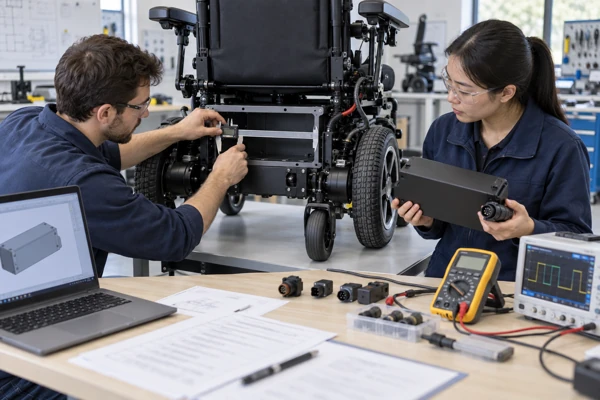
A useful electric wheelchair battery pack RFQ should describe the complete wheelchair system rather than begin with a preferred battery cell.
For example:
“We need a 24V 21700 wheelchair battery.”
is not yet enough information to determine the correct pack.
Electrical Requirements
Provide:
- Nominal system voltage
- Maximum battery voltage
- Minimum controller voltage
- Continuous current
- Peak current
- Peak duration
- Controller undervoltage threshold
- Charger voltage and power
These parameters define the electrical architecture before chemistry or cell format is finalized.
Range and Daily-Use Requirements
Provide:
- Target daily travel distance
- Representative drive cycle
- Indoor / outdoor usage split
- Typical route speed
- Ramp and incline conditions
- User + wheelchair + cargo mass
- Powered seating or accessory loads
- End-of-day reserve requirement
Where possible, provide measured:
Wh/km
or:
power-versus-time / current-versus-time data
from a prototype.
This is much more useful than specifying a brochure range alone.
Mechanical and Portability Requirements
Provide:
- Maximum pack length
- Width
- Height
- Maximum battery mass
- Battery installation position
- Fixed or removable architecture
- Folding / lifting constraints
- Connector orientation
- Wiring and cable requirements
- Enclosure requirements
For a folding wheelchair, battery weight and battery removal workflow may be as important as the nominal energy rating.
Charging Requirements
Define:
- Charging input
- Charger output voltage
- Charger power
- Target charge time
- Typical overnight charging window
- Off-board charging requirement
- Spare-battery strategy
- Charging temperature range
- Whether operation while charging is allowed
This information helps determine whether the proposed pack fits the daily operating workflow.
BMS and SOC Requirements
Specify:
- Protection functions
- Balancing requirement
- SOC display requirement
- SOH requirement where applicable
- Fault reporting
- Controller communication
- Charger communication
- Pack identification where required
The battery-management architecture should match the chair rather than being added as a generic “smart BMS.”
Compliance and Travel Requirements
Powered-wheelchair battery compliance has several different layers.
ISO 7176-4:2008 addresses energy consumption and theoretical distance range for electrically powered wheelchairs and scooters. The standard was reconfirmed in 2023. [1]
ISO 7176-14:2022 addresses power and control systems for electrically powered wheelchairs and scooters, including safety and performance under normal operation and certain fault or abuse conditions. [3]
Most importantly for this article, ISO 7176-31:2023 specifically covers lithium-ion batteries, battery systems and charging systems intended for electrically powered wheelchairs. [2]
Transport requirements are separate.
The 2026 IATA mobility-aid guidance states that lithium batteries used to power wheelchairs and mobility aids must meet the applicable tests in UN Manual of Tests and Criteria, Part III, subsection 38.3. It also contains specific requirements for removed and spare lithium batteries and current 300 Wh conditions in air-transport scenarios. [8]
That 300 Wh threshold should not be treated as:
the maximum size of every wheelchair battery.
It applies in specific air-transport contexts. Installed wheelchair battery systems may use different energy capacities, and airline or jurisdiction-specific requirements should be confirmed for the target travel use case.
Electric Wheelchair Battery Pack RFQ Checklist
| OEM Input | Why It Matters |
|---|---|
| Nominal / maximum / minimum voltage | Defines controller and charger compatibility |
| Daily distance target | Establishes practical mobility-energy requirement |
| Measured or estimated Wh/km | Converts usable battery energy into expected range |
| User + chair + cargo mass | Influences drive-cycle energy consumption |
| Slope / ramp profile | Influences propulsion power and energy demand |
| Continuous current | Defines sustained battery capability |
| Peak current + duration | Defines transient voltage and BMS requirements |
| Battery mass limit | Affects portability and removable-pack handling |
| Battery dimensions | Determines feasible cell and pack architecture |
| Fixed / removable design | Changes connector, handling and charging requirements |
| Charge time / charging window | Helps determine charger power and battery size |
| SOC requirement | Defines fuel-gauge and remaining-range requirements |
| Temperature profile | Affects usable energy, power and aging |
| Travel requirement | May affect Wh architecture and transport documentation |
| Target markets | Determines standards and regulatory work |
Where LONGSING Fits
LONGSING Website B currently provides several rechargeable battery directions relevant to custom electric-wheelchair development.
Its 22.2V / 24V Battery Packs range supports mobility applications and customized voltage, capacity, pack structure, enclosure and BMS configurations.
Its 18650 and 21700 product families provide cylindrical lithium-ion cell options for custom pack architecture.
Website B also provides battery-pack engineering content on 18650 vs 21700 vs prismatic architectures and battery cell matching, which can support pack-level cell-format and production-consistency decisions without repeating those subjects in this article.
These product directions should be treated as candidate development platforms, not as evidence that one predefined LONGSING wheelchair battery is appropriate for every project.
A practical OEM development sequence is:
Wheelchair Voltage Window
↓
Representative Drive Cycle
↓
Wh/km Measurement
↓
Daily Mobility Requirement
↓
Required Usable Wh + Reserve
↓
Battery Mass / Volume Target
↓
Chemistry + Cell-Format Evaluation
↓
Continuous + Peak Current Validation
↓
Fixed / Removable Pack Design
↓
BMS + SOC Integration
↓
Charger Compatibility
↓
ISO / Transport Validation
The wheelchair’s real daily mobility requirement should define the battery—not the largest Ah value that fits the enclosure.
Conclusion
A well-designed electric wheelchair battery pack is not defined by Ah alone.
OEMs need to translate real wheelchair energy consumption into usable Wh, then balance that energy requirement against battery mass, packaging, motor-current demand and the available daily charging window.
Chemistry, cell format, BMS, SOC accuracy, charger compatibility and removable-pack design all influence the final architecture.
For electric wheelchairs, range, weight and daily charging should be engineered together.
Developing an Electric Wheelchair or Powered Mobility Platform?
For a meaningful electric wheelchair battery pack evaluation, prepare:
- Nominal, maximum and minimum system voltage
- Continuous and peak current
- Peak-current duration
- Representative Wh/km or drive-cycle data
- Daily distance target
- User + wheelchair + cargo mass
- Ramp / incline requirements
- Target usable energy
- Maximum acceptable battery mass
- Available battery dimensions
- Fixed or removable battery architecture
- Charging voltage and target charging time
- Temperature requirements
- BMS and SOC requirements
- Connector and communication requirements
- Travel / airline requirement where applicable
- Target markets and compliance requirements
These inputs allow the cell chemistry, pack architecture, BMS, charging strategy and mechanical design to be evaluated against the actual wheelchair platform.
Frequently Asked Questions About Electric Wheelchair Battery Packs
Click to explore more information about electric wheelchair battery packs
Q: What type of battery is used in electric wheelchairs?
Electric wheelchairs can use different rechargeable battery technologies depending on the platform. Lithium-ion systems such as NMC or LiFePO₄ can be considered where weight, energy, lifecycle, charging and packaging requirements support them. The correct chemistry should be selected from the complete wheelchair electrical and mechanical architecture rather than from the application name alone.
Q: How do you calculate electric wheelchair battery range?
Start with usable battery energy in Wh, then divide it by the wheelchair’s representative energy consumption per distance, such as Wh/km. Actual range is affected by user and chair mass, terrain, ramps, speed, stop-start driving, temperature, battery aging and powered accessories. ISO 7176-4 provides a standardized methodology for theoretical range determination. [1]
Q: Is a 24V lithium battery suitable for an electric wheelchair?
A 24V-class lithium architecture can be suitable for some electric wheelchairs, but 24V is not a universal requirement. The battery’s nominal voltage, full-charge voltage and minimum voltage must match the wheelchair controller and charger. Chemistry and series configuration also affect the actual voltage window.
Q: Which is better for a wheelchair battery: NMC or LiFePO₄?
There is no universal winner. NMC can be attractive when specific energy and lower pack mass are important, while LiFePO₄ can be attractive where lifecycle and thermal-stability priorities carry greater weight. The final choice should also consider voltage architecture, charger compatibility, pack volume, current demand and BMS requirements.
Q: Does a larger wheelchair battery always provide more range?
A larger battery generally provides more stored energy if voltage and chemistry remain comparable, but real-world range does not increase in a perfectly fixed ratio. Usable energy, chair efficiency, route conditions, total mass, temperature, battery aging and accessory loads all affect the distance obtained from that energy.
Q: Why does battery weight matter in a folding electric wheelchair?
Battery weight affects lifting, folding, transport and removable-pack handling. In a compact wheelchair, battery mass may therefore be a portability constraint as much as an energy-system parameter. The correct pack should provide sufficient daily usable energy without making the product unnecessarily difficult to handle.
Q: Why does an electric wheelchair battery need a BMS?
A lithium-ion wheelchair battery may require cell-voltage protection, overcurrent and short-circuit protection, temperature monitoring, balancing, current measurement and charge/discharge control. Depending on the product, the BMS may also support SOC estimation, fault reporting and communication with the wheelchair controller or charger.
Q: What information should an OEM provide for a custom electric wheelchair battery pack?
Provide the voltage window, continuous and peak current, daily distance, representative Wh/km or drive cycle, user and chair mass, slope requirements, battery-space limits, maximum battery mass, fixed or removable architecture, charging requirements, temperature conditions, BMS and SOC requirements, connector details and target-market compliance requirements.