
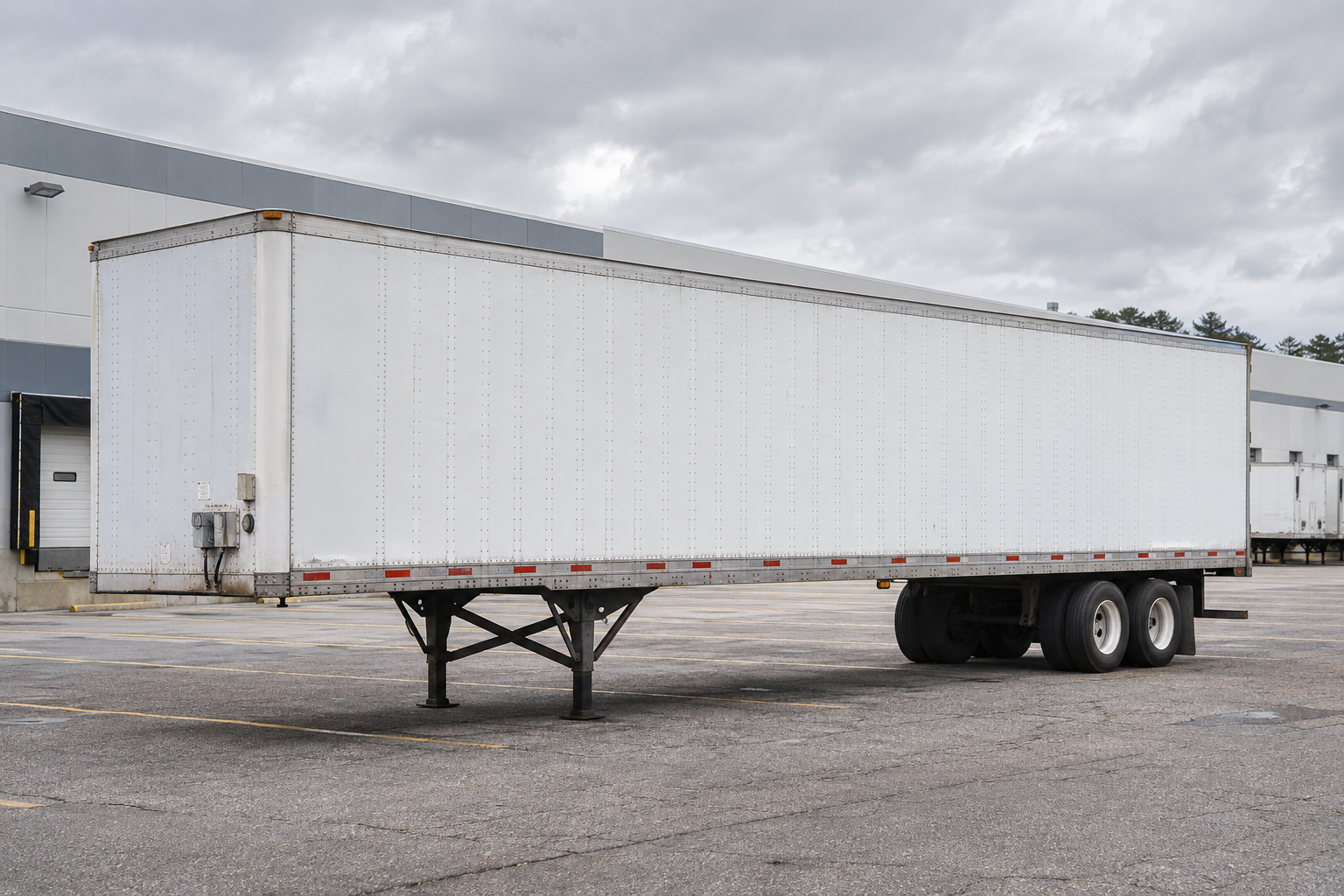
A freight trailer may sit in a logistics yard for days before being collected by the next truck. During that time, its tracking device still needs to report location, detect movement and send alerts when necessary. Yet the trailer may have no connection to a vehicle power supply.
A small solar panel helps reduce the need for battery replacement or manual recharging. The difficulty comes when the trailer is parked under a loading-bay roof, inside a warehouse or outdoors through several cloudy days.
The GPS tracker still needs power, even when the panel is producing very little.
For equipment manufacturers, choosing a solar GPS tracker battery involves several connected decisions: how much energy the tracker consumes, how much sunlight the installation can realistically collect, and how the rechargeable lithium battery behaves during communication peaks and changing temperatures.
The battery also has to fit inside a compact outdoor enclosure, often with limited room for wiring, protection electronics and mechanical support.
Featured Snippet: How Do You Select a Solar GPS Tracker Battery?
A solar GPS tracker battery should be selected from measured daily energy consumption, expected solar input, required days without sunlight, peak communication current and operating temperature. Battery chemistry, usable capacity, charging control and protection must be checked together with the tracker electronics and enclosure before production.
Table of Contents
- How Does a Solar GPS Tracker Use Battery Power?
- How Much Battery Capacity Does a Solar GPS Tracker Need?
- Which Rechargeable Lithium Battery Is Suitable for Solar Tracking?
- How Should Solar Charging and Battery Protection Be Designed?
- What Matters for Trailer and Logistics Tracking?
- What Should OEMs Specify for a Custom Tracker Battery?
1. How Does a Solar GPS Tracker Use Battery Power?
A solar-powered GPS tracker combines energy harvesting, battery storage and low-power electronics. The solar panel collects energy when sunlight is available. The rechargeable battery stores that energy and supplies the device when solar output falls.
This arrangement is particularly useful for unpowered trailers, mobile equipment and other assets that cannot depend on a continuous electrical connection.
Solar Panel, Battery and Tracking Electronics
A simplified tracker power system consists of:
Solar Panel → Solar Charge Management → Rechargeable Lithium Battery → Power Regulation → GNSS / MCU / Communication Modules
Some designs include power-path management, allowing harvested energy to supply the electronics while the battery is charging.
The available panel power changes with sunlight, orientation and shading. The battery supplies the difference whenever harvested power is below the device load. During darkness, it may provide the entire operating energy.
The solar panel and battery therefore need to be sized as parts of the same power system. 【1】
Increasing battery capacity can extend operation without sunlight. It cannot solve an installation that consistently consumes more energy than the panel collects.
Why GPS and Cellular Modules Create Different Loads
A tracker is usually asleep for much of its operating time.
When movement is detected or a scheduled reporting interval arrives, the controller wakes, obtains a position and sends the relevant data.
The operating sequence might look like this:
Deep Sleep → Motion Detection → GNSS Acquisition → Network Connection → Data Upload → Return to Sleep
Each stage draws a different amount of power.
| Operating state | Battery requirement |
|---|---|
| Deep sleep | Low standby consumption |
| Motion detection | Sensor and controller wake-up energy |
| GNSS acquisition | Positioning current and acquisition time |
| Cellular transmission | Short current peaks and stable supply voltage |
| Alarm reporting | Additional energy outside scheduled reporting |
| No useful sunlight | Sufficient stored energy for continued operation |
The communication technology also matters. LTE-M, NB-IoT, LTE Cat 1 and LoRaWAN do not have identical current profiles or connection behavior.
A tracker that sends one report per day may consume substantially less energy than one that uploads frequent location updates. Poor network coverage can also increase power consumption through longer registration periods or repeated transmissions.
These differences should be measured on the intended device rather than estimated from battery capacity alone.
What Happens When the Trailer Is Parked Without Sunlight?

Consider a trailer that remains beneath a loading-bay roof for five days.
The panel may receive little useful light, but the tracker continues its scheduled reports. If the remaining battery energy cannot cover the load, the device will eventually reach its low-voltage limit.
This operating period is known as battery autonomy.
The practical question is how many days the tracker must work with little or no effective solar charging, while still retaining enough power to send important alerts.
That requirement leads directly to battery sizing.
2. How Much Battery Capacity Does a Solar GPS Tracker Need?
A solar GPS tracker battery should be sized from energy consumption, not from an arbitrary mAh figure.
A 5,000mAh battery may be excessive for one tracking device and inadequate for another. Voltage, reporting frequency, communication conditions, usable capacity and power-conversion efficiency all affect the result.
Calculate the Daily Energy Budget
The first step is to measure the tracker through a representative 24-hour operating cycle.
Measurements should include sleep current, wake-up events, positioning, network registration, transmission, sensors and power-management losses.
The daily energy requirement can be expressed as:
Daily Energy (Wh/day) = Sum of Power (W) × Operating Time (h) for all operating states
For a device with changing reporting behavior, engineers should measure more than one operating mode.
A parked trailer may report infrequently, while a moving trailer may send updates more often. Weak-signal operation and repeated alarms also need consideration.
Average energy consumption determines the storage requirement. Peak current is a separate electrical limit that must be verified later. 【2】
Estimate the Solar Energy Available
Solar panel wattage is normally specified under standard test conditions. The energy collected on a real trailer may be lower because of orientation, shading, temperature and contamination.
For an initial estimate:
Daily Solar Energy (Wh/day) ≈ Panel Rated Power (W) × Effective Peak Sun Hours (h/day) × Derating Factor
The derating factor represents the relevant environmental and electrical losses.
This calculation can help compare panel options, but it does not replace field measurements.
A horizontally mounted panel and a panel fitted vertically to the front of a trailer may collect very different amounts of energy, even if both have the same rated wattage.
The least favorable operating season is particularly important. Designing around average summer sunlight may leave insufficient charging energy in winter.
Size the Battery for Days Without Useful Sunlight
For an initial battery estimate:
Required Delivered Energy (Wh) = Daily Energy Consumption × Required Autonomy Days
The nominal cell or pack energy must then account for the usable state-of-charge range, conversion losses, temperature and battery aging.
Consider a hypothetical engineering example:
| Design input | Assumption |
|---|---|
| Daily tracker energy consumption | 1.2 Wh |
| Required operation without solar charging | 7 days |
| Usable battery energy fraction | 70% |
| Battery-to-load conversion efficiency | 90% |
The tracker requires:
1.2 Wh/day × 7 days = 8.4 Wh
The estimated nominal battery energy is:
8.4 Wh ÷ (0.70 × 0.90) ≈ 13.3 Wh
At an assumed nominal cell voltage of 3.7V, this corresponds to approximately 3.6Ah.
These figures illustrate the calculation method; they are not measurements from a LONGSING customer project or a recommended universal capacity.
The final design needs additional checks for the selected cell’s voltage range, low-temperature performance, current capability and end-of-life energy.
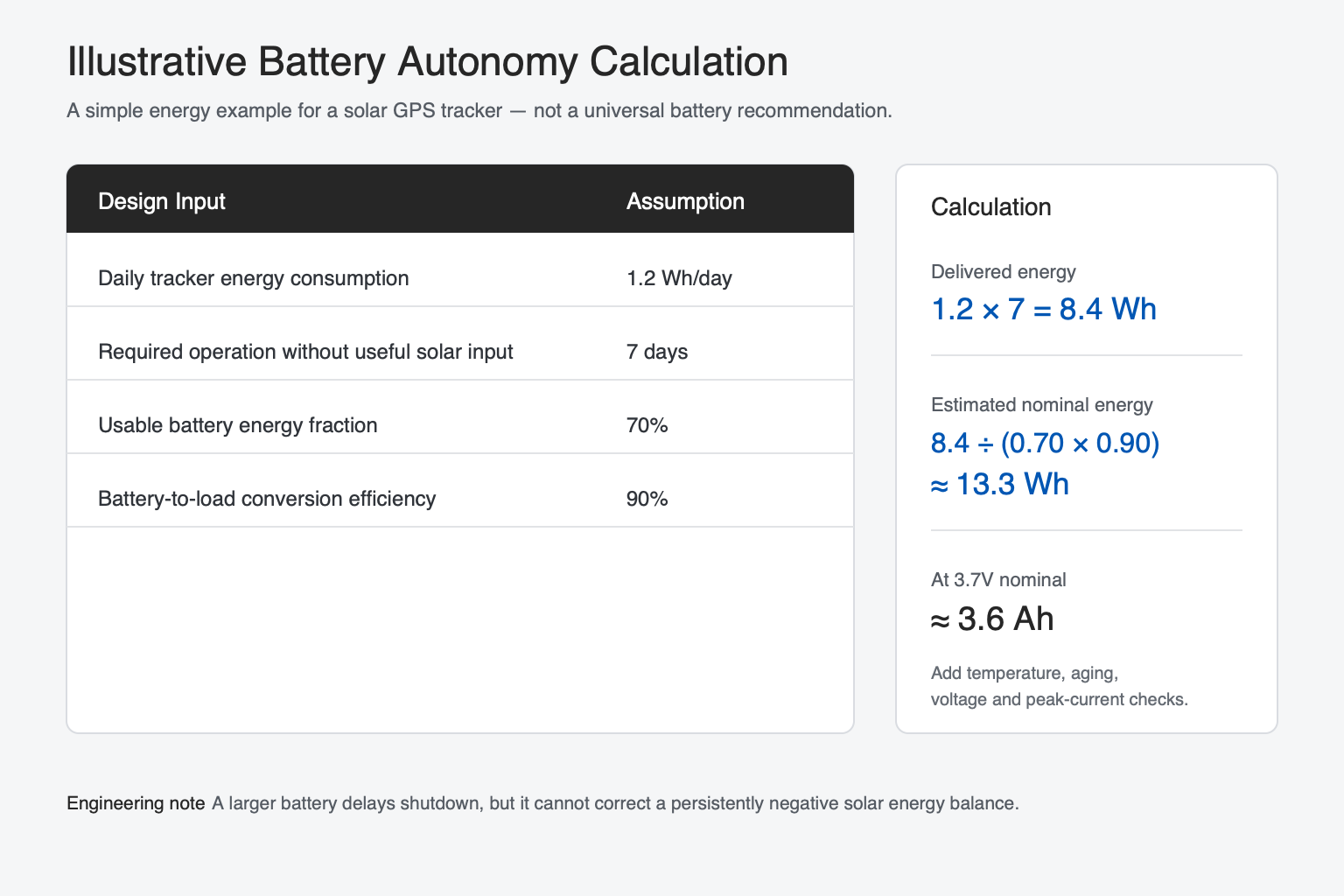
Engineers must also confirm that the solar panel can restore the energy consumed during periods of poor sunlight. 【3】
A larger battery can delay a shutdown, but a persistently negative solar energy balance will eventually discharge it.
3. Which Rechargeable Lithium Battery Is Suitable for Solar Tracking?
Rechargeable lithium batteries are commonly considered for solar-assisted tracking equipment because they can store useful energy in a relatively compact package.
The correct choice depends on enclosure geometry, voltage, charging conditions and the expected operating profile.
Li-ion, Li-polymer and LiFePO4
Different rechargeable lithium options bring different trade-offs.
| Battery option | Potential advantages | Design considerations |
|---|---|---|
| Conventional Li-ion | Established supply options and relatively high energy density | Cell dimensions, current limits and charging temperature |
| Li-polymer pouch | Thin packaging and flexible footprint | Mechanical restraint, swelling allowance and cell protection |
| LiFePO4 | Thermal stability characteristics and cycle-life potential | Lower nominal voltage, energy density and charger compatibility |
Li-polymer is commonly used to describe pouch-format rechargeable lithium batteries. It does not necessarily represent a completely separate cathode chemistry from other lithium-ion cells.
For a small tracking device, the physical dimensions may be just as important as chemistry.
A thin tracker mounted on the outside of a container may suit a pouch cell. A cylindrical housing or thicker electronics enclosure may accommodate a single 18650 or another cylindrical format.
LiFePO4 can be considered where its electrical and service-life characteristics fit the system, but it should not be selected solely because the tracker uses solar charging.
18650, 21700 or a Custom Pouch Cell?
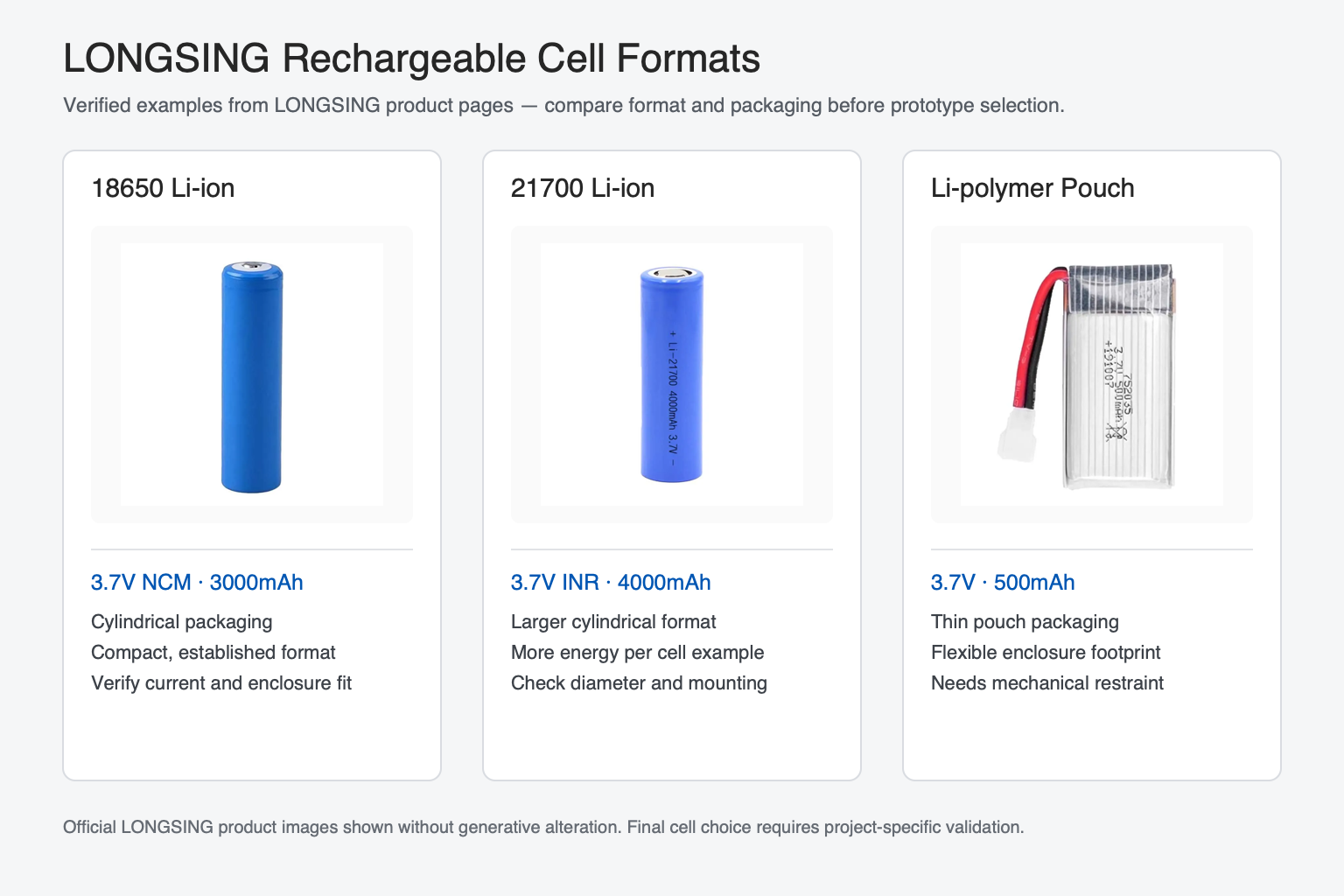
LONGSING provides several rechargeable cell formats that can be evaluated for compact OEM electronics.
Its 18650 lithium-ion battery range offers cylindrical cells for applications where dimensions, energy and current requirements match the selected model.
The 21700 battery range provides a larger cylindrical format, which may offer more energy per cell depending on the specific product.
For thinner enclosures, LONGSING also has industrial Li-polymer battery options.
A larger cell is not automatically a better solution.
A 21700 cell may provide sufficient energy with fewer cells, but its diameter can make installation difficult inside a narrow tracking enclosure. A smaller cylindrical cell may allow a more practical mechanical layout.
Pouch cells offer packaging flexibility, although additional support may be required to protect them from compression and movement.
For more detail on format selection, see LONGSING’s 18650 vs 21700 vs Prismatic Cells comparison.
Battery Capacity Is Not the Same as Peak Current Capability
A tracker can have enough battery energy for several days of operation and still restart during a cellular transmission.
The cause may be excessive voltage drop under load.
Battery internal resistance, connectors, wiring and protection circuitry all contribute to voltage sag. The effect can become more severe when the battery is cold, aged or nearly discharged.
If the modem supply voltage falls below its operating threshold, the communication attempt may fail even though some energy remains in the battery. 【4】
This is why an OEM should provide the battery supplier with the peak current, pulse duration and minimum acceptable system voltage.
The selected cell and protection circuit need to be tested under the actual communication profile. Increasing nominal capacity without checking voltage sag may leave the problem unresolved.
4. How Should Solar Charging and Battery Protection Be Designed?
A solar charging circuit must handle a changing power source while keeping the rechargeable battery within its approved charging limits.
Connecting a photovoltaic panel directly to an ordinary lithium cell without suitable charging control can create unsafe conditions.
Solar Charging and Power Management
A compact solar tracker may include a charger IC or energy-harvesting power-management circuit.
Depending on the system, charging control may need to handle:
-
Variable solar-panel input voltage and current
-
Battery charging voltage and current limits
-
Charging while the tracker is operating
-
Input-voltage regulation or maximum power point tracking
-
Battery and system temperature
-
Low-input-power and restart behavior
Maximum power point tracking, commonly called MPPT, can help extract energy under changing panel conditions. However, a full MPPT arrangement is not necessary for every small solar-powered device.
The charger should be chosen according to the actual panel characteristics, selected battery chemistry and electronic load.
The system also needs to avoid wasting excessive energy in its own power-management electronics during long sleep periods.
What Happens to Solar Charging in Winter?
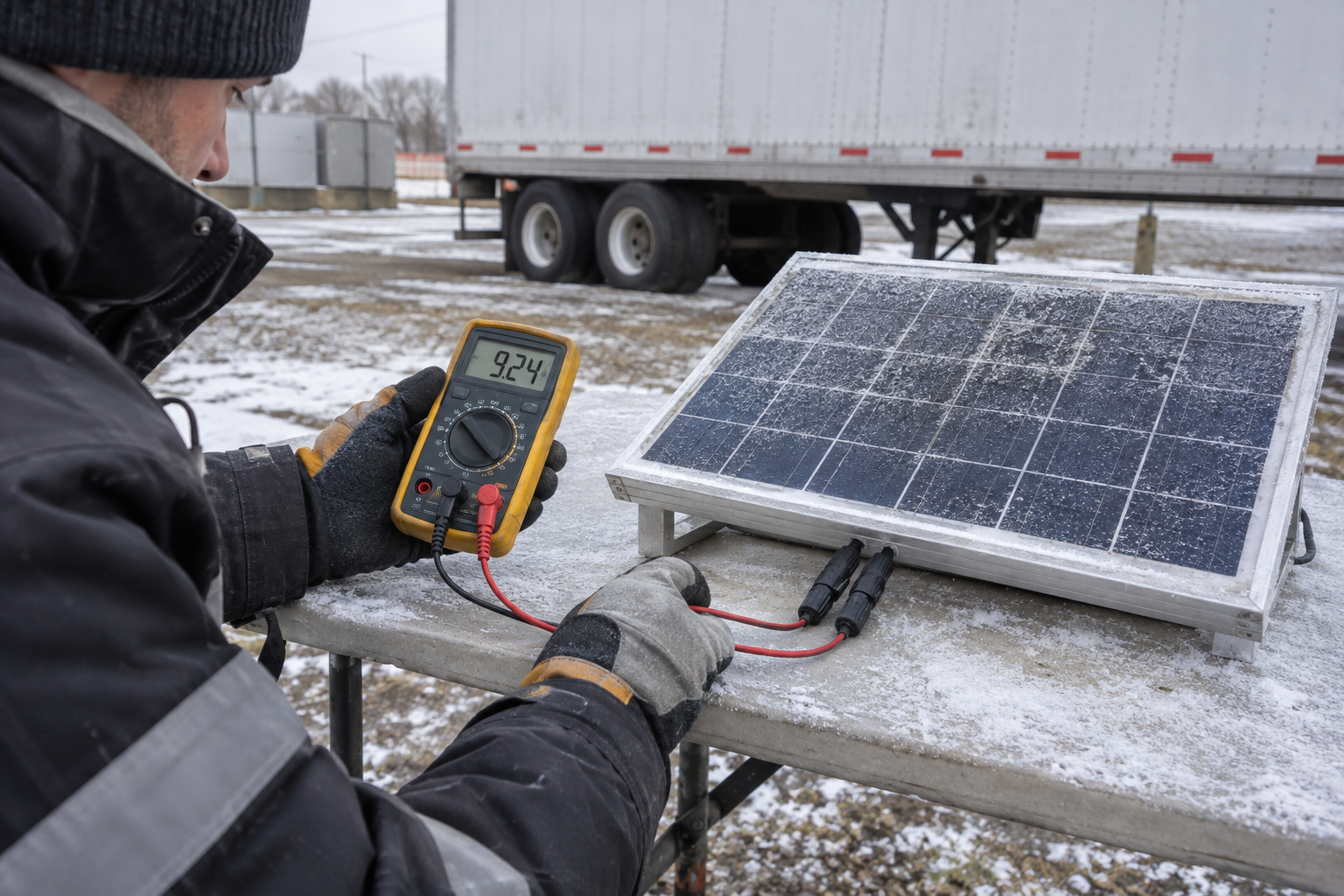
A common design mistake is assuming that a rechargeable battery can be charged whenever the panel produces electricity.
For many conventional lithium-ion cells, charging at or below freezing is restricted unless the specific cell and charging method are approved for those conditions.
A tracker may therefore continue operating from its battery during a cold morning while charging remains suspended.
A suitable design can use a battery thermistor or other temperature-monitoring method to reduce or stop charging outside the permitted range.
The charging temperature threshold must follow the selected cell specifications.
LiFePO4 also requires appropriate low-temperature charging control; its thermal characteristics do not remove this requirement. 【5】
For trackers installed on outdoor trailers, charging and discharging temperature limits should be treated separately.
Protection Circuit, BMS and Battery Aging
Battery protection and battery charging are different functions.
A single-cell tracker may use a compact protection PCB alongside its charging and power-management circuit. Larger or more complex battery packs may require additional BMS functions.
Depending on the design, protection can include overcharge, over-discharge, overcurrent, short-circuit and temperature protection.
Protection thresholds need to be coordinated with the electronics. If the battery disconnects at a voltage above the tracker’s intended low-power shutdown point, the firmware may not have an opportunity to complete a final report.
Outdoor heat is another concern.
A tracker mounted on a sun-exposed metal trailer can become considerably hotter than the surrounding air. Elevated temperature and prolonged time at high state of charge can accelerate battery aging.
Battery service life should therefore be assessed from the real temperature and charging profile, not assumed from the expected life of the solar panel.
5. What Matters for Trailer and Logistics Tracking?
A solar rechargeable tracker that works well on the test bench may behave differently after installation on a commercial trailer.
The mounting position, parking pattern, network coverage and reporting settings all influence the power system.
Trailers and Other Unpowered Logistics Assets
A freight trailer may remain disconnected from its tractor for extended periods. Solar-assisted tracking allows the device to collect energy without depending on a permanent vehicle power connection.
Similar challenges arise with construction equipment, generators, mobile storage assets and some container-monitoring applications.
Their energy requirements are not identical.
A parked trailer may need occasional location confirmation. A high-value asset security device may require immediate alerts following unexpected movement.
The reporting policy changes the battery requirement.
Shading, Network Coverage and Mechanical Exposure
Field conditions introduce problems that are easy to underestimate during early design.
A trailer may spend days in a covered yard. A container may obstruct part of the panel. Dust or snow may reduce sunlight reaching the photovoltaic surface.
Meanwhile, a tracker moving between regions can encounter different cellular coverage conditions.
Long network-registration attempts and repeated data uploads consume additional energy. This can become particularly significant when the battery has already been discharging through several cloudy days.
Mechanical design also matters.
An externally mounted unit may experience vibration, shock, rain, corrosion and sunlight exposure. Battery restraint, connector sealing and cable strain relief should be considered at the complete enclosure level.
A protected battery cell does not make the assembled tracker waterproof. 【6】
Reporting Frequency and Maintenance Planning
Reporting intervals are often configurable, making them a practical way to control energy demand.
For example, a tracker may report less frequently while parked and switch to shorter intervals after movement is detected.
That strategy can reduce unnecessary communication, although the actual saving depends on network behavior and firmware implementation.
For a fleet operator managing hundreds of trailers, fewer battery-service visits can be commercially valuable.
Solar charging may reduce those visits, but it does not eliminate battery aging, enclosure inspection or other maintenance.
The useful performance target is a realistic service interval under the intended deployment conditions.
6. What Should OEMs Specify for a Custom Tracker Battery?
A custom tracker battery project is easier to evaluate when the electrical and mechanical requirements are defined before selecting a cell.
A basic capacity request is rarely enough.
The battery supplier needs to understand the tracker’s actual load, solar charging conditions and the limits imposed by the enclosure.
Battery Specification Checklist
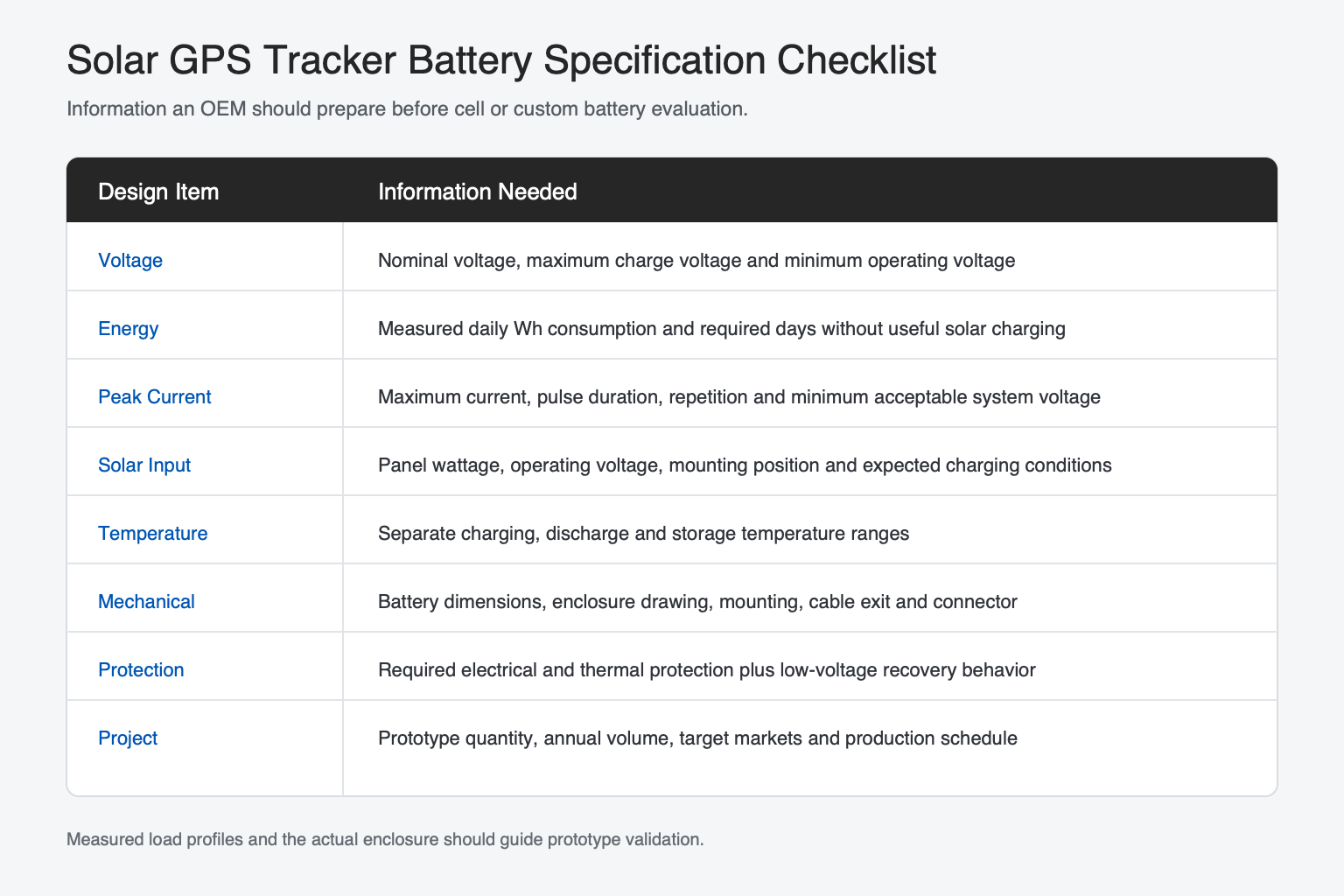
| Design item | Information needed |
|---|---|
| Voltage | Nominal voltage, maximum charge voltage and minimum operating voltage |
| Energy | Daily Wh consumption and required days without solar charging |
| Peak current | Maximum current, pulse duration and repetition |
| Solar input | Panel wattage, operating voltage and expected charging conditions |
| Temperature | Charging, discharge and storage temperature ranges |
| Mechanical | Battery dimensions, weight, mounting and connector |
| Protection | Required electrical and thermal protection functions |
| Service life | Maintenance target and end-of-life capacity assumptions |
| Commercial | Prototype quantity, annual volume, target markets and production schedule |
Measured current profiles are more useful than a capacity estimate based only on the modem datasheet.
If the tracker is still under development, preliminary measurements and clearly identified assumptions can form the starting point for battery evaluation.
Prototype Testing Before Production
Prototype testing should cover the operating conditions most likely to cause problems in the field.
These include:
-
Cellular transmission at low battery state of charge
-
Charging with limited or fluctuating solar input
-
Low-temperature charging control
-
High-temperature storage and operation
-
Low-voltage shutdown and recovery
-
Vibration and connector integrity
-
Repeated reporting under weak network coverage
The tests should use the intended electronics, firmware settings and battery protection configuration.
A cell that passes a standard capacity test may still be unsuitable if it cannot maintain voltage during the tracker’s worst credible communication event.
Where LONGSING Fits
LONGSING supplies rechargeable lithium cells and custom battery pack solutions for OEM applications.
For a compact solar-powered tracking device, the starting point may be a suitable cylindrical cell or industrial Li-polymer battery. A more complex design may require a custom pack with protection circuitry, wiring, connectors and mechanical integration.
LONGSING’s lithium-ion battery pack range provides an overview of available pack solutions.
The battery design should follow the required voltage, measured load profile, enclosure dimensions and charging conditions. No single battery configuration is suitable for every solar tracker.
Review Your Solar GPS Tracker Battery Requirements
For a technical evaluation, provide the tracker voltage, daily power consumption, peak communication current, solar panel specification, required autonomy, battery dimensions, operating temperature and expected production quantity.
This information helps narrow the cell and pack options before prototype development.
Conclusion
A solar GPS tracker battery has two jobs: store the energy collected during useful sunlight and supply the tracking electronics when that energy is unavailable.
Reliable operation depends on matching the battery to the real duty cycle. Daily energy consumption determines the required storage, while communication current peaks, charging conditions and temperature determine whether the selected cell can perform as expected.
For trailer and logistics tracking equipment, mounting position, seasonal sunlight and network behavior also need attention.
LONGSING can evaluate rechargeable lithium cell options and custom battery pack requirements for manufacturers developing solar-powered asset tracking devices.
If you are developing a new tracker or reviewing an existing battery design, contact LONGSING with the electrical, mechanical and environmental requirements for a project-specific discussion.
Frequently Asked Questions About Solar GPS Tracker Batteries
Click to explore more information about solar-powered GPS tracker battery design.
Q: What type of battery is used in a solar GPS tracker?
A: Rechargeable lithium-ion and Li-polymer cells are common options. LiFePO4 can also be considered where its voltage, charging requirements and physical size suit the device. The battery should be selected from the actual energy and current requirements.
Q: Can a solar GPS tracker work without sunlight?
A: Yes. The rechargeable battery supplies the tracker when sunlight is insufficient. The available runtime depends on usable battery energy, reporting frequency, operating temperature and power consumption.
Q: How do you calculate solar GPS tracker battery capacity?
A: Start with measured daily energy consumption and multiply it by the required number of days without useful solar charging. Then allow for usable capacity, conversion losses, temperature and battery aging.
Q: Is a 18650 or 21700 battery better for a GPS tracker?
A: Neither is universally better. A 21700 may provide more energy per cell, while an 18650 may fit a smaller enclosure more easily. Compare the specific cell datasheets, available space, peak current and energy requirement.
Q: Is LiFePO4 suitable for solar-powered trackers?
A: It can be suitable when its nominal voltage, size, energy capacity and charging characteristics match the tracker. Low-temperature charging restrictions still need to be addressed.
Q: Can solar panels charge lithium batteries in winter?
A: They can when sufficient solar energy is available and the battery is within its approved charging temperature range. Many lithium cells require charging to be reduced or stopped at low temperatures.
Q: Does frequent GPS reporting reduce battery life?
A: More frequent reporting generally increases energy consumption because the tracker wakes, obtains positions and communicates more often. The actual effect depends on network conditions, firmware and the reporting schedule.
Q: What information does a battery manufacturer need for a custom solar tracker battery?
A: Provide the operating voltage, measured daily energy use, peak current, solar charging conditions, autonomy requirement, battery dimensions, temperature range, protection requirements and estimated production volume.
References