
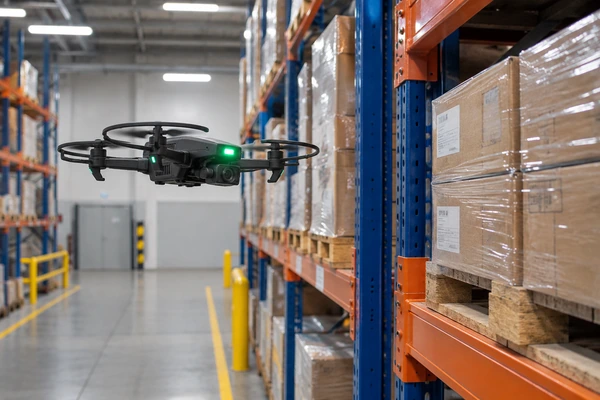
Inventory counting in a large warehouse rarely happens in a single flight. An autonomous drone may inspect several aisles, return to its dock, recharge and continue with another route later in the evening. If charging takes longer than expected or battery voltage drops prematurely, part of the scheduled inventory work may remain unfinished.
In November 2026, Corvus Robotics reported that ASICS America was running seven scheduled drone flights each night at its distribution centre in Byhalia, Mississippi. The system increased inventory counting frequency sixfold in two storage areas, with drones operating in aisles narrower than six feet. 【1】
These operating conditions illustrate why a warehouse inventory drone battery needs to be designed around more than maximum flight time. Aircraft weight, repeated charging, landing reserves and battery degradation all influence how much work a drone can complete over an entire shift.
Table of Contents
- Battery Power Requirements in Warehouse Inventory Drones
- Flight Time, Battery Weight and Usable Energy
- Battery Demands During Repeated Indoor Missions
- Auto-Docking, Charging and Cycle Life
- Li-ion vs LiPo: Battery Selection for Indoor Drones
- Battery Protection and Fleet Maintenance
- OEM Battery Design and Validation
1. Battery Power Requirements in Warehouse Inventory Drones
An inventory drone uses its battery to stay airborne while collecting warehouse data. Unlike a drone carrying a simple camera for occasional inspection, an autonomous inventory aircraft may repeatedly adjust its position to capture labels at different rack heights.
Most of its flight energy is typically associated with propulsion. Motor demand changes during takeoff, climbing, hovering, direction changes and landing.
The battery also supplies other onboard equipment, which may include:
- Barcode-scanning or imaging systems
- Positioning and obstacle-detection sensors
- Onboard processors
- Flight-control electronics
- Wireless communication modules
- Lighting for inventory imaging
These auxiliary loads vary considerably between aircraft designs.
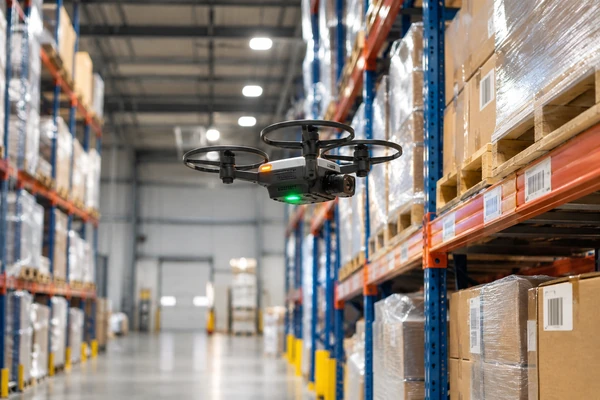
A warehouse inventory drone described by MIT News, for example, uses autonomous navigation and dedicated docking stations for charging and data transfer. 【2】 Other platforms may use different sensing equipment, navigation methods or charging interfaces.
For battery development, the starting point should be a representative flight-current profile. Maximum motor current alone cannot establish how much energy the aircraft needs to complete an inventory route.
2. Flight Time, Battery Weight and Usable Energy
Estimating Flight Time
Battery capacity is often expressed in ampere-hours (Ah). However, batteries operating at different voltages are better compared using their nominal energy in watt-hours (Wh).
Nominal battery energy (Wh) = Nominal voltage (V) × Rated capacity (Ah)
The relationship between electrical energy and power provides a starting point for estimating mission duration.
Estimated mission duration (h) = Available mission energy (Wh) ÷ Average aircraft power (W)
Consider a hypothetical indoor drone with the following parameters:
- Nominal battery energy: 60 Wh
- Energy available for the planned mission after operating limits and landing reserve: 45 Wh
- Average electrical demand measured at the battery terminals: 180 W
The estimated mission duration would be:
45 Wh ÷ 180 W = 0.25 h, or 15 minutes
This calculation is illustrative. It does not represent measured performance from a LONGSING battery or a commercial warehouse drone.
Available mission energy must be established under the expected temperature, discharge profile and battery condition. If landing reserve has already been included in the energy allowance, it should not be deducted a second time.
Why Higher Capacity Does Not Always Mean Longer Flight Time
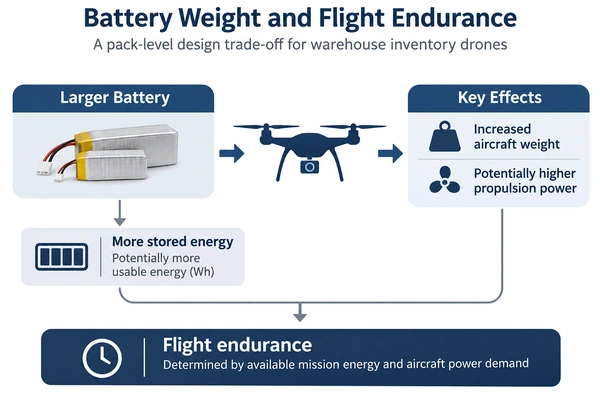
Increasing battery capacity often requires additional cell mass. For a multirotor aircraft, that extra weight increases the thrust needed to remain airborne.
The relationship is influenced by rotor geometry, propulsion efficiency and the aircraft’s overall configuration. Research into multirotor endurance has shown that battery discharge behaviour and aircraft characteristics need to be considered together. 【3】
There are also mechanical limitations.
A larger battery may alter the aircraft’s centre of gravity, reduce installation space or require additional structural support. These changes matter in a compact drone that regularly operates close to shelving and stored goods.
The useful comparison is therefore flight time at the complete aircraft level, using the same payload and representative route.
Further background on endurance calculations is available in our Drone Battery Life Guide.
Voltage Sag and Landing Reserve
Battery voltage does not remain constant throughout a flight.
When motor current increases, terminal voltage may fall because of internal resistance and electrochemical polarisation. A simplified approximation of the resistive component is:
Voltage drop (V) ≈ Current (A) × Effective resistance (Ω)
Additional voltage losses can occur in pack interconnections, wiring and connectors.
At lower states of charge, low temperatures or after prolonged battery ageing, voltage sag may become more pronounced. An aircraft can consequently reach its minimum operating voltage before all nominal battery capacity has been used.
Return-to-dock decisions should account for available energy and voltage behaviour under load. Research on UAV mission planning also identifies flight-time margin as an important part of energy management. 【4】
3. Battery Demands During Repeated Indoor Missions
A warehouse drone may be required to inspect a particular group of racks within a scheduled inventory window. Its battery duty cycle can include repeated flights, short charging intervals and extended periods of standby.
The electrical demand changes throughout each mission.
Warehouse Inventory Drone Mission Stages and Battery Design Implications
| Mission Stage | Main Electrical Loads | Battery Stress | Design Consideration |
|---|---|---|---|
| Takeoff and climb | Motors and flight controller | Elevated current demand | Peak output and voltage stability |
| Aisle navigation | Motors and positioning systems | Variable current | Dynamic discharge capability |
| Inventory scanning | Motors, cameras and processors | Sustained energy consumption | Usable energy and thermal behaviour |
| Repositioning | Motors and flight controls | Transient current demand | Voltage sag and electrical resistance |
| Return and landing | Propulsion and navigation | Operation at lower SOC | Landing reserve |
| Docking and charging | Charger and battery electronics | Repeated charging and contact heating | Charging compatibility and temperature limits |
| Standby | Monitoring and control electronics | Standby drain and calendar ageing | Idle consumption and storage SOC |
Indoor flight is not necessarily more energy-efficient than outdoor flight. Although strong outdoor wind may be absent, frequent hovering, altitude changes and positioning corrections still require propulsion energy.
The amount of time spent capturing inventory data can also vary between aisles. Obstructed labels, different rack heights and navigation adjustments may extend a route beyond its original estimate.
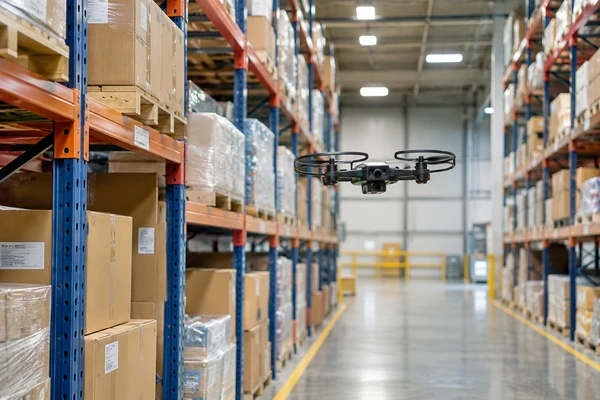
Battery testing should reproduce these operating conditions rather than use only a constant-current discharge test.
For autonomous inventory operations, completing more useful missions during a shift may be more valuable than achieving the longest possible individual flight.
4. Auto-Docking, Charging and Cycle Life
The charging interval between missions is a particularly important part of warehouse drone battery design.
A battery with sufficient flight endurance may still be unsuitable if the aircraft cannot recharge in time for its next scheduled route.
Charging Contact Reliability
In a contact-based docking system, successful landing must be followed by a stable electrical connection and confirmation that charging has started.
The docking interface needs to accommodate mechanical tolerances while maintaining acceptable electrical resistance. Repeated operation can introduce contact wear, contamination or intermittent connections.
The resistive heating at a charging contact can be expressed as:
Power loss (W) = Charging current² (A²) × Contact resistance (Ω)
As contact resistance increases, local heating can become more significant, particularly at higher charging currents.
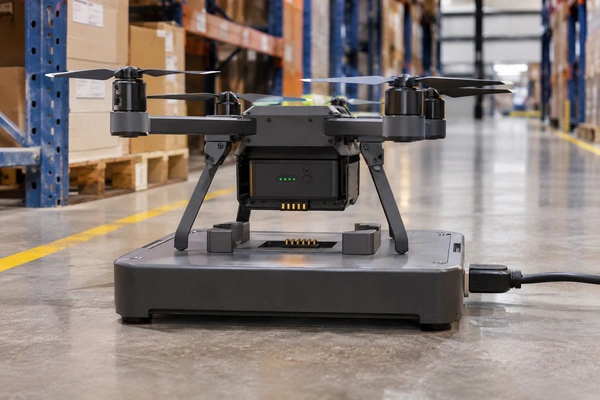
A charging system should detect abnormal connection conditions, battery temperature and interrupted charging. The aircraft should not be released for another mission solely because it has returned to the dock.
Automatic battery swapping is another possible architecture, but it has different mechanical and electrical requirements and should not be assumed to exist in every autonomous drone system.
Matching the Charging Window to the Mission Schedule
Most conventional rechargeable lithium-ion and LiPo cells use a constant-current/constant-voltage (CC/CV) charging profile, subject to the cell manufacturer’s specified limits.
Charging current normally decreases during the constant-voltage phase, which means the charger’s maximum output cannot simply be used to predict the entire charging duration.
A preliminary estimate can be calculated from:
Charging time (h) ≈ Required battery-side charging energy (Wh) ÷ Actual average battery-side charging power (W)
If power is measured at the charging station’s input rather than the battery terminals, energy conversion losses and auxiliary consumption must also be considered.
Additional time may be required for docking, communication checks or battery cooling before charging begins.
Depending on the mission schedule, an aircraft may only need to replenish enough energy for its next route rather than return to full charge after every flight.
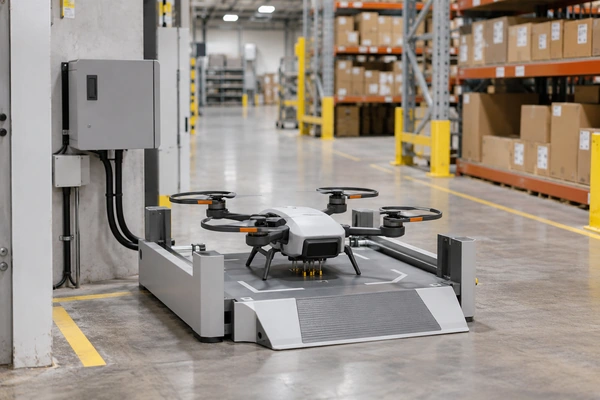
Any partial-charging strategy must remain within the battery’s validated operating limits.
Related charger integration considerations are discussed in our Drone Battery Charger Guide for Commercial UAV Fleets.
Repeated Charging and Battery Ageing
Seven docking events do not necessarily represent seven full battery cycles.
Equivalent full cycles (EFC) provide a way to express cumulative battery usage relative to a defined reference capacity.
For example, four discharge events that each use 25% of the same reference capacity represent approximately one equivalent full cycle on a discharge-throughput basis.
However, equivalent cycle counts alone cannot predict battery service life.
Factors affecting lithium-ion battery ageing include operating temperature, charge and discharge conditions, SOC and time spent in storage. 【5】
A drone that returns from a flight with a warm battery may need a cooling interval before charging. At low temperatures, unsuitable charging rates may increase the risk of lithium plating, a degradation mechanism examined in research on lithium-ion battery fast charging. 【6】
The battery’s charging profile should therefore be established using the selected cell specifications and representative thermal conditions.
For fleet operators, cycle-life validation should reproduce the expected pattern of flight, charging and standby. A laboratory cycle count measured under unrelated conditions is not sufficient to predict replacement intervals.
5. Li-ion vs LiPo: Battery Selection for Indoor Drones
Both lithium-polymer pouch cells and cylindrical lithium-ion cells can be considered for warehouse inventory drones.
LiPo belongs to the broader rechargeable lithium-ion battery family. The common comparison in drone applications concerns cell construction, packaging and performance characteristics rather than two completely independent battery technologies.
Lithium-Polymer Pouch Cells
Pouch cells are available in relatively thin, rectangular formats that may be useful when the aircraft has limited battery-compartment space.
Certain designs offer high discharge capability for propulsion applications. Their suitability depends on the actual cell current limits, thermal behaviour and expected lifetime.
Mechanical integration requires adequate pouch support and protection against puncture, excessive compression and movement.
LONGSING’s Polymer Lithium Batteries range provides a starting point for evaluating different cell formats and installation requirements.
Cylindrical Lithium-ion Cells
Cylindrical formats such as 18650 and 21700 are available in both energy-oriented and power-oriented designs.
A high-capacity cylindrical cell may provide favourable energy density but may not meet the current demands of every multirotor aircraft. Conversely, a power-oriented cell may offer better voltage stability under load while storing less energy.
Pack-level comparisons must include the mass of wiring, interconnections, insulation, connectors, protection electronics and mechanical supports.
Cell format alone cannot establish which design will provide longer flight time or better cycle life.
For a custom indoor UAV battery pack, the preferred configuration depends on the aircraft’s current profile, available space, permitted battery mass and charging schedule.
6. Battery Protection and Fleet Maintenance
Coordinating Battery Protection with Flight Control
An airborne battery cannot always be treated in the same way as a battery powering stationary equipment.
A sudden electrical disconnection during flight may result in loss of propulsion. Normal low-energy warnings, mission termination and landing behaviour must therefore be coordinated with battery protection thresholds.
Depending on the aircraft and pack architecture, relevant functions may include:
- Individual cell and pack voltage monitoring
- Overcurrent and short-circuit protection
- Charging and discharging temperature supervision
- Remaining-energy estimation
- Cell balancing where required
- Electrical fault reporting
Emergency protection must remain effective. Under normal operating conditions, the flight controller should initiate an appropriate landing response before critical protection thresholds are reached.
Small UAVs may distribute these functions between the battery, charger and flight controller rather than use a complex standalone smart BMS.
Communication protocols should be selected according to the actual system architecture. CAN communication is not a universal requirement for compact warehouse aircraft.
Detecting Battery Degradation Before a Flight Fails
State of charge (SOC) estimates the remaining charge relative to a defined battery capacity.
State of health (SOH) describes battery condition relative to a reference condition, which may include capacity retention and internal resistance.
An aged battery indicating 100% SOC may still deliver significantly less usable energy than it did when new. Increased resistance can also cause a greater terminal-voltage drop during takeoff or manoeuvring.
For multi-cell packs, appropriate battery cell matching helps reduce initial differences in cell characteristics during assembly.
Fleet maintenance records should also track:
- Minimum voltage during representative flights
- Usable battery energy
- Charging duration and interrupted charging
- Abnormal temperature
- Physical damage and connector condition
Replacement criteria should reflect the aircraft’s operational requirements. A battery may become unsuitable for a particular flight route because of voltage sag or insufficient landing reserve, even before reaching a conventional capacity-based end-of-life threshold.
7. OEM Battery Design and Validation
Selecting a battery for an autonomous inventory drone begins with understanding the electrical and mechanical demands of the aircraft.
Before requesting a custom battery sample, an OEM should prepare the following information.
Aircraft and Mechanical Requirements
- Total takeoff mass, including payload
- Maximum permitted battery weight
- Available battery-compartment dimensions
- Mounting arrangement and centre-of-gravity requirements
- Mechanical protection and ventilation conditions
Electrical Requirements
- Nominal operating voltage and acceptable voltage range
- Required usable energy per mission
- Continuous and peak current, including peak duration
- Connector and wiring specifications
- Protection and communication requirements
Mission and Charging Requirements
- Planned flight duration
- Number of missions per shift
- Time available between flights
- Charging method and charger output
- Operating and charging temperature limits
- Expected battery service life and replacement criteria
Battery and Aircraft Validation
Battery evaluation should include dynamic discharge testing, temperature measurements, connector durability and repeated charging trials.
The aircraft should also be tested under representative warehouse conditions using batteries at different states of charge and levels of degradation.
Applicable safety requirements depend on the product architecture and intended market.
For example, IEC 62133-2 addresses the safety of portable sealed rechargeable lithium cells and batteries within its defined scope.
UL 3030 addresses electrical safety for certain commercial unmanned aircraft systems. Its applicability must be assessed for the particular aircraft; the standard does not cover every aspect of autonomous flight or safe landing. 【7】
Battery shipments must also comply with applicable lithium battery transport requirements, including UN 38.3 design testing and associated documentation where required. 【8】
Transport testing does not replace aircraft-level safety validation or assessment of an unattended charging installation.
LONGSING Custom Battery Solutions for UAV OEMs
LONGSING develops rechargeable lithium battery solutions for industrial equipment and unmanned aerial vehicle applications.
Our UAV Battery Packs range covers battery products for different aircraft applications.
A compact inventory drone generally requires a different balance of energy, weight, discharge capability and mechanical integration from a large agricultural UAV or VTOL aircraft.
For custom development, providing aircraft drawings, measured flight-current data and the intended charging schedule allows suitable cell formats and pack configurations to be evaluated before sample production.
The battery, aircraft and charging station should then be validated together against the intended warehouse operating conditions.
Conclusion
A warehouse inventory drone battery should be specified around the route it needs to complete, the charging time available and the performance required near the end of its service life.
Additional battery capacity can extend endurance, but the benefit must be assessed against aircraft weight and propulsion demand. Repeated docking introduces further considerations involving charging contacts, temperature and battery degradation.
For an inventory drone fleet, dependable mission completion and predictable battery replacement are practical measures of a well-integrated power system.
Frequently Asked Questions About Warehouse Inventory Drone Batteries
Click to explore more information about warehouse inventory drone battery design.
Q: What battery is used in warehouse inventory drones?
A: Rechargeable lithium-ion batteries, including lithium-polymer pouch cells and cylindrical lithium-ion cells, can be suitable. The selection depends on aircraft mass, discharge demand, installation space and charging requirements.
Q: How long can an inventory drone fly on one charge?
A: Flight duration depends on usable battery energy, aircraft weight, average power consumption and the required landing reserve. A reliable estimate requires a representative flight profile and aircraft testing.
Q: Does a larger battery always increase drone flight time?
A: No. Additional battery capacity often increases aircraft weight and propulsion demand. The improvement in flight time depends on the complete aircraft and battery configuration.
Q: How do autonomous warehouse drones recharge?
A: Some inventory drones return to dedicated charging stations between missions. The docking system establishes a charging connection, verifies battery conditions and replenishes energy before the next flight.
Q: Does frequent charging shorten drone battery life?
A: Battery degradation depends on charging rate, temperature, depth of discharge, state of charge (SOC) and time. Multiple partial charging events do not necessarily correspond to the same number of full equivalent cycles.
Q: Is LiPo better than cylindrical Li-ion for warehouse drones?
A: Neither format is universally better. Pouch cells offer flexible packaging options, while cylindrical cells provide a wide selection of energy and power characteristics. Suitability depends on aircraft requirements and pack-level performance.
Q: Does every autonomous drone battery require a smart BMS?
A: Not necessarily. Battery monitoring and protection may be distributed between the battery, flight controller and charger. The architecture should provide appropriate electrical safeguards and coordinated flight-safety responses.
Q: What should an OEM specify for a custom warehouse inventory drone battery?
A: Required information includes battery voltage, usable energy, continuous and peak current, maximum weight, available dimensions, charging method, mission frequency, temperature limits and service-life requirements.