
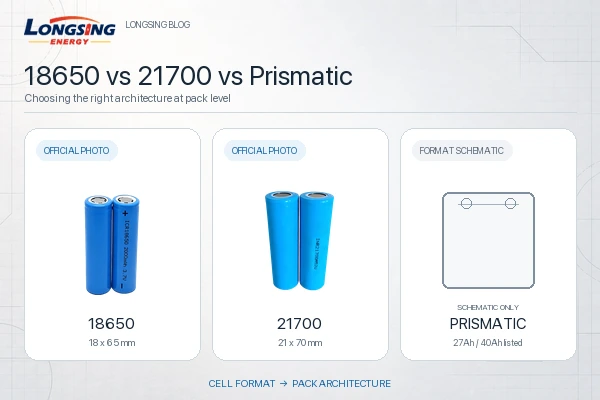
An OEM may already know the required battery voltage, runtime and installation space but still face a difficult architecture decision: should the pack use 18650 cells, larger 21700 cells or a prismatic design?
Comparing only single-cell capacity does not answer that question.
A larger cell can reduce physical cell count, while a smaller cell may provide more layout flexibility. A rectangular cell can fit a box-shaped enclosure efficiently, yet it introduces different mechanical and thermal considerations.
The correct cell format should therefore be selected at pack level—not by ranking individual cells in isolation.
Featured Snippet: What Is the Difference Between 18650, 21700 and Prismatic Cells?
18650 and 21700 are cylindrical lithium-ion cell formats, while prismatic describes a broader rectangular cell architecture. 18650 cells offer high layout flexibility, 21700 cells can reduce physical cell count for a given energy target, and prismatic cells can use rectangular enclosure space efficiently. The best format depends on chemistry, voltage, energy, power, thermal design, mechanical constraints, manufacturing and safety requirements at pack level.
Table of Contents
1. What Is the Real Difference Between 18650, 21700 and Prismatic Cells?
The first step in comparing 18650 vs 21700 vs prismatic cells is to separate cell format from cell chemistry.
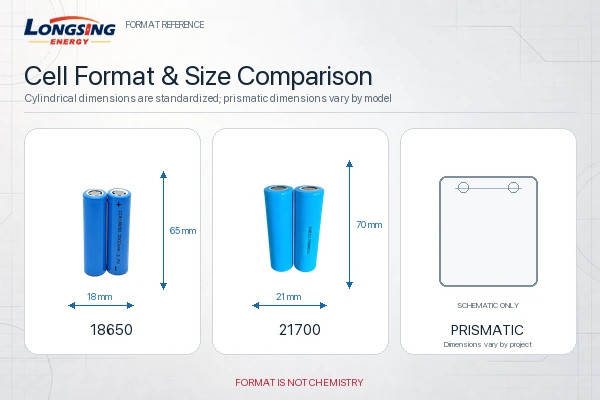
18650 and 21700 describe standardized cylindrical dimensions. Prismatic refers to a broader family of rectangular cells that can use different lithium-ion chemistries.
That distinction matters because voltage, cycle behavior, power capability and thermal characteristics may be strongly affected by chemistry and cell design—not simply by whether the housing is cylindrical or rectangular.
18650 and 21700 Are Cylindrical Cell Formats
An 18650 cell is approximately:
18 mm diameter × 65 mm length
while a 21700 is approximately:
21 mm diameter × 70 mm length
Both use a cylindrical architecture, typically with wound electrode layers inside a metal enclosure.
LONGSING’s 18650 lithium-ion cells can be integrated into customized series/parallel packs where pack voltage, capacity, BMS and mechanical layout are defined around the application.
Its 21700 lithium-ion cells provide a larger cylindrical option for applications where the selected cell’s energy, current capability and physical dimensions better fit the pack requirement.
A controlled academic comparison using the same electrode materials, separator and electrolyte found that the tested 21700 format stored roughly 50% more capacity and energy per cell than the tested 18650 format. The study also found broadly similar voltage behavior and capacity fade under its 1C, 25°C test condition, while the larger 21700 showed stronger internal heating tendencies. [1]
This does not mean:
Every 21700 cell has 50% more capacity than every 18650 cell.
Commercial cells vary by:
- Chemistry
- Electrode loading
- Energy-oriented vs power-oriented design
- Manufacturer
- Internal construction
The useful conclusion is narrower:
A larger cylindrical format can accommodate more active material and may allow a pack to reach its energy target with fewer physical cells.
“Prismatic” Is a Form Factor, Not a Chemistry
Prismatic cells use a rectangular housing rather than a cylindrical can.
But prismatic does not mean LiFePO₄, and LiFePO₄ does not mean prismatic.
Prismatic batteries may use different lithium-ion chemistries and different nominal voltages.
For example, LONGSING includes both LiFePO₄ prismatic cells and custom prismatic battery packs.
That means a comparison such as:
18650 NMC vs prismatic LiFePO₄
changes at least two variables simultaneously:
Cell format + chemistry
If one option has a different voltage, energy density, cycle behavior or charging profile, those differences cannot automatically be attributed to “cylindrical vs prismatic.”
Format and chemistry should therefore be evaluated as separate—but interacting—engineering decisions.
Why Single-Cell Capacity Is an Incomplete Comparison
A cell datasheet may show:
- Nominal voltage
- Ah capacity
- Wh
- Maximum current
- Dimensions
- Mass
But an OEM is designing a battery pack, not purchasing one cell in isolation.
The relevant questions are:
- How many cells are required in series?
- How many parallel paths are required?
- How much usable pack energy is available?
- Can the pack deliver the required continuous and peak power?
- How much enclosure space does the complete assembly consume?
- How much structure, insulation and wiring are required?
- How will heat leave the cells?
- How much does the finished pack weigh?
This is why custom lithium battery pack design should begin from the application specification rather than from a preferred cell format.
2. How Do 18650, 21700 and Prismatic Architectures Change Pack Design?
The most important differences appear when the cells are assembled into a complete battery system.
Physical cell count, series/parallel architecture, cooling, interconnections, mechanical structure and manufacturing complexity all change with cell format.
Physical Cell Count and Series/Parallel Architecture
Battery voltage generally determines the required series configuration together with the selected cell chemistry.
Battery energy and current requirements then help determine the necessary parallel configuration.
A useful engineering sequence is:
Required Pack Voltage
↓
Series Cell Count
↓
Required Energy + Current
↓
Parallel Count
↓
Physical Cell Count
Because a 21700 cell can contain more energy than a smaller 18650 of otherwise comparable design, a 21700 pack may require fewer physical cells to achieve a similar energy target.
That can potentially reduce:
- Cell holders
- Weld points
- Parallel interconnections
- Some busbar complexity
- Assembly operations
But there is an important distinction:
Fewer physical cells do not automatically mean a simpler BMS.
If two packs use the same chemistry and nominal system voltage, they may still have the same number of series groups.
The 21700 version might simply use fewer cells in parallel.
Therefore BMS complexity still depends on:
- Series count
- Voltage monitoring
- Balancing requirements
- Current monitoring
- Communication
- Protection architecture
not only on total physical cell count.
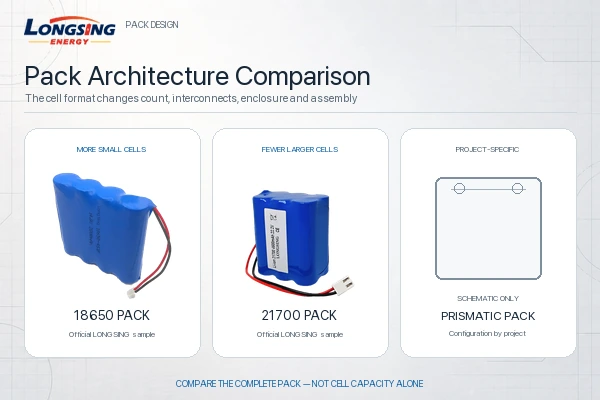
Packaging Efficiency and Layout Flexibility
Cylindrical cells naturally create small gaps when arranged next to each other inside a rectangular enclosure.
That geometric characteristic can make prismatic cells attractive where the battery compartment itself is rectangular.
However, the situation is more nuanced at pack level.
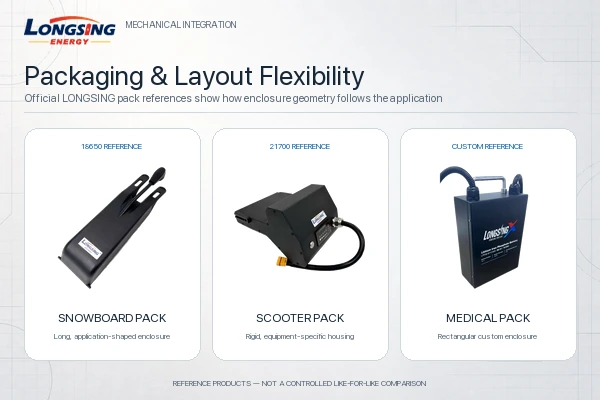
18650 Architecture
Smaller cylindrical cells provide high layout flexibility.
They can be useful when:
- The enclosure is irregular
- Battery volume is distributed across several spaces
- The pack needs fine series/parallel granularity
- The designer wants smaller modular cell groups
The trade-off is that more cells usually mean more:
- Holders
- Welds
- Interconnections
- Cell-level assembly operations
21700 Architecture
21700 preserves the basic cylindrical-pack approach while increasing individual cell size.
This can provide a useful middle ground:
cylindrical modularity + lower physical cell count potential
However, its larger diameter can reduce how precisely the pack can fill narrow spaces compared with 18650.
Prismatic Architecture
Rectangular cells can fit efficiently inside a defined rectangular battery compartment.
This can reduce the geometric voids associated with rows of cylinders.
But claims such as:
“Prismatic cells use 100% of the available volume.”
would be misleading.
A real battery pack still needs space for:
- Insulation
- BMS
- Busbars
- Enclosure walls
- Mechanical supports
- Cooling interfaces
- Wiring
- Service clearance
- Cell expansion allowance where applicable
Recent cell-to-pack research likewise shows that cell-format advantages must be evaluated together with structural overhead, cooling and complete pack integration rather than by cell geometry alone. [3]
Thermal Management Is a Pack-Level Question
One of the easiest mistakes in cell-format comparison is to say:
“21700 has better cooling.”
or:
“Prismatic is easier to cool.”
Neither statement is universally correct.
A study comparing thermal-management metrics for cylindrical cells found an especially useful result:
A tested 21700 cell could reject heat more effectively than the tested 18650 at the individual-cell level under one cooling configuration, yet an equally sized pack using 18650 cells could provide more favorable pack-level heat rejection because of the way surface area and packing geometry changed. [2]
This illustrates the central engineering principle:
Cell-level thermal performance does not automatically predict pack-level thermal performance.
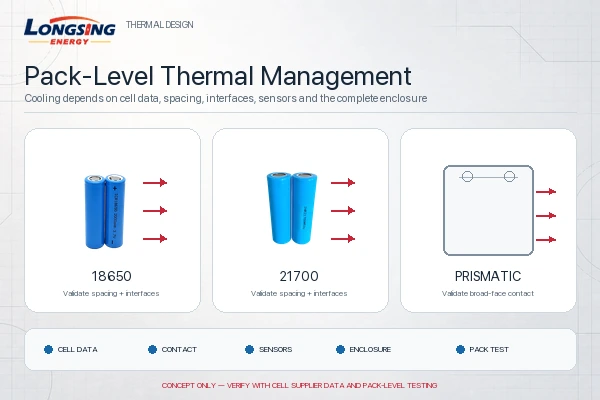
For cylindrical cells, thermal design may depend on:
- Cell spacing
- Side cooling
- Base cooling
- Heat generation
- Holder design
- Air or liquid paths
- Interface materials
Prismatic cells offer large flat surfaces that can integrate well with cooling plates.
But larger cell dimensions can also create greater internal temperature gradients and require careful temperature-uniformity management. [4]
The correct question is not:
Which cell runs cooler?
It is:
How is heat generated and removed from the selected cells in the actual pack geometry?
Mechanical Integration and Cell Restraint
Mechanical requirements also change with architecture.
Cylindrical Packs
Designers may need to manage:
- Individual cell holders
- Weld or busbar connections
- Vibration restraint
- Cell-to-cell spacing
- Pack frame support
- Interconnect strain
The large number of smaller cells can increase assembly count but also provides considerable layout flexibility.
Prismatic Packs
Prismatic packs may contain far fewer physical cells, but each cell becomes a larger structural unit.
Mechanical design may therefore need to address:
- Module frames
- Terminal alignment
- Busbar support
- Large-cell fixation
- Cell expansion
- Mechanical restraint
Research on large-format prismatic lithium-ion cells has measured changing swelling stress during cycling and aging under constrained pack-like conditions, with temperature and cell design affecting mechanical behavior. [5]
That does not mean every prismatic cell requires the same compression method.
Instead:
Mechanical restraint should follow the selected cell manufacturer’s requirements and the measured behavior of the specific battery design.
18650 vs 21700 vs Prismatic: Pack-Level Comparison
| Engineering Factor | 18650 | 21700 | Prismatic |
|---|---|---|---|
| Basic architecture | Smaller cylindrical | Larger cylindrical | Larger rectangular cell family |
| Physical cell count | Usually higher | Can be lower for a similar energy target | Often fewer large cells |
| Layout flexibility | Very high | High | Strongest fit in defined rectangular spaces |
| Series / parallel flexibility | High | High | Strongly influenced by selected cell size and capacity |
| Interconnections | More potential welds and connections | Potentially fewer than 18650 | Fewer large-cell terminals, but busbar design remains important |
| Geometric packing | Round-cell gaps remain | Round-cell gaps remain | Can use rectangular enclosure volume efficiently |
| Thermal design | Many smaller heat sources | Fewer, larger cylindrical heat sources | Large flat interfaces; internal gradients require attention |
| Mechanical integration | Holders and many-cell restraint | Similar cylindrical approach | Module restraint and expansion can become more important |
| Manufacturing | Higher physical cell count | Potentially fewer assembly points | Fewer cells but larger structural interfaces |
| Best choice? | Application dependent | Application dependent | Application dependent |
Notice what is deliberately not included in this table:
- “Safest”
- “Longest cycle life”
- “Highest energy density”
- “Cheapest”
Those outcomes depend too heavily on chemistry, specific cell design, supplier quality and pack implementation to rank accurately by form factor alone.
3. Which Cell Architecture Fits Different Custom Battery Pack Requirements?
The purpose of comparing these formats is not to identify a universal winner.
It is to understand which architecture better fits a particular product.
When 18650 May Be Worth Evaluating
An 18650 architecture may be useful when the project benefits from:
- High layout flexibility
- Smaller modular cells
- Irregular battery compartments
- Distributed battery volume
- Fine series/parallel configuration options
- Established cylindrical-cell pack construction
For compact industrial equipment, robotics or other products with non-rectangular internal geometry, smaller cylindrical cells can sometimes be arranged around structural components more easily than large rectangular cells.
The trade-off is higher physical cell count.
For the same pack-energy target, that can mean more:
- Welds
- Cell holders
- Inspection points
- Interconnections
Therefore 18650 should not be selected solely because the cells are small or widely available.
When 21700 May Be Worth Evaluating
A 21700 architecture can make sense where:
- Cylindrical cells already fit the enclosure
- The selected 21700 provides sufficient energy and power
- The design benefits from reducing physical cell count
- Slightly larger cell diameter is acceptable
- A cylindrical manufacturing architecture is still preferred
Compared with an otherwise similar 18650 design, a higher-energy 21700 may allow fewer parallel cells for the same pack target.
But that does not automatically guarantee:
- Lower pack mass
- Better cooling
- Longer cycle life
- Lower cost
- Simpler BMS
These still depend on the specific cells and complete pack architecture.
The direct 18650/21700 research discussed earlier is useful precisely because it shows both the potential energy advantage of the larger format and the need to evaluate thermal behavior separately.
When Prismatic Cells May Be Worth Evaluating
Prismatic architecture can be attractive where:
- The battery compartment is rectangular
- Larger cells fit the enclosure efficiently
- The design benefits from fewer physical cells
- Large flat cooling interfaces are useful
- A rigid module structure is already planned
LONGSING’s custom prismatic battery packs can be evaluated around application-specific voltage, capacity, BMS and mechanical constraints rather than forcing the application into a predefined pack.
However, a lower cell count does not eliminate system engineering.
Designers still need to consider:
- Mechanical restraint
- Thermal uniformity
- Busbars
- Terminal loading
- Pack structure
- Serviceability
- Cell expansion
- Protection architecture
Why Application Requirements Should Decide the Format
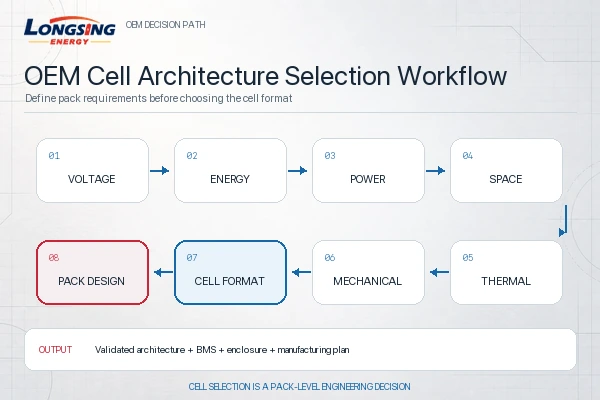
A better selection process is:
System Voltage
↓
Required Usable Energy
↓
Continuous / Peak Power
↓
Available Volume
↓
Weight Target
↓
Thermal Strategy
↓
Mechanical Architecture
↓
Cell Format
Not:
“We always use 21700.”
or:
“Prismatic is the most advanced architecture.”
A custom battery pack should be built around the product—not around a preferred cell shape.
4. What Should OEMs Specify Before Choosing Cells for a Custom Battery Pack?
A battery supplier cannot make a meaningful 18650 vs 21700 vs prismatic recommendation from a target Ah value alone.
The OEM needs to define the complete electrical, mechanical and thermal system.
Electrical Requirements
Provide:
- Nominal battery voltage
- Minimum operating voltage
- Maximum operating voltage
- Required usable energy
- Average current / power
- Maximum continuous current
- Peak current
- Peak duration
- Minimum acceptable voltage under load
- Charging input and charge-time requirement
These parameters determine the basic series/parallel architecture.
For example, the system voltage influences the number of series groups, while energy and current requirements influence how much parallel capacity is required.
Mechanical and Thermal Requirements
Provide:
- Maximum pack dimensions
- Available installation volume
- Required pack shape
- Weight target
- Mounting orientation
- Vibration / shock conditions
- Cooling method
- Thermal interface location
- Enclosure restrictions
- Serviceability requirements
This is often where the difference between cell formats becomes decisive.
A design with:
long, narrow, distributed battery spaces
may arrive at a different answer from one with:
one large rectangular battery bay
even if the two systems require similar Wh.
BMS, Manufacturing and Cell Consistency
The battery-management architecture should then be designed around:
- Cell chemistry
- Series count
- Pack current
- Protection limits
- Temperature sensing
- Balancing
- SOC requirements
- Communication requirements where applicable
Physical cell count can also affect manufacturing complexity.
A larger number of cylindrical cells may require more:
- Welds
- Cell holders
- Electrical connections
- Inspection points
while larger prismatic cells reduce physical cell count but increase the importance of large-cell busbars, terminal interfaces and mechanical restraint.
Regardless of format, multi-cell packs also depend on cell consistency.
Differences in:
- Capacity
- Open-circuit voltage
- Internal resistance / ACIR
can affect finished-pack behavior.
LONGSING’s dedicated Battery Cell Matching guide explains these production considerations in detail, so they do not need to be repeated here.
The key point is:
Cell-format selection and cell matching solve different engineering problems.
Safety and Validation
Cell shape does not determine battery safety on its own.
Battery safety depends on a combination of:
- Chemistry
- Specific cell design
- Cell manufacturing quality
- BMS
- Current limits
- Temperature limits
- Mechanical protection
- Interconnections
- Thermal-propagation strategy
- Charger design
- System validation
Industrial lithium battery projects may also need to consider applicable standards such as IEC 62619:2022, which addresses safety requirements and testing for secondary lithium cells and batteries used in industrial applications. [6]
The applicable standard and certification route should still be confirmed for the actual end product.
Therefore:
Selecting 18650, 21700 or prismatic cells does not replace pack-level safety engineering.
Custom Battery Pack Cell-Selection Checklist
Before requesting a battery architecture recommendation, an OEM should provide:
| Parameter | Why It Matters |
|---|---|
| Nominal voltage | Determines series architecture |
| Operating-voltage range | Ensures system compatibility |
| Required usable Wh | Defines mission/runtime energy |
| Average power | Determines continuous energy demand |
| Peak current | Influences cell and interconnect selection |
| Peak duration | Separates transient and sustained loads |
| Minimum system voltage | Defines acceptable load voltage sag |
| Battery dimensions | Strongly influences cell format |
| Pack shape | Determines layout efficiency |
| Weight target | Influences cell and structural design |
| Cooling strategy | Determines thermal interface |
| Vibration / shock | Influences mechanical structure |
| Charging requirement | Affects chemistry and pack design |
| BMS requirements | Defines monitoring and protection |
| Communication | Influences BMS integration where required |
| Serviceability | Affects removable / fixed design |
| Safety / compliance targets | Influences design and validation |
Where LONGSING Fits
LONGSING supports rechargeable battery development across several architectures, including:
- 18650 lithium-ion cells
- 21700 lithium-ion cells
- LiFePO₄ prismatic cells
- Custom prismatic battery packs
- Custom lithium battery packs
These should be treated as engineering options rather than predetermined solutions.
A more useful development sequence is:
Application Requirements
↓
Electrical Load and Runtime
↓
Mechanical Envelope
↓
Chemistry Selection
↓
Cell Format Comparison
↓
Series / Parallel Architecture
↓
BMS + Thermal + Mechanical Design
↓
Prototype Validation
Conclusion
There is no universal winner in 18650 vs 21700 vs prismatic cells. 18650 can provide high layout flexibility, 21700 can reduce physical cell count while retaining cylindrical architecture, and prismatic cells can integrate efficiently into suitable rectangular battery spaces.
The correct decision depends on chemistry, pack voltage, usable energy, power, thermal path, enclosure geometry, mechanical restraint, manufacturing and safety requirements. The best cell is the one that enables the best complete battery pack for the application.
Discuss Your Custom Battery Pack Requirements
Developing a custom rechargeable battery pack?
For a useful cell-architecture evaluation, provide:
- Nominal system voltage
- Operating-voltage range
- Usable energy requirement
- Average load
- Peak current and duration
- Required runtime
- Available battery dimensions
- Pack-shape constraints
- Weight target
- Cooling method
- Operating temperature
- Vibration / mechanical requirements
- Charging strategy
- BMS requirements
- Communication requirements
- Connector requirements
- Target market and applicable safety requirements
These inputs allow 18650, 21700 and prismatic architectures to be compared against the actual product requirements rather than against generic cell specifications.
Frequently Asked Questions About 18650, 21700 and Prismatic Cells
Click to explore more information about 18650, 21700 and prismatic cell selection
Q: Which is better for a custom battery pack: 18650, 21700 or prismatic cells?
A: There is no universal best format. 18650 may provide greater layout flexibility, 21700 may achieve the required energy with fewer physical cells, and prismatic cells may integrate efficiently into rectangular battery spaces. The correct choice depends on voltage, energy, power, geometry, weight, thermal management, mechanical design and chemistry.
Q: What is the difference between 18650 and 21700 cells?
A: Both are cylindrical lithium-ion formats. An 18650 is approximately 18 mm × 65 mm, while a 21700 is approximately 21 mm × 70 mm. The larger format can accommodate more active material, but actual capacity, current capability and thermal behavior depend on the specific cell design.
Q: Do 21700 cells reduce battery pack cell count?
A: They can. If the selected 21700 stores more energy or supports more current than the selected 18650, fewer physical cells may be required to reach the same pack target. However, series count still depends on pack voltage and chemistry, so BMS architecture does not necessarily become simpler.
Q: Are prismatic cells more space-efficient than cylindrical cells?
A: Prismatic geometry can use rectangular battery compartments efficiently because it avoids some of the geometric gaps between cylindrical cells. However, the finished pack still requires structure, insulation, BMS, busbars, thermal interfaces and mechanical clearances, so pack-level space efficiency must be evaluated from the complete design.
Q: Which cell format provides better thermal management?
A: No cell format is universally superior. Thermal performance depends on cell heat generation, surface area, cooling direction, spacing, cooling interface and pack geometry. A cell that appears easier to cool individually may not create the best thermal architecture when assembled into a complete pack.
Q: Are prismatic cells safer than 18650 or 21700 cells?
A: Not automatically. Safety depends on chemistry, specific cell design, manufacturing quality, pack structure, BMS, temperature control, current limits and system validation. Cell format changes the engineering approach but does not by itself determine safety.
Q: Can 18650 and 21700 cells use the same BMS architecture?
A: Potentially, if chemistry, series count, voltage range, current and monitoring requirements are compatible. A 21700 design may use fewer cells in parallel while retaining the same number of series groups, so total physical cell count alone does not determine BMS architecture.
Q: What information should an OEM provide before selecting a battery cell format?
A: Provide system voltage, required Wh, average and peak loads, runtime, available dimensions, weight target, thermal strategy, vibration requirements, charging method, BMS requirements, communication needs and applicable safety requirements. These parameters allow the cell format to be evaluated at pack level.
Reference: