

A smart ring has to fit sensing, wireless communication, processing, charging hardware, structural support and a rechargeable battery into an extremely small enclosure.
That makes battery design very different from simply choosing the largest mAh value available.
More battery volume can support longer runtime, but it also leaves less room for sensors, PCB, antenna, charging electronics and sealing structures. At the same time, continuous background sensing and periodic Bluetooth synchronization consume energy throughout the day.
For smart-ring OEMs, battery design is therefore a system-level optimization problem involving battery volume, daily device energy and charging frequency.
A smart ring battery must be sized from the 24-hour energy budget and the mechanical envelope at the same time.
Featured Snippet: How Is a Smart Ring Battery Designed?
A smart ring battery should be designed around both the device's mechanical envelope and its 24-hour energy budget. Runtime depends not only on battery capacity, but also on sensor duty cycle, Bluetooth Low Energy activity, MCU processing, standby current, power-management losses and usable battery voltage. Because internal volume is extremely limited, longer runtime often requires reducing device energy consumption as well as increasing battery capacity.
Table of Contents
1. What Determines Smart Ring Battery Life?
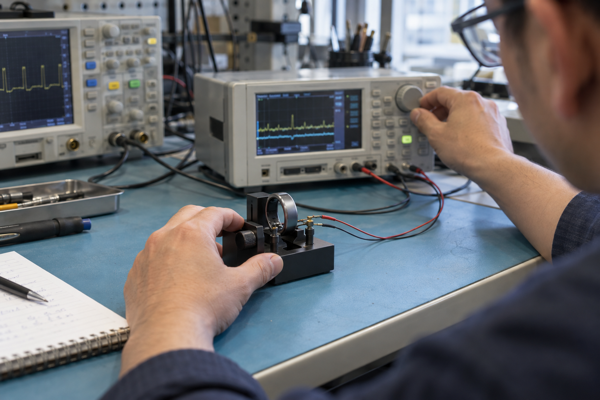
Smart ring battery life cannot be predicted reliably from mAh alone.
The more useful engineering sequence is:
Battery Energy
→ Usable Device Energy
→ Daily Device Energy Consumption
→ Runtime / Charging Interval
A battery can contain a certain nominal capacity, but the number of days the ring operates depends on how much of that energy the electronics can actually use and how much energy the complete device consumes each day.
Battery Capacity Is Only the First Layer
Battery capacity is commonly expressed in mAh.
For system design, energy is often more useful:
Nominal Battery Energy ≈ Nominal Voltage × Capacity
For example, voltage and Ah together determine the amount of stored electrical energy available from the cell.
But:
Nominal battery energy is not the same as smart ring runtime.
The same battery can produce different operating times in two rings if their sensing frequency, BLE behavior, standby current or processing workload is different.
Usable Energy Depends on the Complete Device
Not all nominal battery energy is necessarily usable by the electronics.
Usable energy can be affected by:
- System minimum operating voltage
- Battery protection cutoff
- Regulator efficiency
- Voltage drop under load
- Temperature
- Battery aging
- Required low-SOC reserve
A useful engineering distinction is therefore:
Nominal Energy
versus
Usable Device Energy
If the battery voltage falls below the PMIC or system minimum threshold during operation, some electrochemical capacity may remain even though the device can no longer use it reliably.
Daily Device Energy Must Be Built From Operating States
For a smart ring, the daily power budget should include more than sensors.
A first-order model is:
Daily Device Energy = Sensor Energy + MCU Energy + BLE Energy + Storage Energy + Standby Energy + Power-Management Losses
That means OEMs should evaluate the device state by state:
- Low-power standby
- Optical sensing
- Motion sensing
- Temperature sensing
- MCU processing
- Data storage
- BLE advertising
- BLE synchronization
- Supporting PMIC / charger quiescent loads
Average current can still be useful, but it should be the result of a validated operating model—not the only input.
What Determines Smart Ring Battery Life?
| Layer | Main Question | Key Inputs | Common Mistake | Engineering Output |
|---|---|---|---|---|
| 1. Battery Energy | How much nominal energy is stored? | Cell voltage, capacity, dimensions | Treating mAh as runtime | Nominal mWh / Wh |
| 2. Daily Device Energy | How much energy does the complete ring consume each day? | Sensor duty cycle, MCU active time, BLE activity, standby current, PMIC losses | Measuring only one subsystem | Daily mWh consumption |
| 3. Runtime / Charging Interval | How long can the ring operate between charges? | Usable battery energy, daily energy use, aging margin, reserve | Converting nominal capacity directly into days | Expected charging interval |
Runtime Should Be Calculated From Usable Energy
A useful first-order relationship is:
Estimated Runtime ≈ Usable Battery Energy ÷ Average Daily Device Energy
This is more meaningful than:
Battery mAh ÷ one current number
because smart-ring workloads are strongly duty-cycled.
Real runtime can still vary with:
- Sensor configuration
- User activity
- BLE synchronization frequency
- Temperature
- Battery age
- Firmware behavior
- Feature settings
So runtime should be treated as a validated system result, not a fixed property of battery capacity alone.
2. How Do Sensors and Bluetooth Affect the Smart Ring Power Budget?
A smart ring typically spends much of its time operating small loads repeatedly rather than sustaining one large continuous load.
This makes duty cycle and quiescent current especially important.
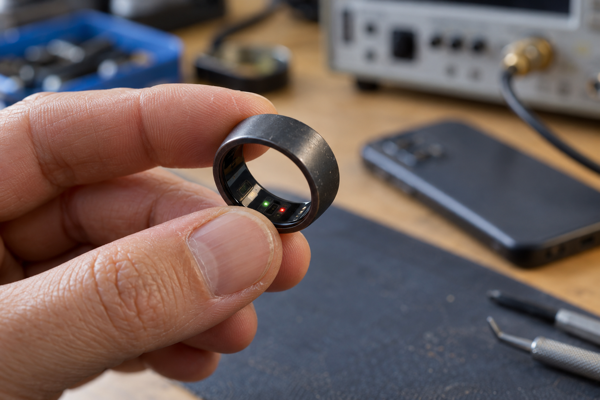
Optical sensing, motion monitoring, temperature measurement and BLE synchronization may each consume relatively little energy per event, but their cumulative 24-hour contribution can become significant.
Optical Sensing Depends on Duty Cycle
Wearable optical sensing may involve:
- LEDs
- Photodiodes
- Analog front end
- ADC
- Digital processing
Its energy consumption can depend on:
- LED current
- LED on-time
- Sampling rate
- Number of optical channels
- Measurement interval
- Averaging
- Processing duration
Wearable optical-sensor platforms provide programmable sensing parameters specifically because measurement performance and power consumption must be balanced. [5]
Therefore:
PPG or optical-sensing power should not be represented by one universal current value.
The relevant question is:
How much energy does one measurement cycle require, and how often does that cycle occur?
Peer-reviewed smart-ring research has also demonstrated aggressive optical duty cycling as one way to reduce power consumption in a highly constrained ring form factor. [3]
The specific duty-cycle values in a research prototype should not be treated as universal design targets, but the underlying principle is important:
Longer runtime can come from reducing subsystem active time—not only from increasing battery capacity.
Motion and Temperature Sensors Add Persistent Background Loads
Accelerometers and temperature sensors may operate periodically or in low-power monitoring modes.
Their energy impact depends on:
- Sampling frequency
- Wake-up behavior
- Event-detection settings
- Processing frequency
- Required measurement resolution
For example, a movement sensor configured primarily for event detection can have a different energy profile from one continuously collecting high-rate motion data.
So the design sequence should be:
Required sensing function
→ Required sampling strategy
→ Measured energy consumption
rather than reducing sensor activity arbitrarily because battery capacity is limited.
BLE Power Depends on Communication Behavior
Bluetooth Low Energy is designed for low-power wireless communication, but its actual battery cost is highly configuration dependent.
Bluetooth LE behavior can be influenced by:
- Advertising interval
- Connection interval
- Peripheral latency
- TX power
- Packet size
- PHY
- Data-transfer volume
- Synchronization frequency
Bluetooth SIG documentation describes how connection intervals and Peripheral Latency affect how frequently a peripheral participates in connection events, which directly affects radio active time. [1]
Nordic Semiconductor's low-power BLE guidance similarly shows that advertising and connection settings can materially change energy consumption. [2]
Therefore:
BLE should not be treated as “negligible” simply because it is a low-power radio technology.
The battery engineer needs the actual communication behavior.
Background Sensing and Synchronization Should Be Modeled Separately
A useful smart-ring power model separates two operating groups.
Background Operation
may include:
- Low-power MCU operation
- Sensor sampling
- Motion detection
- Temperature monitoring
- Local data storage
- Periodic optical sensing
Synchronization Events
may include:
- BLE advertising
- Connection establishment
- Data transfer
- App synchronization
- Configuration updates
This separation helps OEMs identify whether most daily energy is being spent on sensing, communication or always-on overhead.
Typical Smart Ring Load States
| Operating State | Main Components | Key Battery Question |
|---|---|---|
| Low-power standby | MCU, RTC, PMIC, always-on circuits | What is the true system quiescent load? |
| Sensor acquisition | PPG, temperature sensor, accelerometer | What sampling rate and duty cycle are required? |
| Processing | MCU / DSP | How long does the processor remain active? |
| Data storage | Memory / flash | How frequently is data written? |
| BLE advertising | Radio | How often must the ring be discoverable? |
| BLE synchronization | Radio + MCU | How much data is transferred and how often? |
| Charging | Charger / PMIC / battery | What charge current and thermal limits apply? |
The table also highlights a point that is easy to overlook:
Supporting electronics consume energy too.
Charger quiescent current, regulators, protection circuits, fuel-gauge circuitry and leakage paths may matter more in an ultra-small wearable than in a device with a large battery.
3. How Should Battery Size, Charging and Mechanical Integration Be Balanced?
Once the device power budget is understood, the next question is mechanical:
Can the required battery actually fit without compromising the rest of the ring?
This is where smart-ring battery design becomes fundamentally different from many other rechargeable devices.
Battery Volume Competes With Every Other Component
The battery shares the same tiny internal envelope with:
- Optical sensors
- Temperature sensors
- Motion sensors
- PCB or flex PCB
- MCU
- BLE electronics
- Antenna
- Charging components
- Mechanical structure
- Sealing features
Every cubic millimeter assigned to the battery is unavailable to another subsystem.
That produces a fundamental relationship:
More Battery Volume
→ potentially more stored energy
but also:
More Battery Volume
→ less room for sensing, RF, electronics or mechanical structure
This is why smart-ring development should begin with both:
energy budget
and
space budget
at the same time.
Battery Thickness May Matter More Than Capacity Alone
For a smart ring, battery dimensions can directly influence:
- Ring thickness
- Outer diameter
- Internal finger clearance
- Sensor placement
- Structural wall thickness
- Antenna clearance
- Overall comfort
A request such as:
“We need a 30 mAh battery”
is therefore incomplete.
A battery supplier also needs:
- Maximum thickness
- Maximum width
- Maximum length
- Available battery volume
- Tab orientation
- Keep-out areas
- Mechanical clearances
In this application, mechanical envelope can be as important as capacity.
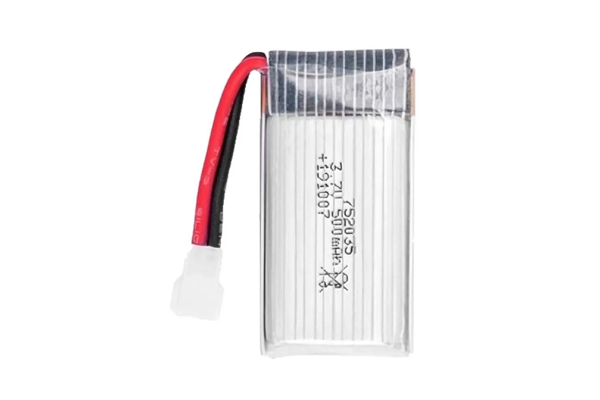
3.7V / 1S Li-Polymer Is a Candidate, Not a Standard
LONGSING Website B currently provides Polymer Lithium Batteries for thin, lightweight and compact rechargeable applications and a 3.7V Battery Pack category for 1S lithium-ion / Li-polymer architectures.
These product families can provide candidate directions for compact wearable development.
However:
A 3.7V-class or 1S Li-polymer architecture should not be treated as a universal smart-ring standard.
Actual battery architecture must match:
- Device voltage window
- Maximum charging voltage
- PMIC
- Protection design
- Required capacity
- Geometry
- Charge current
The same applies to chemistry.
Li-polymer may be attractive where thin or compact packaging is important, but it is not automatically the only valid battery solution for every smart ring.
Custom Dimensions Do Not Automatically Mean Curved Cells
Smart rings can create unusual battery-shape requirements.
Research prototypes have demonstrated curved or arc-shaped battery integration in ring form factors. [3]
But this creates an important manufacturing distinction:
Custom length / width / thickness
is not the same as:
curved / arc-shaped / annular cell manufacturing
A supplier that supports dimensional customization should not automatically be assumed to support every non-standard cell geometry.
For LONGSING specifically, current Website B material supports polymer lithium and customized battery dimensions, but it should not be interpreted as confirmation of a dedicated curved or ring-shaped smart-ring cell unless such capability is separately verified.
Charging Frequency Is Part of the Product Architecture
Charging interval follows the same energy relationship as runtime:
Charging Interval ≈ Usable Battery Energy ÷ Daily Device Energy
If battery volume is fixed, higher device energy consumption generally means the ring must return to the charger sooner.
This creates two paths to longer runtime:
Path 1 — Increase Usable Battery Energy
subject to:
- available volume
- weight
- thickness
- mechanical constraints
Path 2 — Reduce Daily Device Energy
through:
- optical duty-cycle optimization
- lower MCU active time
- optimized BLE behavior
- lower standby consumption
- more efficient power conversion
The second path is especially important in smart rings because the battery often cannot simply become larger.
Faster Charging Creates a Thermal Trade-Off
Increasing charge current can reduce charging time, but it should not be treated as a free improvement.
Charge-current selection should account for:
- Cell specification
- Battery capacity
- Battery temperature
- Charger thermal regulation
- Enclosure thermal path
- Lifecycle requirements
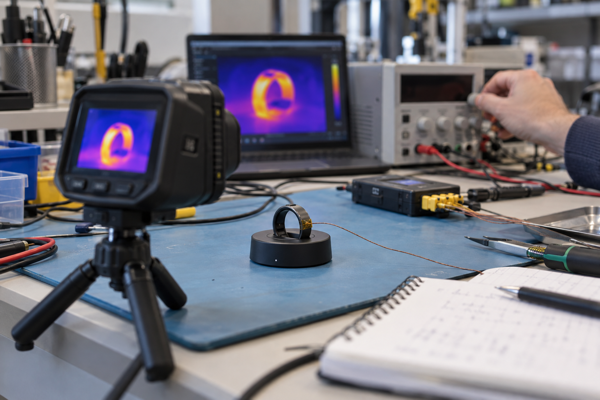
Compact wearable charging ICs commonly include battery-temperature monitoring and thermal regulation because thermal behavior is part of the charging architecture. [6]
So:
Charge current should be selected from the actual cell and complete-device thermal requirements—not from the shortest possible charging-time target.
Waterproofing Is an Enclosure Requirement
Smart rings are often expected to tolerate sweat, washing or water exposure, but the finished product's environmental protection belongs to the complete enclosure design.
It may involve:
- Housing seals
- Welding or adhesive
- Charging-contact design
- PCB protection
- Corrosion control
- Battery-tab routing
- Mechanical tolerances
The battery itself should not inherit the finished ring's IP rating unless the battery has independently verified environmental protection.
In other words:
A waterproof smart ring does not automatically contain a “waterproof battery.”
Mechanical Design Must Account for Cell Tolerance and Aging
The enclosure should also be designed around the real battery mechanical specification.
Relevant inputs may include:
- Cell dimensional tolerance
- Maximum specified thickness
- Required clearance
- Mechanical retention
- Compression policy
- Swelling allowance where applicable
These values must come from the actual selected cell and validation process.
No universal swelling allowance should be assumed.
Smart Ring Battery Design Trade-Offs
| Design Change | Potential Benefit | Main Engineering Trade-Off |
|---|---|---|
| Increase battery volume | Longer potential runtime | Less room for sensors, PCB, antenna or enclosure structure |
| Reduce sensor duty cycle | Lower daily energy consumption | May affect measurement availability or algorithm requirements |
| Reduce BLE synchronization frequency | Lower communication energy | Data may be updated less frequently |
| Increase charging current | Shorter charging time | Greater thermal and cell-stress requirements |
| Use thinner battery geometry | More mechanical flexibility | May reduce available capacity depending on the actual cell design |
| Increase sealing / structural volume | Greater mechanical robustness | Less available battery and electronics volume |
The correct solution is therefore not simply the configuration with the largest battery.
It is the configuration that satisfies the complete runtime, sensing, charging, mechanical and thermal requirements together.
For comparison with a different wearable power profile, see LONGSING's Smart Glasses Battery engineering guide.
4. What Should OEMs Specify Before Developing a Custom Smart Ring Battery?
A battery supplier cannot determine the correct smart-ring cell from a target runtime alone.
For example:
“We need a smart ring battery that lasts seven days”
does not provide enough engineering information.
The supplier needs both the mechanical envelope and the complete electrical load profile.

Mechanical Requirements
Provide:
- Maximum battery length
- Maximum battery width
- Maximum battery thickness
- Available internal battery volume
- Enclosure geometry
- Battery mounting method
- Tab orientation
- Sensor / PCB keep-out areas
- Mechanical clearances
- Sealing constraints
For a smart ring, battery thickness and geometry may be just as important as capacity.
24-Hour Power Budget
Provide the measured or estimated energy profile for:
- Standby current
- Optical sensing
- Motion sensing
- Temperature sensing
- MCU processing
- Data storage
- BLE advertising
- BLE synchronization
- Charger / PMIC quiescent load
- Other always-on circuitry
Ideally, this should be based on measured current-versus-time behavior from representative firmware.
Runtime and Charging Requirements
Provide:
- Target runtime
- Acceptable charging frequency
- Target charging time
- Charger architecture
- Expected charging current
- Required low-SOC reserve
- User charging assumptions
A runtime target should always be paired with an energy budget.
Otherwise, the supplier cannot determine whether the target can be achieved inside the available volume.
Electrical Requirements
Provide:
- Nominal cell voltage requirement
- Maximum charging voltage
- Minimum system operating voltage
- Peak current
- Peak-current duration where relevant
- Protection requirements
- Power-regulation architecture
Although average energy is the dominant design consideration, peak current should still be checked because a very small cell can experience greater loaded-voltage drop under short higher-current events.
Thermal and Environmental Requirements
Provide:
- Operating temperature
- Charging temperature
- OEM-defined allowable enclosure / skin-facing temperature
- Thermal path
- Sweat / moisture exposure
- Waterproofing requirement
- Charging-contact environment
- Sealing method
Because the device is continuously worn against the body, thermal validation should be performed at the complete-device level rather than only on a bare cell.
Skin-interfaced electronics research treats abnormal device heating as an important design concern for wearable systems. [4]
However, the allowable temperature limit depends on the actual product, operating mode, intended use and applicable standards.
Battery Aging and End-of-Life Requirements
Battery selection should not be based only on a fresh cell.
Define:
- Expected product service life
- Acceptable end-of-life runtime
- Typical depth of discharge
- Charging profile
- Temperature history
- Charging frequency
- Battery replacement strategy, if any
Lithium-ion aging depends on more than the number of times a charger is connected.
Temperature, state of charge, depth of discharge and charge/discharge rate all affect degradation.
Therefore:
Charging frequency and battery cycle life are not the same metric.
A shallow recharge is not automatically equivalent to one full battery cycle.
Safety and Transport Requirements
Two standards / regulatory areas should be kept separate.
IEC 62133-2 addresses safety requirements and testing for portable sealed secondary lithium cells and batteries under intended use and reasonably foreseeable misuse. [7]
UN Manual of Tests and Criteria, Part III, Subsection 38.3 addresses lithium-cell and battery testing for transport. [8]
They serve different purposes.
Passing transport testing does not by itself establish complete wearable-product safety compliance.
Likewise, the finished smart ring may have additional requirements depending on:
- Market
- Product classification
- Intended use
- Wireless functions
- Health-related claims
If a product is marketed for medical diagnosis or another regulated medical purpose, additional medical-device requirements may apply. Battery engineering alone does not establish medical performance or regulatory status.
Smart Ring Battery RFQ Checklist
| OEM Input | Why It Matters |
|---|---|
| Maximum battery dimensions | Defines whether the battery can physically fit |
| Battery thickness limit | Critical to ring comfort and enclosure geometry |
| Target runtime | Defines required usable energy |
| Sensor duty cycle | Strongly influences daily energy consumption |
| BLE synchronization interval | Defines communication energy |
| Standby current | Determines persistent background consumption |
| System voltage window | Defines how much battery energy is usable |
| Peak load | Checks loaded-voltage margin |
| Charge current / target charge time | Defines charging and thermal requirements |
| Operating / charging temperature | Affects battery performance and charging limits |
| Sealing architecture | Changes available volume and thermal path |
| Mechanical tolerance / clearance | Supports safe battery integration |
| Target product life | Defines aging and end-of-life runtime requirements |
| Target markets | Determines applicable safety and transport requirements |
Where LONGSING Fits
LONGSING Website B currently provides several rechargeable product directions relevant to compact wearable development.
Its Polymer Lithium Batteries product family is positioned around lightweight, thin-form-factor and compact rechargeable applications.
Its 3.7V Battery Packs provide a candidate 1S rechargeable architecture for portable and wearable devices, with customization around electrical and mechanical requirements.
The broader Lithium-ion Battery Pack platform can also support projects that require customized dimensions, protection or interface requirements.
For a smart ring project, these should be treated as candidate development directions, not as proof that an existing LONGSING product is already qualified for smart-ring use.
A practical development sequence is:
Define Ring Mechanical Envelope
↓
Define Sensing Functions
↓
Measure Each Operating State
↓
Build a 24-Hour Energy Budget
↓
Set Runtime / Charging Target
↓
Calculate Required Usable Energy
↓
Check Battery Thickness and Volume
↓
Optimize Sensor + BLE Duty Cycle if Required
↓
Select Candidate Rechargeable Cell Architecture
↓
Design Protection + Charging
↓
Validate Complete-Device Thermal Performance
↓
Validate Battery Aging / End-of-Life Runtime
↓
Validate the Sealed Finished Device
In a smart ring, longer battery life often depends as much on reducing energy per sensing and synchronization event as on increasing battery capacity.
Conclusion
A smart ring battery cannot be selected from mAh alone.
The battery must fit within an extremely limited mechanical envelope while supporting continuous sensing, BLE communication and an acceptable charging interval. That means OEMs must develop the battery and device power budget together.
The strongest designs balance battery volume, daily device energy, charging frequency, thermal behavior and mechanical integration as one complete wearable system.
Developing a Smart Ring or Ultra-Compact Wearable?
For a meaningful battery evaluation, prepare:
- Maximum battery length, width and thickness
- Available internal battery volume
- System voltage window
- Standby current
- Sensor duty cycles
- MCU active-time profile
- BLE advertising and synchronization behavior
- Daily energy estimate
- Target runtime
- Acceptable charging frequency
- Target charge time
- Peak-current requirement
- Operating and charging temperatures
- Sealing and waterproof-enclosure requirements
- Mechanical clearances
- Target service life
- End-of-life runtime requirement
- Safety and transport requirements
- Target markets
These inputs allow the battery architecture to be evaluated against the actual wearable design rather than a target mAh value alone.
Frequently Asked Questions About Smart Ring Batteries
Click to explore more information about smart ring batteries
1. What type of battery is used in a smart ring?
Smart rings can use small rechargeable lithium-based cells where the voltage, capacity, thickness, geometry, charging requirements and protection design fit the device. Li-polymer or other compact single-cell lithium architectures may be candidates, but there is no universal battery specification for all smart rings.
2. How is smart ring battery life calculated?
A first-order estimate divides usable battery energy by the complete device's average daily energy consumption. The daily power budget should include sensors, MCU processing, BLE communication, storage, standby current and power-management losses. Real runtime should then be validated under representative device settings and temperature conditions.
3. Why can't a smart ring simply use a larger battery?
Internal space is extremely limited. A larger battery can reduce the space available for sensors, PCB, antenna, charging components, structural walls and sealing features. It can also increase ring thickness or affect comfort. Battery capacity therefore has to be optimized with the complete mechanical design.
4. How do sensors affect smart ring battery life?
Sensor energy depends on configuration. Optical sensing can vary with LED current, duty cycle and sampling rate, while motion and temperature sensing depend on sampling and wake-up behavior. Higher sensing activity generally increases daily energy consumption, so sensing requirements should be included directly in the battery budget.
5. How does Bluetooth Low Energy affect smart ring battery consumption?
BLE energy consumption depends on advertising interval, connection interval, Peripheral Latency, TX power, data volume and synchronization frequency. BLE is optimized for low-power communication, but frequent connections or large data transfers can still become a meaningful part of the smart ring's daily energy budget.
6. Is a 3.7V Li-polymer battery suitable for a smart ring?
A 3.7V-class Li-polymer or other 1S lithium architecture may be suitable for some designs, but it is not a universal smart-ring standard. Compatibility must be verified against the device voltage window, maximum charge voltage, capacity, dimensions, peak load, charging system and mechanical enclosure.
7. How does charging frequency affect smart ring battery aging?
Charging frequency alone does not determine battery aging. Lithium-ion degradation is also influenced by temperature, state of charge, depth of discharge and charge/discharge rate. A product's charging strategy should therefore be evaluated using the actual usage and thermal profile rather than simply counting charging sessions.
8. What information should an OEM provide for a custom smart ring battery?
Provide the maximum battery dimensions, available volume, voltage window, sensor duty cycles, standby current, BLE behavior, target runtime, charging frequency, peak load, charge current, operating and charging temperature, enclosure constraints, required product life and applicable safety or transport requirements.
References
[1] Bluetooth SIG — Bluetooth Low Energy Primer. Supports connection interval, Peripheral Latency and BLE operating behavior. ↪
[2] Nordic Semiconductor — Bluetooth LE Power Optimization. Supports advertising, connection, TX and data-transfer power trade-offs. ↪
[3] Development of a Rotation-Robust PPG Sensor for a Smart Ring (2025). Peer-reviewed research on optical duty cycling and battery-constrained smart-ring integration. ↪
[4] Responsive Materials and Mechanisms as Thermal Safety Systems for Skin-Interfaced Electronic Devices; Wearable Ring-Shaped Biomedical Device. Peer-reviewed wearable integration and thermal-safety research. ↪
[5] Analog Devices MAX86174B and Texas Instruments AFE4420 — wearable optical-sensing technical resources. ↪
[6] Texas Instruments BQ25150 — wearable charger and power-management technical resource. ↪
[7] IEC 62133-2:2017+AMD1:2021 — safety requirements for portable sealed secondary lithium cells and batteries. ↪
[8] UNECE — UN Manual of Tests and Criteria, Rev. 8 and Amendment 1 — Part III, subsection 38.3 lithium-cell and battery transport testing. ↪