
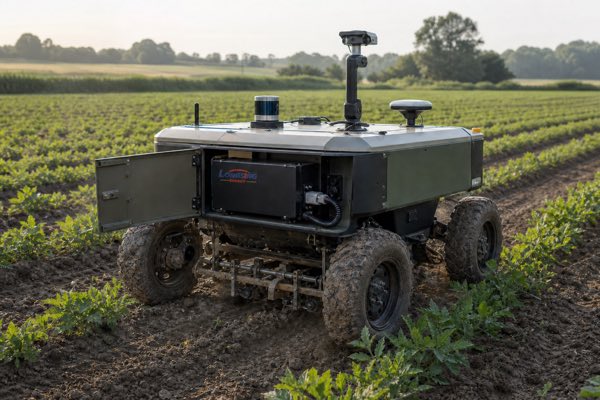
Agricultural robots may look like another type of mobile robot, but field operation creates a very different battery problem. Long working periods, changing motor and actuator loads, dust, moisture, uneven terrain and repeated charging all influence whether the robot can complete productive work reliably.
An agricultural robot battery therefore needs to be engineered around the complete duty cycle—not selected only by voltage and Ah capacity.
A rechargeable lithium battery pack is suitable for many agricultural robots, but there is no universally best chemistry or format. Engineers should select the battery according to operating voltage, capacity, peak current, runtime, temperature, charging strategy, available space, weight, cycle-life target and safety requirements. 18650, 21700 and LiFePO₄ systems can all be appropriate when matched to the actual farming application.
The battery should therefore be treated as part of the agricultural robot’s electrical, mechanical and control architecture—not as a standalone component selected after the robot design is finished.
Table of Contents
- Why Do Agricultural Robots Create Different Battery Requirements?
- How Should Engineers Select and Size an Agricultural Robot Battery Pack?
- How Should Battery Architecture Change by Agricultural Robot Operating Scenario?
- What Should OEMs Specify for a Custom Agricultural Robot Battery Pack?
1. Why Do Agricultural Robots Create Different Battery Requirements?
An agricultural robot battery has to support a machine whose electrical demand and operating environment can change significantly during one working cycle. A field platform may simultaneously power traction motors, steering systems, pumps, manipulators, sensors, cameras, onboard computers and communication equipment.
Modern agricultural robotics covers tasks including weeding, spraying, harvesting, crop monitoring and multipurpose field operations, and different tasks can require very different sensing, actuation and powertrain architectures. [1]
That is why battery selection should begin with the actual field duty cycle rather than a generic “robot battery” specification.
Different Tasks Create Different Load Profiles
An inspection robot and a spraying robot may look similar mechanically but impose very different demands on the battery.
A crop-monitoring platform may spend much of its energy on:
- Traction
- Cameras
- LiDAR or other sensors
- Positioning systems
- Onboard computing
- Wireless communication
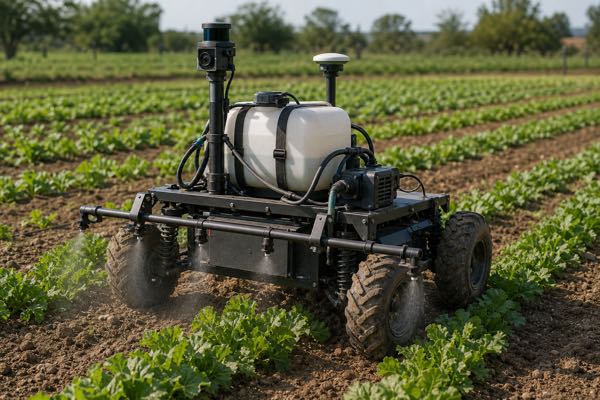
A spraying robot can add:
- Liquid pumps
- Valves
- Application actuators
- Additional payload
A mechanical weeding platform may add:
- Cutting tools
- Rotary implements
- Servo systems
- Short-duration high mechanical loads
A harvesting robot may combine traction with manipulators, perception hardware and repeated actuator movements.
The battery engineering question is therefore not simply:
“How many amp-hours does the battery have?”
A more useful question is:
“What electrical load must the battery support throughout the complete agricultural task?”
Average Power and Peak Power Must Both Be Considered
Battery runtime is mainly an energy problem, but motors, pumps and actuators can also create short periods of substantially higher current.
A first-order energy relationship is:
Battery Energy (Wh) = Nominal Voltage (V) × Capacity (Ah)
A first estimate of runtime can then be expressed as:
Estimated Runtime ≈ Usable Battery Energy ÷ Average System Power
However, a practical design should also account for:
- Conversion losses
- Reserve State of Charge
- Terrain
- Payload
- Temperature
- Peak-current events
- Battery aging
A pack with enough theoretical Wh can still be unsuitable if its cells, interconnects or BMS cannot support the required peak load without excessive voltage drop or protection trips.
Field Operation Adds Environmental and Mechanical Stress
Agricultural robots may operate over:
- Uneven ground
- Dry dust
- Wet soil
- Mud
- Vegetation
- Rain or irrigation moisture
- Repeated vibration and shock
This makes an outdoor robot battery pack a mechanical and environmental subsystem as well as an electrical one.
Important design areas include:
- Cell restraint
- Module fixation
- Busbar and weld reliability
- Cable strain relief
- Connector selection
- Enclosure sealing
- Condensation management
- Service access
If a project requires a defined IP classification, the target should be specified and validated for the actual enclosure. IEC 60529 defines the IP Code used to classify enclosure protection, but this does not mean every agricultural robot battery should automatically be described as IP65, IP67 or another rating. [6]
The required environmental protection level must come from the real field application and validated pack design—not from a generic “outdoor battery” label.
Long Daily Use Makes Battery Aging Part of the Design Problem
Commercial farming equipment may charge and discharge repeatedly over long working seasons.
Lithium-ion aging depends on more than cycle count. Factors such as charge/discharge rate, temperature, State of Charge history and depth of discharge can influence long-term degradation. [5]
For additional technical background, see the NREL battery lifetime and degradation research.
For an OEM, the correct question is therefore not simply:
“How many cycles does this cell have?”
A more useful question is:
“What charging, temperature and depth-of-discharge conditions will the agricultural robot actually impose over its expected service life?”
2. How Should Engineers Select and Size an Agricultural Robot Battery Pack?
Engineers should select an agricultural robot battery pack by defining the machine’s voltage window, energy requirement, average and peak current, charging strategy, temperature conditions, mechanical envelope and expected life before choosing the cell chemistry or format.
Start With Voltage, Energy and Current—not Cell Format
Before deciding between 18650, 21700, LiFePO₄ or another rechargeable lithium solution, define:
- Nominal system voltage
- Minimum and maximum operating voltage
- Average current or power
- Peak current and duration
- Required productive runtime
- Charging current
- Available installation volume
- Maximum acceptable battery weight
This prevents a common design mistake:
Choosing a familiar cell first and then trying to force the agricultural robot architecture around it.
Voltage should match the drive electronics and other DC loads. Capacity should satisfy the energy target. Peak-current capability must accommodate traction and actuator transients.
For some farming platforms, a 48V agricultural robot battery may fit the electrical architecture; other robots may use lower or higher system voltages.
The correct voltage depends on the motors, converters, charger and controller design rather than the application name alone.
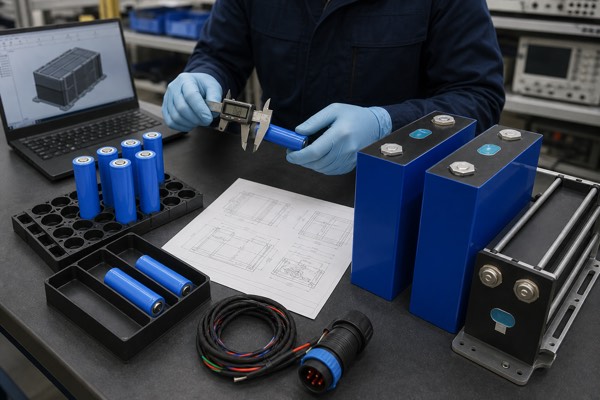
18650 vs 21700 vs LiFePO₄: Which Architecture Fits?
There is no universal winner.
18650 battery cells can be useful when designers need a mature cylindrical architecture with flexible series and parallel configuration.
21700 battery cells provide another cylindrical option and can reduce the number of individual cells needed for a given energy target when the selected cell provides a suitable per-cell capacity and current capability.
LiFePO₄ prismatic cells may be considered where priorities such as cycle performance and thermal stability align with the application, while acknowledging the different voltage and energy-density characteristics compared with some nickel-based lithium-ion chemistries.
The selection should therefore depend on:
| Design Factor | Engineering Question |
|---|---|
| Energy density | How much energy must fit into the available volume and weight? |
| Peak power | Can the cell and pack support traction, pump or actuator transients? |
| Cycle requirement | How frequently will the robot charge and discharge? |
| Temperature | What field and charging temperatures must be supported? |
| Mechanical space | Does cylindrical or prismatic packaging integrate better? |
| Serviceability | Is the pack fixed, removable or regularly swapped? |
| Safety strategy | What cell, pack, BMS and enclosure protections are required? |
For applications where a custom prismatic architecture is preferred, LONGSING Website B also provides custom prismatic battery packs.
Temperature Must Be Considered at Cell and Pack Level
Temperature influences available battery performance, charging behavior and aging, while the pack itself also generates heat during charging and discharge.
NREL thermal-characterization work emphasizes that battery thermal management should be evaluated at both cell and pack level and that temperature non-uniformity can develop inside a pack. [4]
For technical background, see the NREL lithium-ion battery thermal characterization study.
For an agricultural robot, engineers should therefore define:
- Expected ambient-temperature range
- Charging-temperature range
- Maximum sustained load
- Peak load
- Enclosure heat rejection
- Temperature sensor placement
- BMS temperature thresholds
Do not publish a generic operating-temperature range unless it has been verified for the selected cell, BMS and complete battery pack.
Smart BMS Protects the Pack—but Must Match the Application
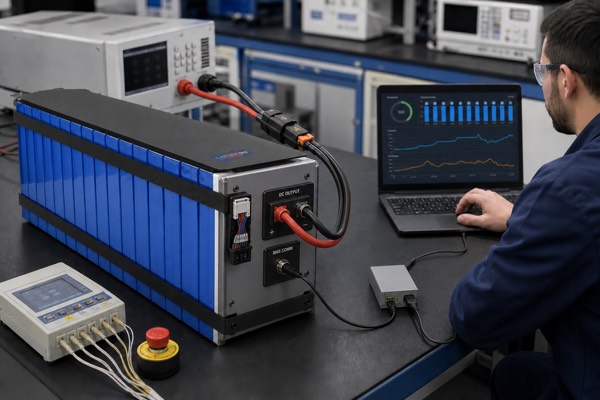
A Smart BMS can monitor and protect multi-cell lithium battery packs by measuring variables such as individual cell voltage, current and temperature.
Modern BMS architectures may support functions such as:
- Individual cell monitoring
- Overvoltage protection
- Undervoltage protection
- Charge and discharge overcurrent protection
- Short-circuit protection
- Overtemperature and undertemperature protection
- Cell balancing
Texas Instruments battery-monitor architectures provide examples of these monitoring and protection functions in multi-cell lithium battery systems. [7]
For a farming robot, the actual BMS requirements should be defined according to:
- Battery chemistry
- Number of series cells
- Current level
- Temperature-sensor requirements
- Charger architecture
- Service strategy
- Robot controller
Proper pack consistency also starts before the BMS is connected. For deeper technical background, see LONGSING’s battery cell matching guide covering capacity, OCV and ACIR.
SOC and Communication Can Become System-Level Requirements
For an autonomous farming robot, battery information can affect machine behavior.
Depending on the architecture, the controller may use:
- State of Charge (SOC)
- Pack voltage
- Current
- Battery temperature
- Warnings
- Protection status
- Charge and discharge permissions
Communication may therefore be required between:
Battery ↔ Robot Controller ↔ Charger
However, CAN is not mandatory for every agricultural robot.
A system may use:
- CAN
- RS485
- UART
- A proprietary communication interface
NXP battery-management communication documentation provides examples of systems bridging interfaces such as CAN, SPI and UART. [8]
The important engineering rule is:
Specify both the physical communication interface and the actual protocol/data definition before freezing the BMS architecture.
For more detail, see LONGSING’s CAN vs RS485 for Lithium Battery BMS engineering guide.
3. How Should Battery Architecture Change by Agricultural Robot Operating Scenario?
The best lithium battery for agricultural robots depends strongly on what the machine actually does. Inspection, spraying, weeding and harvesting platforms can have very different energy, power, charging and integration priorities.
Agricultural Robot Battery Architecture by Operating Scenario
| Agricultural Robot Scenario | Typical Load Characteristics | Battery Priority | Possible Charging Approach | Important Design Considerations |
|---|---|---|---|---|
| Crop-monitoring / inspection robot | Traction + cameras + sensors + computing | Runtime and auxiliary efficiency | Docking, manual or swap | Energy density, SOC accuracy, low-power electronics |
| Autonomous weeding robot | Traction + mechanical, thermal or laser tools depending on design | Runtime + transient power | Docking or swappable pack | Peak current, vibration, tool duty cycle |
| Spraying robot | Traction + pump + valves + payload | Energy + sustained auxiliary load | Manual, opportunity or swap | Pump current, payload changes, moisture protection |
| Harvesting / field-service robot | Traction + manipulators + sensing + repeated actuators | Energy + peak power + availability | Swap or scheduled charging | Current transients, mechanical integration, serviceability |
These are architecture examples rather than fixed specifications. Exact battery requirements should come from the OEM’s measured or modeled robot duty cycle.
Docking Charging
Automatic docking can be useful when the agricultural robot repeatedly returns to a known base station.
Design questions include:
- Charger voltage and current
- Contact alignment
- Charging temperature
- Communication handshake
- Charge completion criteria
- Protection during connector faults
Docking works best when charging time fits naturally into the robot’s workflow.
Swappable Battery Packs
For robots where downtime is expensive or access to a fixed charger is difficult, a replaceable agricultural robot battery pack may be more practical.
This architecture adds requirements such as:
- Quick mechanical retention
- Robust connectors
- Safe disconnect sequence
- Battery identification
- Operator handling
- State tracking between packs
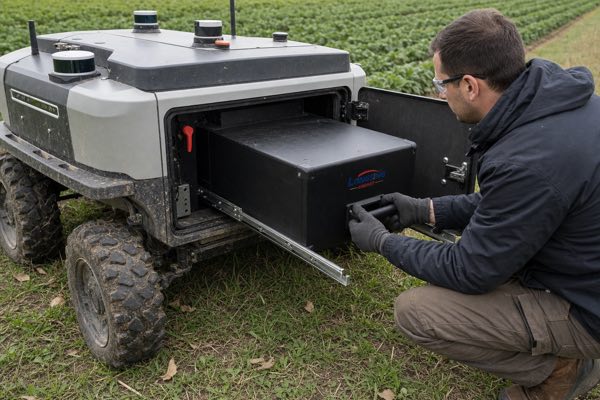
A swappable architecture can reduce vehicle downtime, but it also increases battery-fleet and connector-management complexity.
Opportunity Charging
Some agricultural robots may have short planned idle periods during:
- Refilling
- Unloading
- Tool exchange
- Service stops
These periods may support opportunity charging if the selected chemistry, charger and thermal conditions support the required charge rate.
“Fast charging” should never be selected from a headline C-rate alone.
Charge rate, cell temperature, State of Charge window, chemistry and expected battery lifetime should be evaluated together.
Field Serviceability Should Influence the Pack From the Start
An agricultural robot operating far from a workshop has different service requirements from an indoor robotic platform.
The battery pack design may therefore need to consider:
- Replacement access
- Connector visibility
- Diagnostic access
- Enclosure fasteners
- Carrying and handling
- Contamination around sealing surfaces
- Maintenance procedures
Serviceability should be designed into the battery architecture rather than added after the enclosure and robot chassis are already frozen.
4. What Should OEMs Specify for a Custom Agricultural Robot Battery Pack?
An OEM should specify the agricultural robot’s electrical load, runtime target, installation constraints, charging method, environment, communication and service-life goals before requesting a custom agricultural robot battery pack.
The quality of the initial engineering information strongly affects how accurately a battery supplier can evaluate chemistry, cell format, series/parallel configuration, BMS and mechanical design.
Electrical Requirements
Provide:
- Nominal voltage
- Full operating-voltage window
- Average current or power
- Peak current
- Peak-current duration
- Expected runtime
- Auxiliary loads
- Regenerative or reverse-current conditions, if applicable
If possible, provide an actual current-versus-time load profile from the agricultural robot.
For a machine with drive motors, pumps and manipulators, this is considerably more useful than simply stating:
“We need a 48V 50Ah battery.”
Charging Requirements
Define whether the robot uses:
- Docking charging
- Manual plug-in charging
- Swappable battery packs
- Opportunity charging
Also provide:
- Charger voltage
- Desired charging time
- Expected charging temperature
- Charger communication requirements
- Connector requirements
Mechanical and Environmental Requirements
Provide:
- Maximum battery dimensions
- Weight target
- Mounting orientation
- Retention method
- Vibration and shock conditions
- Dust and moisture exposure
- Enclosure requirements
- Connector position
- Cable and harness requirements
- Service or replacement method
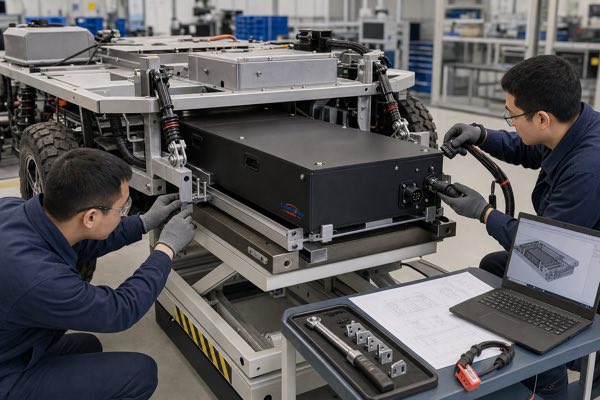
Where an IP rating is required, specify it as a project requirement and validate the complete battery enclosure, rather than assuming the cells or a generic battery pack automatically meet that rating.
BMS and Communication Requirements
Define:
- Number of series cells
- Current requirement
- Temperature-sensor requirements
- Balancing requirements
- SOC / SOH requirements
- Fault diagnostics
- Charger interface
- Host-controller interface
If CAN is required, also provide:
- CAN bitrate
- Protocol
- Message IDs
- Data definitions
- Transmission timing
- Fault behavior
- DBC file, where available
Cell Matching and Production Validation
Pack performance also depends on consistency between the cells used in a series and parallel assembly.
Before mass production, an agricultural robot battery project may require validation of:
- Capacity
- Discharge performance
- Peak-load response
- Charging behavior
- BMS protection functions
- Temperature sensing
- Communication
- Connector and interface behavior
- Mechanical fit
- Environmental enclosure
- Representative agricultural duty cycle
For industrial secondary lithium batteries, IEC 62619 addresses safety requirements and testing, while IEC 62620 covers performance requirements and tests for industrial secondary lithium cells and batteries. The applicable standard set still depends on the actual product, market and equipment classification. [2][3]
Where LONGSING Fits
LONGSING Website B currently supports custom lithium-ion battery packs and customized rechargeable battery solutions based on electrical parameters, mechanical dimensions and interface requirements.
The current Website B product structure also includes:
- 18650 battery cells
- 21700 battery cells
- LiFePO₄ prismatic batteries
- custom prismatic battery packs
- 48V battery packs
This allows an agricultural robot project to begin from the machine requirements rather than from a predetermined cell or standard pack.
Conclusion
A reliable agricultural robot battery must support the robot’s complete field duty cycle—not only its nominal voltage and capacity. Load profile, peak current, chemistry, temperature, charging method, Smart BMS, communication, enclosure and serviceability all influence the final battery design. The right architecture therefore depends on what the farming robot does, where it operates and how it must remain productive throughout the working day.
Developing an autonomous farming platform?
For a custom battery evaluation, prepare the following project information:
- Nominal and operating voltage
- Target capacity or runtime
- Average and peak load
- Available battery space
- Weight target
- Charging method
- Operating environment
- Communication requirements
- Connector and mounting requirements
These inputs allow the cell configuration, battery pack, BMS and mechanical architecture to be evaluated against the actual agricultural robot rather than a generic battery specification.
Frequently Asked Questions about Agricultural Robot Batteries
Click to explore more information about agricultural robot battery design
Q: What type of battery is used in agricultural robots?
A: Many electric agricultural robots use rechargeable lithium battery systems, but the most suitable chemistry and format depend on voltage, runtime, peak current, space, weight, temperature, charging strategy and cycle-life requirements. 18650, 21700 and LiFePO₄ battery architectures can all be appropriate for different farming robots.
Q: Is LiFePO₄ suitable for agricultural robots?
A: Yes. LiFePO₄ can be suitable when its cycle-performance, thermal and packaging characteristics align with the application. However, its voltage and energy-density characteristics differ from other lithium-ion chemistries, so it should not automatically be considered the best option for every agricultural robot.
Q: How do you calculate agricultural robot battery capacity?
A: Start with the robot’s average power and required operating time to estimate energy in Wh. Then account for reserve SOC, efficiency losses, temperature, aging and the actual duty cycle. Peak-current capability should be checked separately because Ah capacity alone does not prove that the battery can support motor, pump or actuator transients.
Q: Why does an agricultural robot need a Smart BMS?
A: A Smart BMS can monitor cell voltage, current and temperature and provide protection against conditions such as overvoltage, undervoltage, overcurrent, short circuit and abnormal temperature. Depending on the design, it may also support balancing, diagnostics and battery-status communication.
Q: Can agricultural robots use 18650 or 21700 cells?
A: Yes. Both formats can be configured into custom battery packs when their energy, current, thermal and mechanical characteristics fit the agricultural robot. The selection should be based on pack-level requirements rather than choosing a format only because it is widely available.
Q: How does temperature affect an agricultural robot battery?
A: Temperature affects battery resistance, available performance, charging behavior and degradation. Outdoor robots therefore need pack-level thermal analysis, temperature sensing and charging and discharging limits appropriate to the selected cells and duty cycle.
Q: What is the best charging method for an autonomous farming robot?
A: There is no universal best method. Docking may suit robots that regularly return to a base, swappable packs may suit applications where uptime is critical, and opportunity charging can use planned idle periods. The decision should consider charge rate, temperature, battery life, workflow and charging infrastructure.
Q: What information is needed to design a custom agricultural robot battery pack?
A: Provide voltage range, average and peak current, runtime target, battery space, weight target, charging strategy, ambient conditions, moisture and dust requirements, connector details, communication protocol and expected service life. A measured current-versus-time load profile is especially useful.
Reference: