
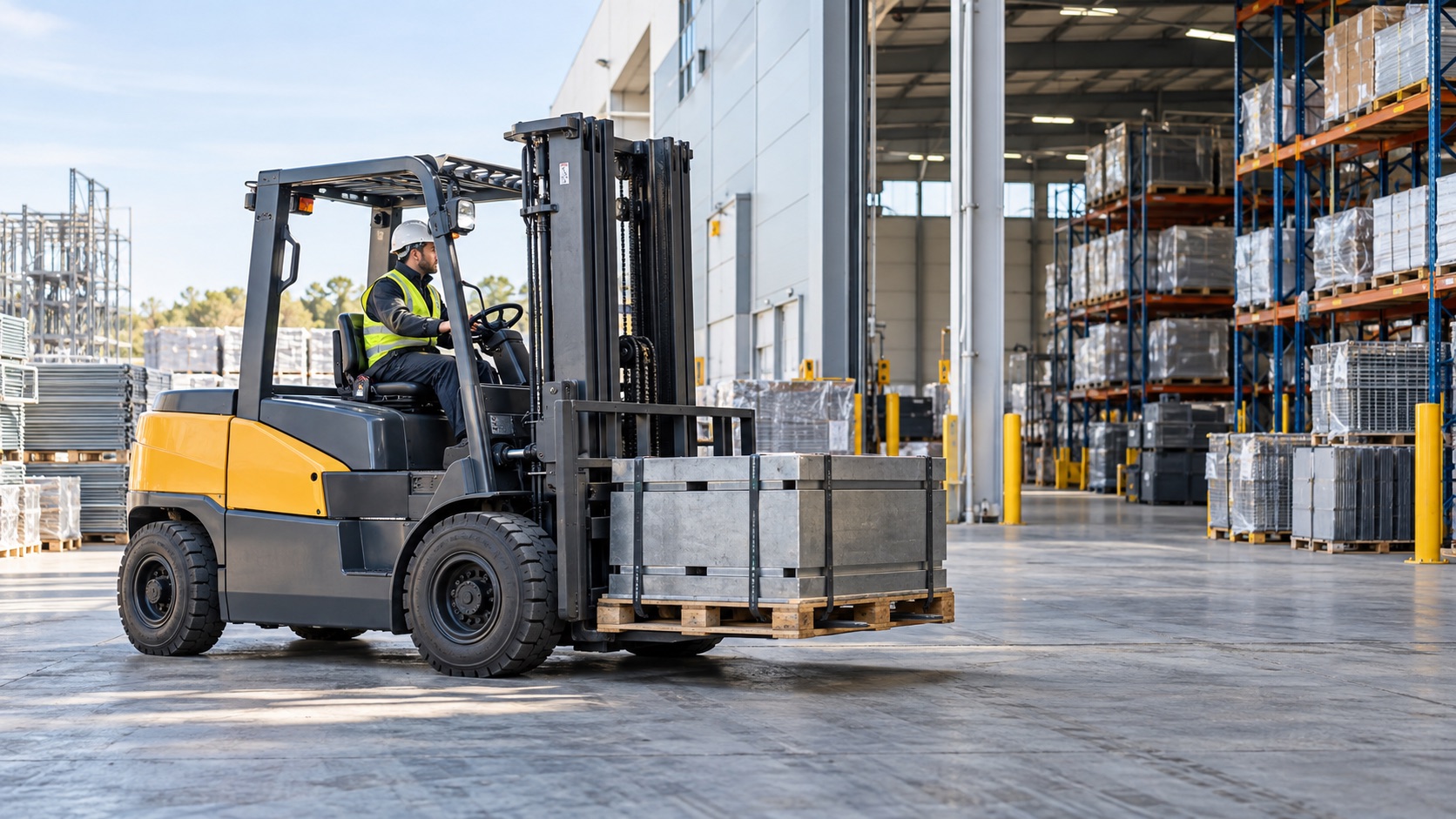
As electric forklifts move from lighter warehouse applications into heavier material-handling duties, does the electric forklift battery simply need more capacity—or does the entire pack architecture need to change?
That question is becoming increasingly relevant as electric powertrains move into higher-capacity industrial trucks.
In September 2026, Hyundai Material Handling completed a high-voltage electric counterbalance forklift range covering lifting capacities from 4 to 18 tonnes. Its smaller and heavier machines do not simply use progressively larger versions of the same battery architecture: the range uses approximately 309–348 V systems in the 4–9 tonne models and 618 V in the 10–18 tonne machines. [1]
The important engineering lesson is not that every heavy-duty forklift should use high voltage.
High voltage is one engineering option for higher-power forklift architectures, not a universal requirement for heavy-duty electric forklifts.
As lifting capacity, traction power, hydraulic demand and operating intensity increase, the battery may need to support a fundamentally different combination of voltage, current, energy, thermal management and charging requirements.
An electric forklift battery supplies much more than propulsion. Depending on the truck architecture, the pack may supply traction motors, hydraulic pumps, lifting systems, steering, controllers, lighting and other auxiliary loads—sometimes simultaneously.
This changes the battery-design question from:
“How many amp-hours does the forklift need?”
to:
“What combination of voltage, usable energy, continuous power, peak current, charging strategy and mechanical integration can support the actual forklift duty cycle?”
Featured Snippet: What Battery Is Suitable for an Electric Forklift?
An electric forklift battery may use lead-acid or rechargeable lithium chemistry, including LiFePO4 and other lithium-ion systems. The suitable battery depends on system voltage, traction and hydraulic power demand, runtime, peak current, shift pattern, charging windows, battery compartment, operating temperature and required battery mass. Heavy-duty forklifts may require substantially different power and voltage architectures from light warehouse trucks, so battery sizing should follow the actual duty cycle rather than Ah alone.
Table of Contents
1. Why Heavy-Duty Electric Forklifts Create a Different Battery Challenge
Traction Is Only Part of the Electrical Load
An electric forklift is not simply an electric vehicle with forks attached.
The electric forklift battery may need to supply several major electrical systems, including:
- traction motors;
- hydraulic pumps;
- lifting and mast functions;
- steering systems;
- vehicle controllers;
- displays and onboard electronics;
- lighting; and
- application-specific auxiliary equipment.
The resulting load profile changes continuously.
During steady travel on a level surface, traction may dominate. During pallet pickup, stacking or mast operation, hydraulic demand becomes more important. Acceleration, ramp climbing or simultaneous travelling and lifting can create short periods in which battery power demand is much higher than the shift average.
Repeated pallet-handling also creates frequent start-stop events rather than a smooth discharge profile.
For this reason, an electric forklift battery should be specified from the actual operating cycle, including acceleration, lifting, lowering, travelling, turning, idling and combinations of those functions.
Energy, Power and Peak Current Are Different Requirements
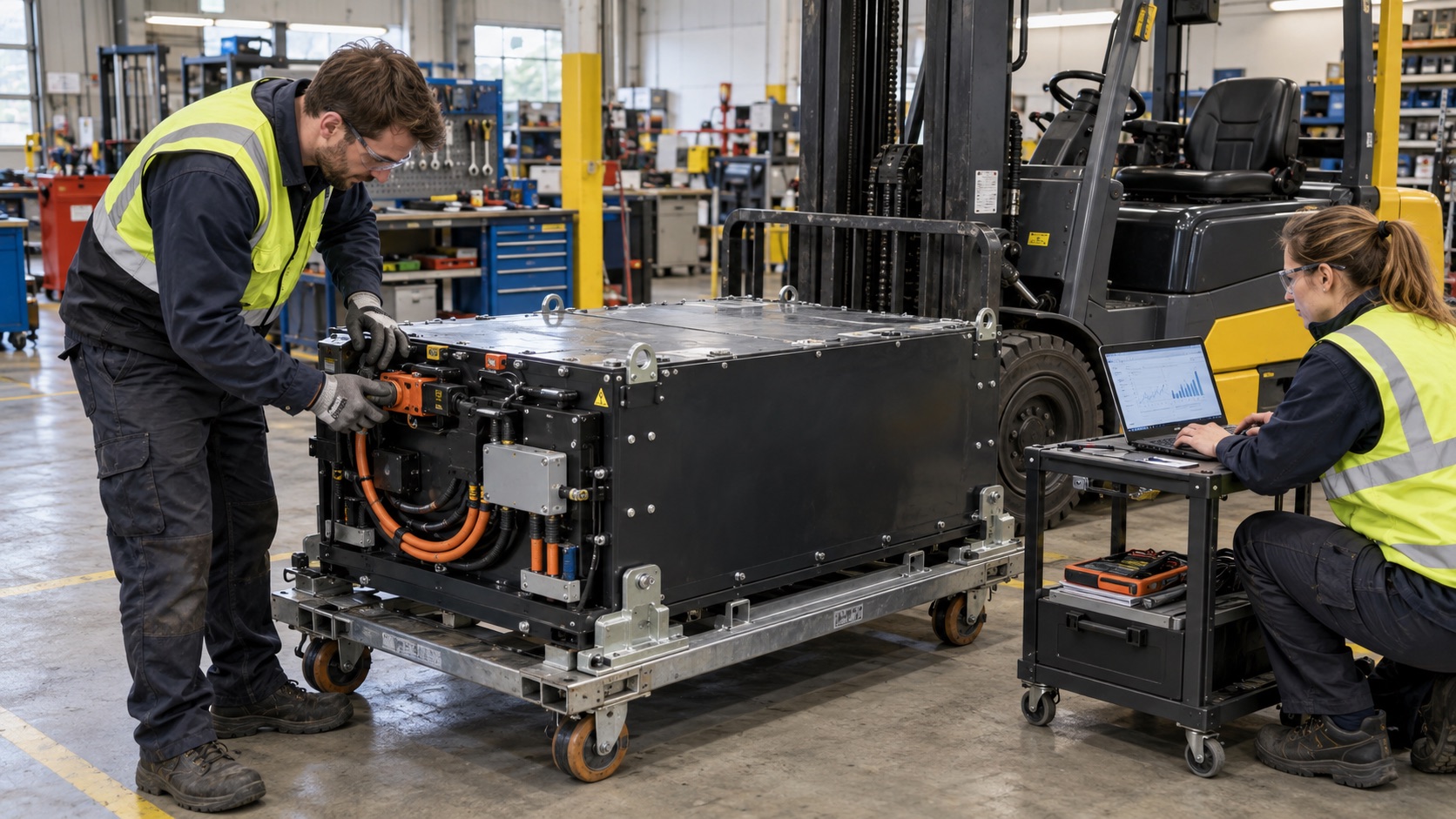
Three electrical quantities must be separated when sizing an electric forklift battery.
Energy — Wh or kWh
Energy describes how much electrical work the battery can provide over time.
Energy (Wh) ≈ Nominal Voltage (V) × Capacity (Ah)
This is one reason Ah alone is not sufficient for comparing battery systems. Two batteries with the same Ah rating but different nominal voltages do not contain the same nominal energy.
Power — W or kW
Power describes how rapidly energy must be delivered:
Power (W) = Voltage (V) × Current (A)
The electric forklift battery must therefore support the continuous electrical power required by the forklift—not simply enough energy to complete the shift.
Peak Current
Peak current describes short-duration current demand during acceleration, heavy lifting, intensive hydraulic operation, ramp climbing or simultaneous travel and hydraulic activity.
A battery can theoretically contain enough kWh for an entire work shift and still be poorly matched to the forklift if excessive voltage drop, BMS current limiting or thermal stress occurs during peak events.
That is why a forklift lithium battery pack should not be sized from Ah alone.
OEM engineers should define or measure:
- average energy consumption;
- continuous discharge requirement;
- peak-current magnitude;
- peak-current duration;
- frequency of peak events; and
- simultaneous traction and hydraulic loads.
Duty Cycle Determines Battery Requirements
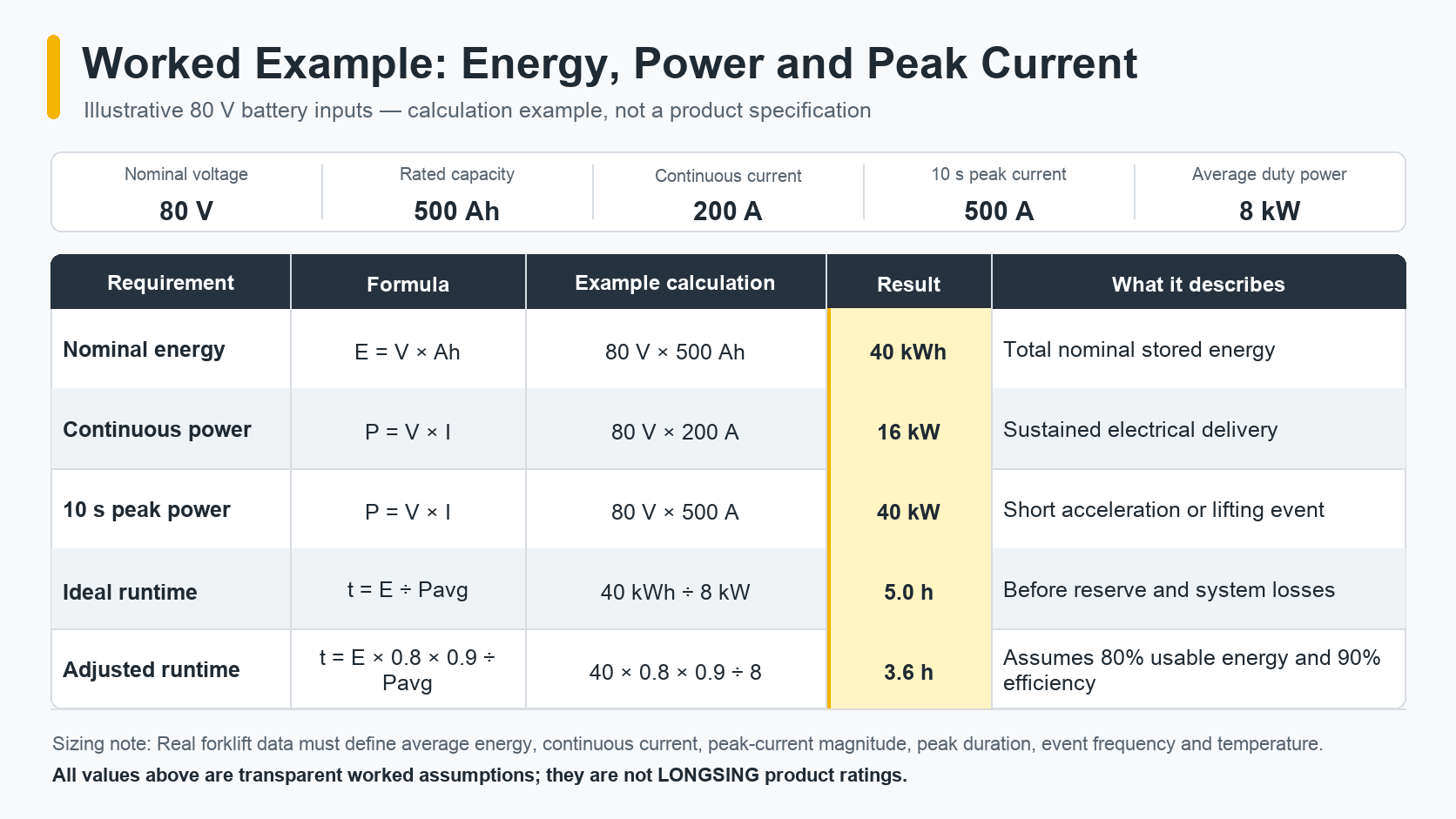
Two forklifts with similar rated lifting capacities can have very different battery requirements.
Important variables include typical and maximum load, travel distance, number of lifts, lift height, floor gradient, acceleration frequency, vehicle speed, idle time, operating hours per shift, shifts per day and available charging windows.
A warehouse forklift travelling short distances may spend much of its working time stopping, turning and lifting. Another truck may travel substantially longer distances between loading points. A heavy industrial forklift may combine significant traction demand with repeated high-power hydraulic operation over long outdoor shifts.
Electric forklift battery selection should therefore be based on measured or realistically modelled duty-cycle data rather than forklift tonnage alone.
When Does Higher System Voltage Become Useful?
Electrical power is approximately:
P = V × I
For the same power, increasing system voltage reduces the required current.
Electrical conductor losses are approximately related to:
P-loss = I²R
Reducing current can therefore reduce resistive losses and heat generation. Depending on the complete electrical architecture, higher voltage may also allow changes in cable size, busbars and power-electronic design.
This is one reason higher-voltage architectures become attractive as forklift power increases.
Hyundai’s current B-X range provides a useful real-world example. Its 4–9 tonne machines use approximately 309–348 V systems, while the 10–18 tonne machines use 618 V. Hyundai identifies reduced electrical current and lower heat generation among the reasons for using higher-voltage architecture in these high-capacity trucks. [1]
However, these values belong to one manufacturer’s vehicle architecture. They are not standard forklift battery voltages.
Actual voltage depends on the forklift class, lifting capacity, required vehicle power, traction-motor architecture, hydraulic system, motor controller, charger and overall OEM electrical design.
A 48 V architecture may be appropriate for some material-handling equipment, while a heavy industrial forklift may require a much higher system voltage.
The correct sequence is therefore:
Vehicle power requirement → suitable system voltage → battery architecture
rather than selecting a battery voltage first and forcing the forklift system around it.
For projects where a higher-voltage architecture is technically appropriate, LONGSING’s High-Voltage Battery Packs category covers customized battery systems based on project-specific voltage, capacity, power, chemistry, series-parallel configuration, BMS and enclosure requirements.
2. How to Design a Lithium Battery Pack for an Electric Forklift
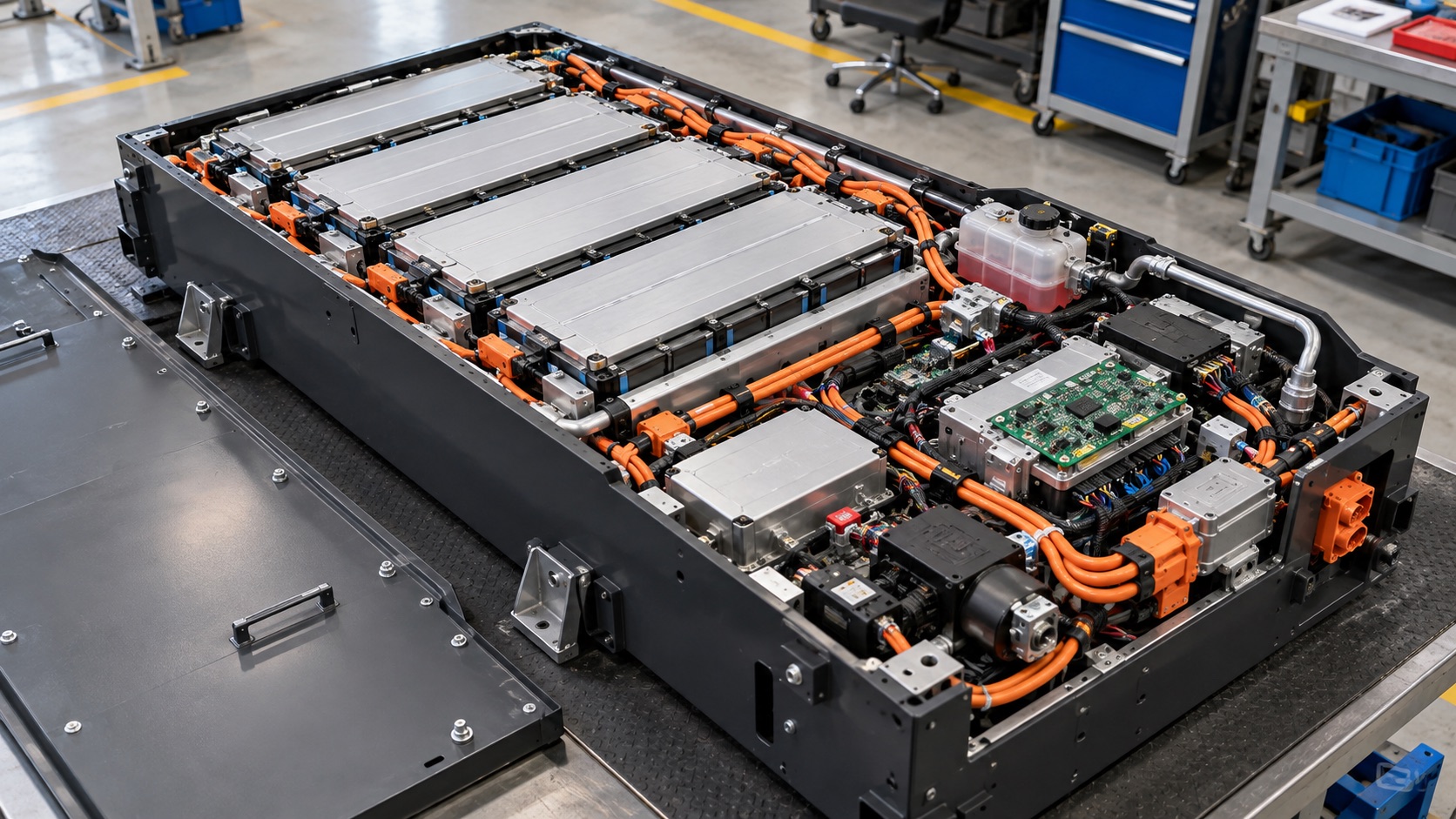
Once the operating profile is understood, those requirements have to be translated into cell chemistry, cell format, series-parallel architecture, BMS, charging strategy, thermal design and mechanical integration.
Selecting Battery Chemistry
LiFePO4 and other lithium-ion chemistries can both be relevant to electric forklift applications.
LiFePO4 is often considered where industrial cycling, thermal behaviour and long-term durability are important design considerations. NMC and other lithium-ion chemistries can provide higher specific or volumetric energy where pack weight or installation volume is particularly constrained.
The trade-off is not simply LFP = good, NMC = bad or LFP = forklift battery.
Chemistry selection should consider cycle-life target, energy density, power capability, cell temperature, required pack weight, available volume, charging strategy, safety architecture, environmental conditions and overall system cost.
LiFePO4 should not automatically be specified merely because the application is a forklift.
The cell chemistry has to match the vehicle and operating profile.
Prismatic vs Cylindrical Cell Architecture
An electric forklift battery may use prismatic or cylindrical cells depending on the required energy, available space, thermal architecture, mechanical design, manufacturing process and service requirements.
For larger industrial battery systems, prismatic LiFePO4 cells can be particularly relevant because their rectangular geometry can support efficient packaging in larger modules and enclosures.
Cylindrical architectures can also be suitable where modularity, automated assembly or a particular current-distribution and thermal architecture is preferred.
The correct cell format should consider required pack energy, series and parallel configuration, cell current capability, module architecture, busbar design, heat-transfer path, mechanical restraint, enclosure geometry, manufacturing method and serviceability.
LONGSING’s Prismatic Lithium Batteries and Custom Prismatic Packs provide relevant development directions where a prismatic architecture fits the electrical and mechanical requirements.
Cell Consistency in Large Battery Packs
A high-energy pack contains multiple electrochemical cells or parallel cell groups working together.
Differences in capacity, open-circuit voltage, internal resistance and thermal behaviour can cause some cells or series groups to reach their operating limits before others. That can reduce the amount of pack capacity that is practically usable or cause earlier BMS intervention.
Cell matching should therefore be considered during manufacturing rather than assuming that every new cell of the same model behaves identically.
For a detailed explanation of capacity, OCV and ACIR matching, see LONGSING’s Battery Cell Matching: Capacity, OCV & ACIR Explained.
Smart BMS Functions
In a forklift operating through repeated high-power cycles, the BMS is much more than a basic overcharge-protection circuit.
Depending on pack architecture, relevant functions may include:
- cell-voltage and total pack-voltage monitoring;
- current and temperature monitoring;
- overcharge, over-discharge, overcurrent and short-circuit protection;
- cell balancing;
- state-of-charge and state-of-health estimation;
- fault reporting; and
- contactor control where applicable.
For high-voltage systems, BMS integration may also extend to contactors, pre-charge control and coordination with other high-voltage components.
The important engineering question is not simply whether the product specification says “Smart BMS.” Protection limits have to correspond to the real vehicle operating envelope.
For example, a short acceleration or lifting event may require high current without representing an electrical fault. Conversely, the BMS must still identify and respond to genuinely abnormal current, voltage or temperature conditions.
BMS Communication: Battery ↔ Forklift ↔ Charger
Many modern industrial battery systems require communication between:
Battery ↔ Forklift Controller ↔ Charger
CAN and RS485 are two possible interfaces, but neither can be assumed for every forklift. OEM-specific interfaces and protocols are also common.
An integration specification should define more than “CAN required.”
Relevant information may include the physical interface, bitrate or baud rate, higher-layer protocol, CAN message IDs or serial-register mapping, transmission timing, byte order and data scaling, SOC and SOH definitions, temperature information, warning and fault codes, allowable charge and discharge current commands, charge authorization and communication-loss behaviour.
Two products with CAN hardware are not automatically compatible if their higher-layer protocols or message definitions differ. The same principle applies to RS485.
For the communication fundamentals, LONGSING’s CAN vs RS485 BMS article provides a more detailed explanation.
Charging Strategy Must Be Designed With the Battery
Electric forklift battery charging architecture should be decided together with capacity and fleet operating pattern.
End-of-shift or overnight charging
This may be practical when the forklift operates one main shift and has a sufficiently long charging period before the next shift.
Opportunity charging
Energy is added during planned periods of downtime, such as meal breaks or shift changes. This can support some multi-shift operations but requires a battery, charger and thermal system designed for the expected charging pattern.
Fast charging
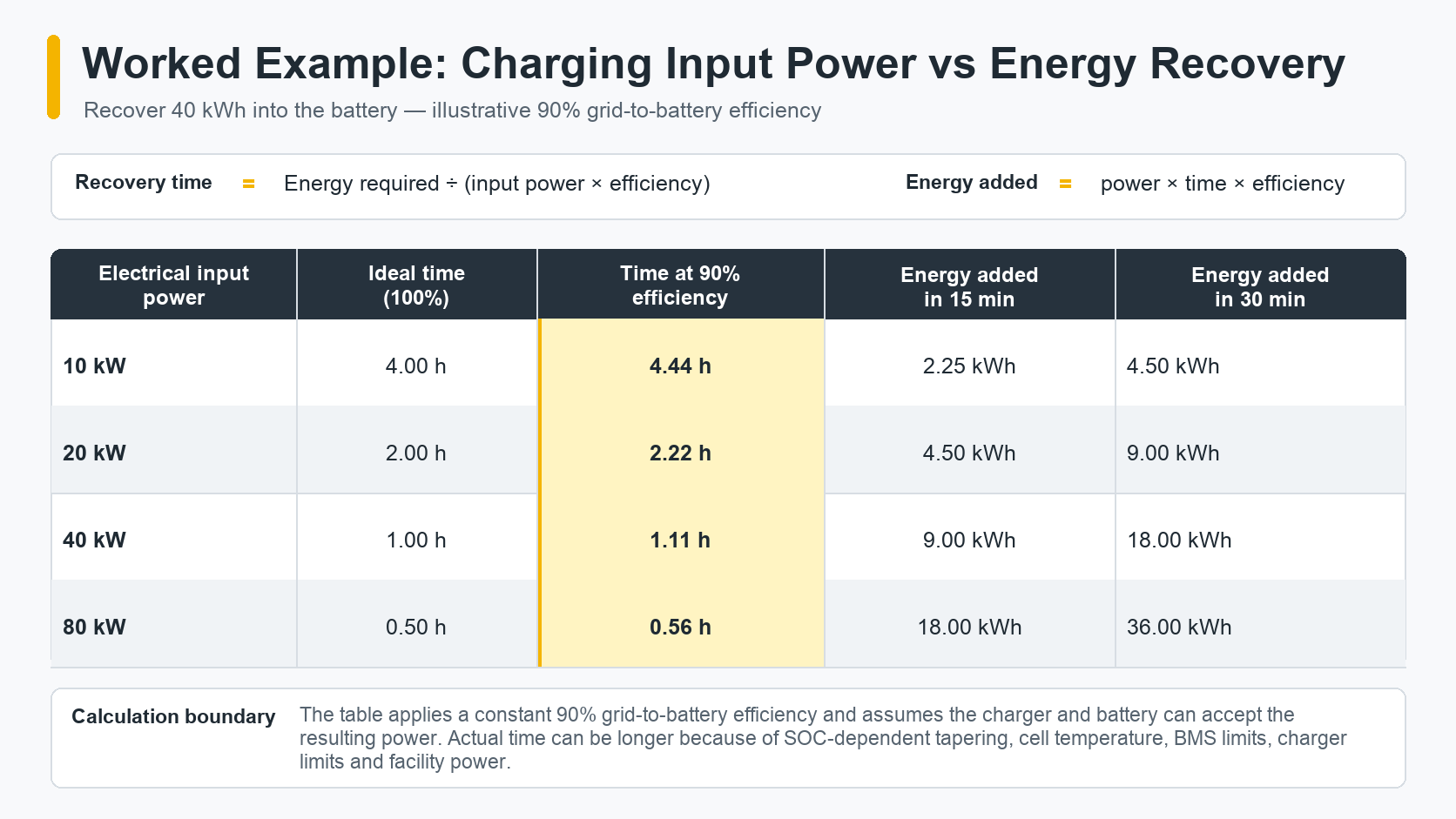
Higher charging power can reduce the time required to restore battery energy. However, higher charge power increases the importance of cell charge capability, battery temperature, BMS charge-current control, charger power, electrical infrastructure and cycle-life objectives.
There is no universal fast-charging rate suitable for every electric forklift battery.
Battery swapping
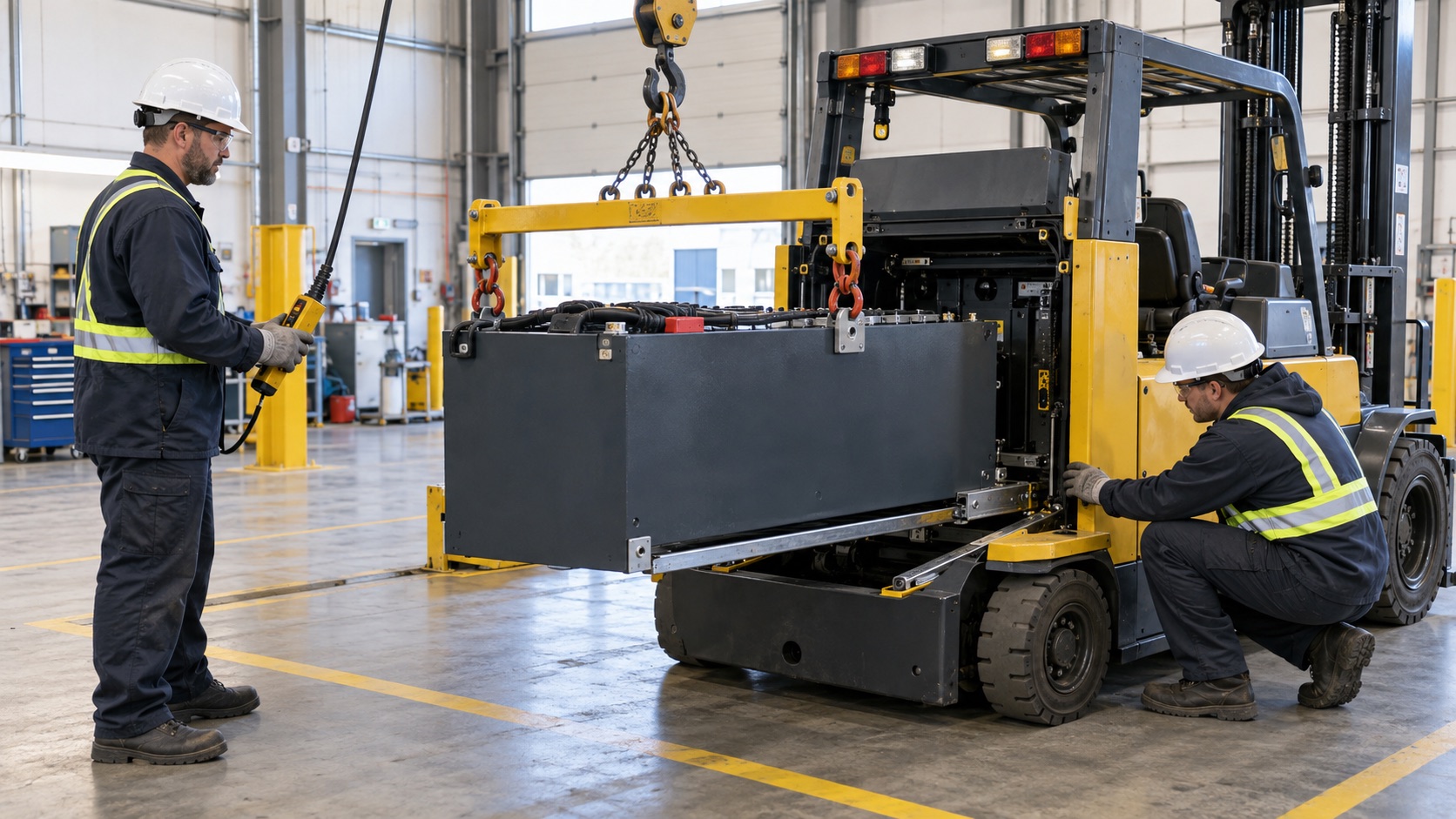
Some high-utilization operations may use spare batteries so a discharged pack can be replaced while another pack is charging or cooling. This strategy introduces different requirements involving spare-battery inventory, battery-handling systems, connectors, mechanical serviceability, storage space and fleet scheduling.
Toyota Material Handling’s 2026 charging guidance similarly distinguishes conventional, fast and opportunity charging and notes that the appropriate approach depends on operating shifts, available charging time and operational demand. [2]
Multi-Shift Operation Changes the Battery Strategy
Consider two otherwise similar forklifts.
A truck operating one shift per day may have enough downtime for a long overnight charge. The same vehicle working two or three shifts has much less recovery time.
The second operation may therefore require a combination of greater usable battery energy, opportunity charging, increased charger power, spare batteries or a different fleet operating plan.
Multi-shift electric forklift battery sizing should consider total daily energy throughput—not only energy per shift. Engineers should also confirm whether the battery and charger can repeat the intended charge/discharge pattern without exceeding cell, BMS, connector or thermal limits.
Thermal Design and Regenerative Current
Electric forklift battery temperature affects available power, charge acceptance, voltage behaviour, aging and protection limits.
Thermal design should consider ambient temperature, solar exposure, nearby heat sources, enclosure sealing, airflow or liquid-cooling boundaries where applicable, temperature gradients between modules and heat generated during repeated high-current events.
Cold-temperature charging limits can be especially important for lithium battery systems used outdoors. A heating strategy may be needed in some climates, but it must be integrated with the BMS and charger rather than added as an isolated accessory.
Depending on the forklift drive architecture, deceleration or lowering functions may also return energy to the DC system. The pack and BMS must be able to accept the expected regenerative current at the actual SOC and temperature, or the vehicle must manage that energy through another control strategy.
Mechanical Integration and Required Battery Mass
Electrical compatibility alone does not make a battery mechanically interchangeable.
An electric forklift battery specification may also need to define compartment dimensions, pack mass and centre of gravity, mounting points, retention, lifting provisions, connector location, cable routing, service access, ingress protection, shock and vibration conditions and collision protection.
Battery mass can be part of the truck’s stability architecture. A lighter lithium battery is not automatically a safe drop-in replacement for a heavier lead-acid battery, even if voltage and Ah appear similar.
OSHA 29 CFR 1910.178 requires manufacturer approval for modifications that affect capacity or safe operation and also states that additional forklift counterweighting should not be added without manufacturer approval. [3]
For retrofit projects, the truck manufacturer should therefore confirm whether the replacement battery’s mass, dimensions, centre of gravity and retention method are acceptable. For a new OEM platform, those parameters should be designed together with the vehicle structure and stability calculations.
3. Battery Strategies for Different Forklift Duty Cycles
There is no single electric forklift battery architecture for every operating profile. The table below compares five common operating scenarios and the engineering priorities that tend to change between them.
| Forklift Duty Cycle | Typical Operating Characteristics | Battery Priorities | Possible Strategy |
|---|---|---|---|
| Light intermittent warehouse use | Short trips, modest loads, long idle periods | Right-sized energy, simple charging, packaging and cost | Lower-voltage architecture may be suitable if vehicle power allows |
| Single-shift material handling | Predictable daily runtime with long off-shift window | Shift energy, peak lifting current, overnight recharge | One pack with end-of-shift charging may be practical |
| Multi-shift warehouse fleet | High daily utilization and scheduled breaks | Daily energy throughput, charge acceptance, charger access and temperature | Opportunity or fast charging, larger usable energy or spare batteries |
| Outdoor industrial operation | Long travel, gradients, weather exposure and repeated hydraulic demand | Peak power, thermal management, ingress protection and mechanical robustness | Application-specific pack, enclosure and environmental controls |
| Heavy-duty high-capacity forklift | High traction and hydraulic power, long operating hours and high lift capacity | System voltage, continuous and peak power, cooling, high-voltage safety and vehicle integration | Higher-voltage architecture may be appropriate when justified by the complete vehicle design |
This comparison is directional. Actual selection requires measured or realistically modelled vehicle data.
Lithium vs Lead-Acid Is a System Decision
Lead-acid remains widely used in material handling, while lithium-ion systems can provide different charging, maintenance, monitoring and packaging characteristics.
The engineering comparison should include:
- usable energy across the operating window;
- continuous and peak power capability;
- charging time and available charging windows;
- maintenance and watering requirements where applicable;
- temperature behaviour;
- required battery mass and stability implications;
- battery room and swapping requirements;
- BMS and communication needs;
- service and replacement strategy; and
- total lifecycle cost.
A lithium system should not be justified by one general claim such as “lighter,” “maintenance-free” or “longer cycle life.” The value depends on the complete forklift, charger, duty cycle and operating plan.
Cycle Life, Uptime and Total Cost of Ownership
Electric forklift battery cycle-life figures are useful only when the test conditions resemble the intended application.
Depth of discharge, charge rate, discharge rate, cell temperature, end-of-life criterion and rest periods can all affect reported cycle life.
Fleet uptime also depends on more than the number of laboratory cycles. Charger availability, maintenance, battery swapping, diagnostic access, spare parts, operator charging behaviour and the time required to recover from a fault all contribute to operational performance.
A stronger electric forklift battery total-cost comparison should therefore consider battery and charger cost, installation, facility power, spare batteries, handling equipment, maintenance, downtime, expected energy throughput and replacement planning.
For projects that combine vehicle integration with custom pack engineering, LONGSING’s Electric Mobility Battery Packs provide a relevant product-category reference without assuming one fixed forklift specification.
4. What OEMs Should Specify Before Developing a Custom Forklift Battery
A useful electric forklift battery RFQ should begin with the machine and operating requirement—not only a target voltage and Ah value.
| RFQ Area | Information to Provide | Why It Matters |
|---|---|---|
| Vehicle architecture | Forklift type, motor controller, traction and hydraulic systems, nominal and allowable voltage range | Defines the electrical system boundary |
| Energy requirement | Measured Wh or kWh per shift, shifts per day and required reserve | Supports usable-energy sizing |
| Power requirement | Continuous power, peak current, duration and frequency of peak events | Prevents voltage sag, current limiting and overheating |
| Duty cycle | Travel, loads, lifts, gradients, speed, idle time and simultaneous functions | Connects the battery to real vehicle use |
| Charging | Charger model, charge voltage/current, available time, opportunity charging, fast charging or swapping plan | Defines daily energy recovery and thermal demand |
| Communication | CAN, RS485 or other interface, protocol, message map, timing, charger commands and fault behaviour | Establishes controller and charger compatibility |
| Mechanical integration | Compartment, mass, centre of gravity, mounting, retention, connector and service access | Protects packaging, stability and serviceability |
| Environment | Ambient range, outdoor exposure, ingress, vibration, shock, dust, moisture and altitude where relevant | Guides enclosure, thermal and validation work |
| Compliance boundary | Target markets, battery, truck and transport requirements, certification responsibility | Maps standards to the correct product and market |
| Commercial plan | Prototype quantity, validation stages, production volume, service life and traceability needs | Supports a realistic development and production route |
Standards Must Be Mapped to the Correct System Boundary
Electric forklift battery projects may involve several standards and regulatory layers, but they do not all evaluate the same product.
- IEC 62619:2022 addresses safety requirements and tests for secondary lithium cells and batteries used in industrial applications, including forklift trucks as a motive-application example. [4]
- ISO 3691-1:2011 with Amendment 1:2020 addresses safety requirements and verification for defined types of self-propelled industrial trucks. [5]
- EN 1175 addresses electrical and electronic requirements for industrial trucks. [6]
- UL 583 is the U.S. standard for electric-battery-powered industrial trucks where applicable. [7]
- UN Manual of Tests and Criteria, subsection 38.3 addresses lithium-cell and battery transport testing; it is not a complete forklift certification. [8]
Applicability depends on the battery, complete truck, target market, installation and transport route. A battery test report does not by itself establish compliance of the complete forklift, and a vehicle-level standard does not replace battery-level validation.
From Requirement to Custom Battery Architecture
The most reliable development sequence is:
Duty cycle → energy and power → system voltage → cell chemistry and format → BMS and communication → charging → thermal and mechanical design → validation
This sequence reduces the risk of selecting a battery architecture from a headline Ah value or a preferred cell before the vehicle requirements are understood.
LONGSING’s relevant Website B portfolio includes high-voltage battery packs, electric mobility battery packs, prismatic lithium batteries and custom prismatic packs. These categories provide development directions rather than a claim that one existing SKU fits every forklift.
Conclusion
An electric forklift battery must be designed as part of the complete material-handling vehicle.
The specification should separate energy, continuous power and peak current; model both traction and hydraulic loads; define the daily shift and charging plan; integrate BMS communication with the truck and charger; and treat thermal, mechanical and stability requirements as part of the same engineering problem.
Higher voltage can be valuable when the required power makes lower current beneficial, but it is not automatically the correct choice for every heavy-duty forklift. Likewise, LiFePO4, prismatic cells, opportunity charging and lithium replacement can each be appropriate only when they match the real system requirement.
If you are developing a custom electric forklift battery or industrial vehicle battery, LONGSING can review your voltage window, energy, peak current, shift profile, charger, communication protocol, battery compartment, required mass and compliance targets before proposing a pack architecture.
Frequently Asked Questions About Electric Forklift Batteries
Click to explore more information about electric forklift batteries
1. What type of electric forklift battery is best?
There is no single best electric forklift battery for every application. Lead-acid, LiFePO4 and other lithium-ion systems can be suitable depending on voltage, traction and hydraulic power, runtime, charging windows, battery mass, environment and vehicle integration.
2. How do you size an electric forklift battery?
Size the battery from measured or realistically modelled duty-cycle data. Define usable energy, continuous power, peak current and duration, shifts per day, charging opportunities, environmental conditions, battery compartment and required mass. Ah alone is not enough.
3. Why do heavy-duty forklifts use higher battery voltage?
For the same power, a higher system voltage reduces current. This can reduce resistive losses and heat and may change cable, busbar and power-electronic design. However, high voltage is an engineering option—not a universal requirement for heavy-duty forklifts.
4. Is LiFePO4 suitable for forklift batteries?
LiFePO4 can be suitable where its cycling, thermal and durability characteristics match the application. The complete pack still requires correct cell selection, BMS, charging, thermal design, enclosure and vehicle-level validation.
5. Can a lithium battery directly replace a lead-acid forklift battery?
Not automatically. Voltage, current capability, charger compatibility, communication, dimensions, retention, pack mass and centre of gravity must be checked. Battery weight may be part of the forklift’s stability design, so manufacturer approval may be required.
6. What is opportunity charging for a forklift?
Opportunity charging adds energy during planned downtime such as breaks or shift changes. It can support multi-shift use when the battery, charger, schedule and thermal limits are designed for the required daily energy throughput.
7. Does a forklift battery need CAN or RS485 communication?
Some forklifts require CAN, RS485 or an OEM-specific interface between the battery, vehicle controller and charger. The protocol, message map, timing, data scaling and communication-loss behaviour must match; the connector name alone does not guarantee compatibility.
8. Which standards apply to lithium forklift batteries?
Applicable requirements depend on the battery, complete truck, target market and transport route. IEC 62619 may apply at industrial battery level, ISO 3691-1 and EN 1175 address industrial-truck requirements, UL 583 may apply in the United States, and UN 38.3 addresses transport testing.
References
[1] Hyundai Material Handling. “Hyundai Material Handling Completes 4–18 Tonne High-Voltage Electric Forklift Range.” September 2026. ↪
[2] Toyota Material Handling. “Assessing Forklift Charging Methods.” July 20, 2026. ↪
[3] OSHA. 29 CFR 1910.178 — Powered Industrial Trucks. ↪
[4] IEC 62619:2022 — Safety requirements for secondary lithium cells and batteries for industrial applications. ↪
[5] ISO 3691-1:2011 — Safety requirements and verification for self-propelled industrial trucks. ↪
[6] BS EN 1175 — Safety of industrial trucks: Electrical requirements. ↪
[7] UL 583 — Electric-Battery-Powered Industrial Trucks. ↪
[8] UN Manual of Tests and Criteria, Part III, subsection 38.3 — Lithium cells and batteries. ↪