
AI infrastructure is increasing both the scale and concentration of data-center power demand. The IEA reported that global data-center electricity consumption grew 17% in 2025, while electricity use by AI-focused data centers increased even faster. For UPS engineers, however, the more important question is not simply how much electricity AI consumes, but how critical loads must be supported across different power-event timescales. [1]
A data center UPS battery must therefore be selected around a defined electrical role: the load it supports, the power it must deliver, the required ride-through time, the DC bus, redundancy, thermal conditions, monitoring and the applicable safety framework.
A UPS battery does not directly absorb every GPU power spike.
Very fast accelerator transients, facility load variations, utility interruptions, generator transitions and longer-duration energy services belong to different layers of the power architecture. Treating them as one battery-sizing problem can produce the wrong power rating, runtime or system boundary.
What Battery Is Used in a Data Center UPS?
Data center UPS systems may use valve-regulated lead-acid (VRLA) or rechargeable lithium-ion batteries, including LiFePO4 in suitable architectures. The correct battery depends on UPS voltage, load power, ride-through time, redundancy, space, thermal conditions, cycling profile and applicable safety requirements. AI workloads increase power-density and integration challenges, but there is no single chemistry, voltage or architecture for every data center.
Table of Contents
1. Why AI Workloads Are Changing Data Center Power Requirements
AI data centers concentrate substantial electrical demand into accelerator clusters, while their workloads can create rapid and coordinated changes in power. This makes power distribution, cooling, capacity planning and control coordination increasingly important. Higher density alone does not determine data center UPS battery runtime; the UPS role must still be defined from the critical load and facility continuity strategy.
Higher Voltage Is an Architecture Trend, Not a Product Shortcut
Higher-density infrastructure is also driving changes in power distribution. Current open-industry work is attempting to establish 800 VDC as an open standardized architecture for next-generation AI data centers. This should be treated as a developing architecture direction, not a completed universal standard. Related data-center energy-storage work covers UPS integration, transient buffering, telemetry, state of charge and state of health. [2]
The practical implication is simple: battery voltage must follow the actual power architecture. A 48V battery may fit telecom, edge, smaller distributed DC UPS, rack-level or subsystem applications. It should not be presented as a universal hyperscale AI data-center UPS standard. Large centralized systems may use much higher DC buses, and the required architecture must be defined before a data center UPS battery is selected.
Dynamic GPU Loads Operate on Different Timescales
Fast load changes may first be managed by board power electronics, power supplies, DC-link capacitors, rack-level capacitors and local power-smoothing controls. These layers can buffer or shape demand before it reaches the facility UPS. This reinforces the system boundary: the fastest GPU transient is not automatically passed directly to the facility UPS battery.
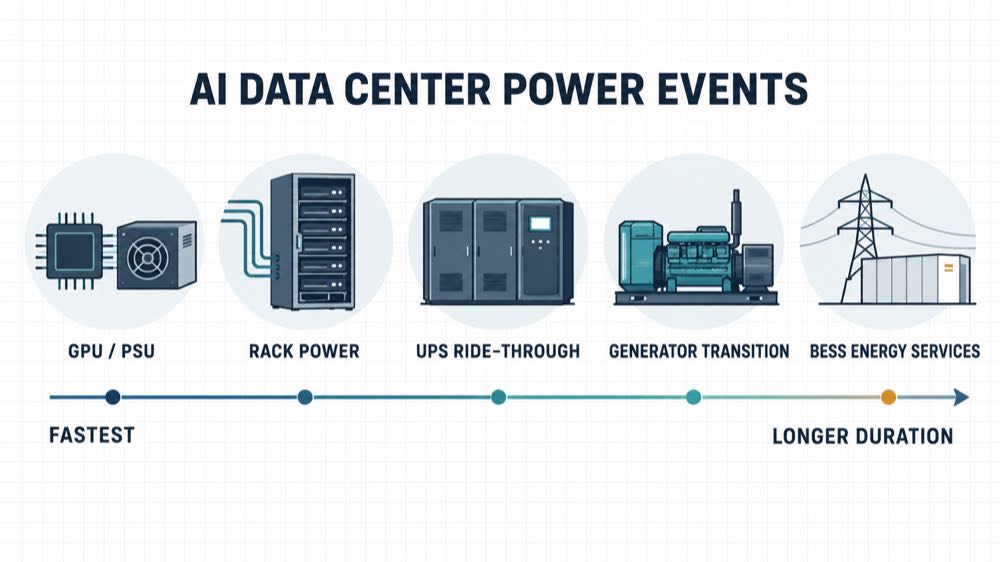
| Power Event | Typical First Power-Management Layer | Possible Battery Relevance |
|---|---|---|
| Very fast GPU transient | Board power electronics, PSU/DC link, local capacitors, rack-level power smoothing | Facility UPS battery is generally not the first response layer |
| Short rack or facility load variation | Rack power architecture, converters, UPS/inverter control or local storage | Architecture-dependent |
| Utility disturbance or interruption | UPS | Critical continuity and ride-through role |
| Generator or alternate-source transition | UPS plus switchgear and generation system | Bridges the transition as designed |
| Longer outage | UPS plus generator, on-site generation or alternate supply | Depends on runtime and facility strategy |
| Peak shaving or load shifting | BESS, power conversion system and EMS | Common potential BESS role, not necessarily a UPS role |
| Renewable or grid interaction | BESS, power conversion system and EMS | Possible where the facility architecture supports it |
The exact boundaries vary by facility. The engineering requirement is to assign each event to the correct power-management layer before specifying battery power or capacity.
2. What Does a Data Center UPS Battery Actually Need to Deliver?
A data center UPS battery needs sufficient energy and sufficient power, but those are different requirements.
kWh or MWh measures energy: how much electrical energy is available and, with the load profile, how long support may continue. kW or MW measures power: how much load the battery and conversion system must support at a given moment.
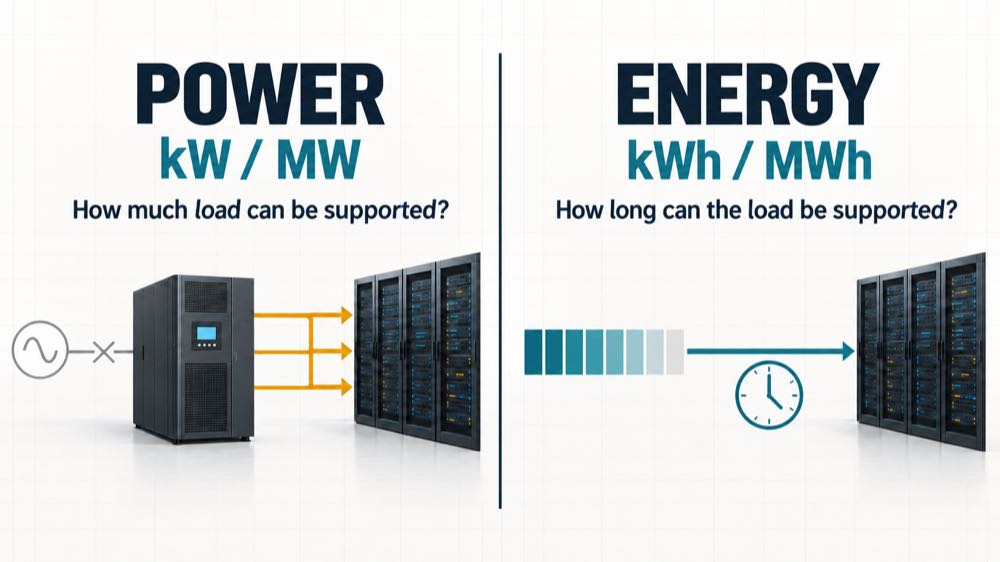
A data center UPS battery system can contain enough theoretical kWh and still fail the application if its DC voltage, allowable current, voltage sag, thermal behavior, inverter limits or end-of-life power capability cannot support the critical load.
Runtime Is a System Requirement
A first-order energy estimate may begin with:
Required usable energy ≈ critical load × required support time
But a real data center UPS battery specification also needs to account for conversion losses, allowable end voltage, operational reserve, aging margin, temperature, UPS topology and redundancy. There is no universal five-, ten- or fifteen-minute runtime for every AI data center. The correct duration follows the site’s generator or alternate-source strategy and the consequence of losing the defined critical load.
VRLA vs Lithium and LiFePO4
LiFePO4 is an established stationary-storage chemistry and may be relevant to suitable UPS designs, especially where modular lithium architecture, monitoring or more frequent cycling matters. It is not universally the best chemistry. Final selection still depends on electrical, thermal, reliability, safety, commercial and lifecycle requirements. Public stationary-storage research places LFP among the major lithium-ion directions used for stationary applications. [3]
| Design Consideration | VRLA | Lithium / LiFePO4 |
|---|---|---|
| UPS deployment history | Long-established | Increasingly used in suitable UPS architectures |
| Battery management | May use battery-monitoring systems | Requires lithium battery management and protection |
| Cycling profile | Selection depends strongly on standby/cycle duty | Can be relevant where more frequent cycling is required |
| Safety engineering | Requires appropriate battery-room and electrical safety controls | Requires BMS, thermal and lithium-ion fire-risk controls |
Standby Life Is Not the Same as Cycle Life
A traditional UPS battery may spend most of its life charged, monitored and waiting for an outage. In that duty, calendar aging, standby reliability and the ability to deliver the required power after long periods without deep discharge are central.
An actively cycled BESS may instead experience repeated depth of discharge, energy throughput and changing charge conditions. The same chemistry can therefore face a different aging problem in a standby UPS than in a peak-shaving asset. Cycle-life data alone does not prove standby service life.
Battery Management, SOC and SOH
For a lithium data center UPS battery, the Battery Management System should be designed around the actual cells, modules and UPS or power-conversion interface. Relevant functions may include cell-voltage and temperature monitoring, current measurement, balancing, protection, contactor control, fault logging, state of charge (SOC) and state of health (SOH).
SOH is especially important in standby backup. A battery can complete few deep cycles yet still lose capability through calendar aging or thermal exposure. Operators need evidence that the system can still meet the defined power and runtime requirement when an outage occurs.
Battery Modules → Battery Management System → UPS / PCS → EMS / DCIM / Building Management System
This wording avoids the common ambiguity between a battery BMS and a Building Management System. Communication may use CAN, RS485, Modbus, Ethernet or another interface depending on the architecture; a physical interface does not by itself define the application protocol.
Thermal Design and Redundancy
Thermal design is not limited to an ambient-temperature number. Engineers should consider cooling integration, airflow or liquid-cooling boundaries, module-to-module temperature consistency, sensor placement, local heat sources and the effect of temperature on aging and power capability.
Redundancy must also be defined at system level. N, N+1 and distributed modular concepts can change the load assigned to each string or module and determine whether maintenance can occur without reducing the required resilience. A battery supplier needs the intended topology, but a battery specification should not be treated as a complete data-center electrical design guide.
3. UPS Battery vs BESS: Different Roles in AI Infrastructure
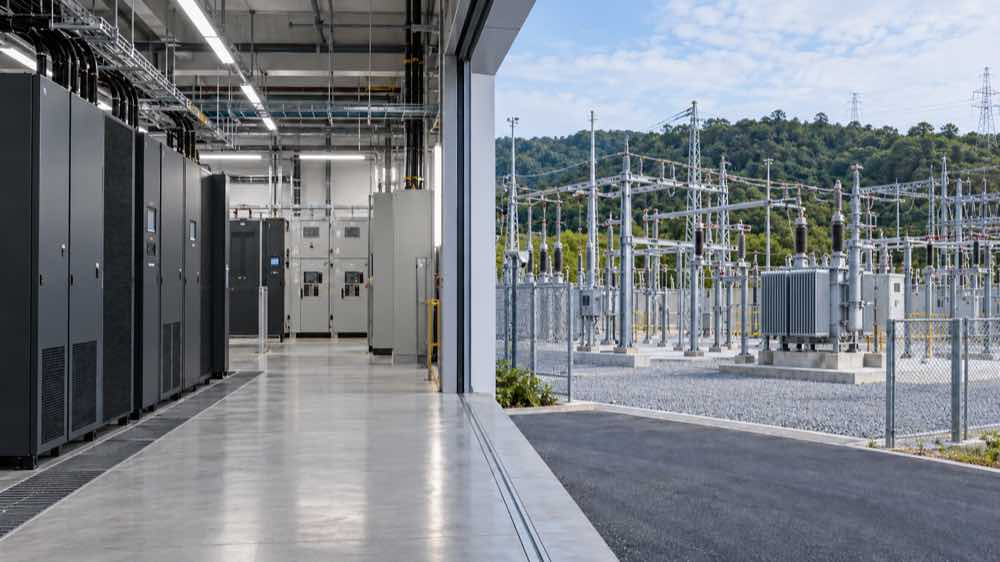
A data center UPS battery and a battery energy storage system may use similar rechargeable chemistries, but they are not automatically the same asset. The distinction comes from the system function, controls, power conversion, duty cycle, availability requirement and operating strategy.
UPS continuity, demand response or peak shaving, renewable-energy shifting and power balancing are distinct storage use cases. Each requires its own controls, reserve policy, cycling assumptions and availability targets; a battery installed for one role should not automatically be treated as qualified for all of them.
| System Function | UPS Battery | BESS |
|---|---|---|
| Utility interruption | Core continuity function | May contribute depending on design |
| Generator transition | Core ride-through function | Architecture-dependent |
| Power quality | UPS priority | Possible with suitable PCS and control |
| Peak shaving | Not normally the primary function | Common BESS use case |
| Load shifting | Not normally the primary function | Common BESS use case |
| Renewable integration | Limited or architecture-specific | Common potential use |
| Frequent cycling | Depends on UPS strategy | Often more relevant |
| Longer energy duration | Defined by UPS design | Often a major design parameter |
A facility can coordinate UPS and BESS functions, but doing so requires deliberate controls and a clear priority hierarchy. Revenue or energy-management cycling must not silently consume the reserve needed for critical-load continuity. Power capability, available SOC, recharge strategy, maintenance state and fault response all need system-level coordination.
4. What Should OEMs and Integrators Specify Before Selecting a Data Center Battery System?
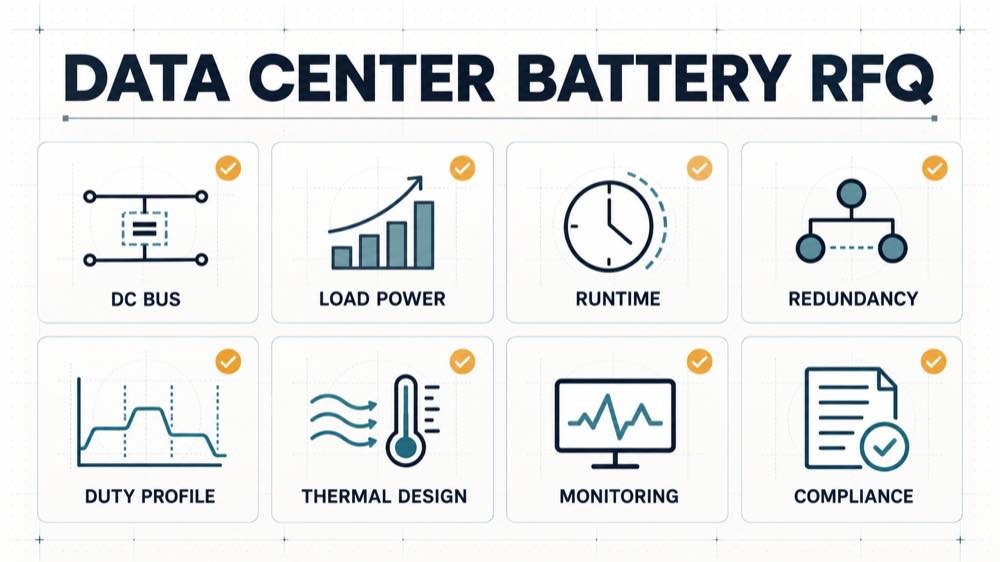
A useful data center UPS battery RFQ should begin with the electrical and operating requirement, not a preferred battery voltage or chemistry. For a centralized or hyperscale UPS, the battery architecture must first be defined from DC bus, power, runtime, redundancy and compliance requirements.
| RFQ Area | Information to Provide | Why It Matters |
|---|---|---|
| UPS architecture | Topology, DC-bus range, inverter limits, existing or new design | Defines electrical compatibility |
| Critical load | Rated, continuous and step-load power assigned to the battery | Separates energy sizing from power sizing |
| Runtime | Required support time and generator or alternate-source transition | Defines usable-energy requirement |
| Redundancy | N, N+1, distributed modular concept, maintenance state | Determines loading and failure tolerance |
| Duty profile | Standby only, test events, expected cycling, peak shaving or other BESS services | Distinguishes calendar-life and cycle-life priorities |
| Environment | Ambient range, cooling method, room or cabinet layout, altitude if relevant | Supports thermal and derating analysis |
| Monitoring | SOC, SOH, alarms, fault history, required interface and application protocol | Defines diagnostics and supervisory integration |
| Mechanical integration | Rack or cabinet envelope, service access, connectors, cabling and installation limits | Prevents late-stage packaging conflicts |
| Compliance boundary | Target market, complete system boundary, installation code and AHJ requirements | Determines which standards and evaluations apply |
| Lifecycle plan | Test policy, maintenance, replacement criteria, logistics and end-of-life plan | Protects long-term availability |
Standards Must Be Mapped to the Correct System Boundary
- UPS equipment: IEC 62040-1; UL 1778 where applicable
- Industrial or stationary lithium battery: IEC 62619; UL 1973 where applicable
- ESS or BESS system: UL 9540
- Thermal runaway and fire-propagation test method: UL 9540A
- Installation and fire-code context: NFPA 855 where applicable
IEC 62040-1 addresses UPS equipment safety. [4] IEC 62619 covers secondary lithium cells and batteries for industrial applications, including stationary UPS and energy-storage uses. [5] UL 1778 addresses UPS equipment where applicable. [6] UL 1973, UL 9540 and UL 9540A cover different stationary-battery, ESS-equipment and fire-propagation testing boundaries. [7] NFPA 855 provides stationary energy-storage installation and fire-code context where applicable. [8] These documents do not automatically all apply to every project; applicability depends on the system boundary, market, installation and authority having jurisdiction (AHJ).
Where LONGSING Product Directions May Fit
LONGSING’s current Website B portfolio includes LiFePO4 prismatic batteries, custom prismatic battery packs, lithium-ion battery packs and energy storage systems.
For edge, telecom, distributed backup, smaller data centers, rack-level subsystems and modular industrial backup, 48V battery packs may provide a relevant development direction. For projects that genuinely require a higher DC bus, high-voltage battery packs provide a separate customization direction that must be evaluated against the complete system requirement.
These capabilities should not be interpreted as a claim that a current LONGSING 48V rack module is a direct replacement for a hyperscale AI data-center UPS battery. Large centralized UPS and hyperscale systems require project-specific electrical architecture, safety engineering, compliance and validation.
Conclusion
AI changes the power environment around the UPS, but data center UPS battery selection still starts by defining exactly what the battery must do, on what timescale, at what power and for how long.
The most reliable specification separates fast GPU transients from facility ride-through, power from energy, standby life from cycle life, and UPS continuity from broader BESS services. It then connects those requirements to the DC bus, redundancy, thermal design, Battery Management System, SOC/SOH monitoring and the correct compliance boundary.
If you are developing a telecom, edge, distributed backup, modular industrial UPS or custom energy-storage system, LONGSING can review your voltage window, power, runtime, mechanical envelope, monitoring and compliance targets before proposing a rechargeable battery direction.
Frequently Asked Questions About Data Center UPS Batteries
Click to explore more information about data center UPS batteries
1. What type of battery is used in a data center UPS?
A data center UPS battery may use VRLA or rechargeable lithium-ion technology, including LiFePO4 in suitable architectures. Selection depends on the UPS DC bus, required power, runtime, redundancy, environment, service plan and applicable safety requirements.
2. Are LiFePO4 batteries suitable for data center UPS systems?
LiFePO4 can be suitable where the cells, Battery Management System, UPS interface, thermal design and compliance boundary are engineered together. It is not universally the best choice for every data center or every UPS topology.
3. How does AI change data center UPS battery requirements?
AI can increase rack density, facility power concentration, cooling demand and load variability. The battery requirement still depends on the event assigned to the UPS, but the surrounding electrical and thermal architecture may become more demanding.
4. Do UPS batteries handle GPU power spikes directly?
Not every spike. Very fast GPU transients may first be handled by board power electronics, power supplies, DC-link or rack-level capacitors and power-smoothing controls. The facility UPS battery is primarily sized for the functions assigned to it, such as continuity during an unacceptable or failed source.
5. How do you calculate UPS battery runtime for a data center?
Begin with the critical load and required support time, then account for conversion losses, voltage limits, reserve, aging, temperature and redundancy. The battery and UPS must also meet the required power and current, not only the calculated kWh.
6. What is the difference between a UPS battery and a data center BESS?
A UPS battery is normally prioritized for critical-load continuity and ride-through. A BESS may also perform peak shaving, load shifting, renewable integration or grid-support functions. Similar chemistry does not make the system roles identical.
7. Why is BMS monitoring important for data center batteries?
The Battery Management System monitors and protects lithium cells and can provide temperature, current, SOC, SOH, alarms and fault information. In standby systems, SOH helps show whether the battery can still deliver its specified power and runtime after calendar aging.
8. Is a 48V lithium battery suitable for an AI data center?
It can be suitable for certain telecom, edge, distributed, rack-level, subsystem or smaller data-center UPS architectures. It is not a universal AI data-center standard. Centralized and hyperscale systems may require a higher DC bus defined from the UPS, power, runtime, redundancy and compliance requirements.
References
[1] Data-center electricity and AI-energy terminology, 2026. ↪
[2] Data-center energy-storage workstream: UPS integration, transient response and telemetry. ↪
[3] Stationary-storage technology context and LFP terminology. ↪
[4] IEC 62040-1 — Safety requirements for UPS. ↪
[5] IEC 62619 — Safety requirements for industrial secondary lithium batteries. ↪
[6] UL 1778 — Standard for uninterruptible power systems. ↪
[7] UL 1973 / UL 9540 / UL 9540A — stationary batteries, ESS equipment and fire-propagation testing. ↪
[8] NFPA 855 — Installation of stationary energy-storage systems. ↪