
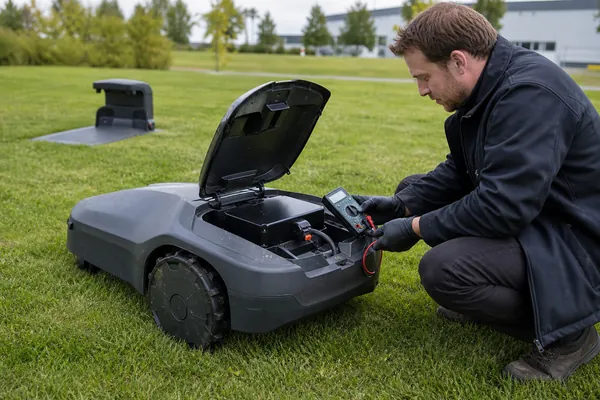
Autonomous lawn mowers require more than a rechargeable battery. Outdoor operation, repeated charging cycles, vibration and smart control systems demand a reliable autonomous lawn mower battery designed for long-term performance, safety and integration.
An autonomous lawn mower battery must support long operating hours, frequent charging cycles, outdoor conditions and intelligent system control. Custom lithium battery packs with Smart BMS help robotic mower manufacturers improve runtime, reliability and product performance.
As outdoor robotics continues to evolve, battery pack engineering has become a key factor in autonomous lawn mower reliability and user experience.
Table of Contents
1. Why Do Autonomous Lawn Mowers Need Custom Lithium Battery Packs?
Autonomous lawn mowers require customized lithium battery packs because they operate differently from traditional electric tools. Unlike occasional-use equipment, robotic mowers must repeatedly perform mowing cycles, automatically return to charging stations and operate reliably in outdoor environments.
A standard consumer rechargeable battery may provide basic power, but it is usually not designed for the specific requirements of autonomous outdoor robotics, including long runtime, frequent cycling, environmental exposure and communication with intelligent control systems.
Why Standard Batteries Are Not Suitable for Autonomous Outdoor Robots
Autonomous lawn mowers are integrated robotic systems rather than simple battery-powered devices. Their battery systems must support multiple functions, including:
- driving motors
- cutting motors
- navigation modules
- sensors
- communication systems
- automatic charging functions
A suitable robotic lawn mower battery pack must be designed around the complete system load rather than only the battery capacity.[1]
Important engineering factors include:
- required operating time
- peak current demand
- charging frequency
- available installation space
- operating environment
- communication requirements
For OEM manufacturers, battery selection is not only about choosing lithium cells. It requires designing a complete battery system that matches the mower’s electrical and mechanical requirements.
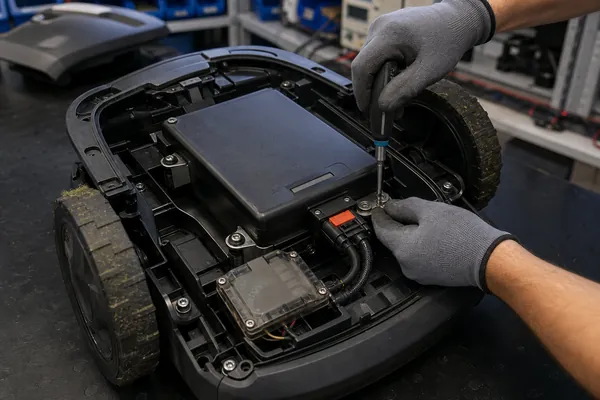
How Battery Performance Affects Mowing Efficiency and Product Reliability
Battery performance directly affects how efficiently an autonomous lawn mower completes its tasks.
A battery system with insufficient capacity or unsuitable characteristics may cause:
- shorter mowing time
- more frequent charging cycles
- reduced mowing coverage
- inconsistent user experience
For smart gardening equipment manufacturers, battery reliability is closely connected with product performance.
A properly designed lithium battery for lawn mower applications should balance:
- energy capacity
- discharge capability
- cycle life
- safety protection
- system integration
The goal is not simply to maximize battery size, but to create an optimized energy system that matches the mower’s operating requirements.
Why OEM Battery Pack Design Matters
Autonomous lawn mower manufacturers often require customized battery solutions because different product designs have different requirements.
A custom battery pack design can consider:
- battery dimensions
- voltage configuration
- capacity requirements
- connector design
- enclosure structure
- charging interface
- communication functions
For example, cylindrical lithium-ion cells such as 18650 or 21700 cells can be configured into different series and parallel combinations to achieve the required voltage and energy capacity.

A professional battery pack manufacturer can help OEM customers evaluate:
- suitable cell configuration
- protection requirements
- BMS integration
- production feasibility
2. What Design Challenges Must an Autonomous Lawn Mower Battery Solve?
Autonomous lawn mower battery systems must operate under conditions that are significantly more demanding than many indoor electronic devices. Engineers must consider runtime, cycling performance, environmental protection and mechanical reliability during the battery design process.
How Battery Capacity Determines Operating Time
Battery capacity is one of the most important factors affecting autonomous lawn mower operating time.
The required energy depends on:
- mower motor power consumption
- cutting conditions
- terrain
- grass density
- operating schedule
- navigation system consumption
Battery energy can generally be evaluated using:
Energy (Wh) = Voltage (V) × Capacity (Ah)
For example, a 24 V 10 Ah battery provides 240 Wh of nominal energy. If approximately 80% is available for normal operation and the mower consumes an average of 160 W, the estimated operating time would be about 1.2 hours. Actual runtime will vary with terrain, grass density, motor efficiency and system power consumption.
For OEM development, selecting the correct battery capacity requires balancing:
- desired mowing duration
- product weight
- installation space
- charging frequency
An oversized battery may increase product weight and cost, while an undersized battery may reduce operational efficiency.
Therefore, the battery pack should be customized according to the complete mower system design.
How Frequent Charging Cycles Affect Battery Life
An autonomous lawn mower battery typically operates through repeated automatic cycles:
- mowing operation
- returning to charging station
- battery charging
- restarting operation
This repeated usage pattern creates higher demands on rechargeable battery performance.
Battery engineers should consider:
- cycle life requirements
- charging current
- discharge conditions
- temperature influence
- cell consistency
High-quality lithium-ion cells combined with appropriate battery management can help maintain stable performance throughout repeated operating cycles.
How Temperature, Waterproofing and Vibration Influence Battery Design
Outdoor robotic equipment faces environmental challenges that indoor devices usually avoid.
A smart lawn mower battery pack may need to handle:
Temperature Variation
Outdoor temperatures can affect:
- available capacity
- charging performance
- internal resistance
- battery aging[2]
Battery systems may require temperature monitoring and protection through the BMS.
Waterproof and Dustproof Requirements
Autonomous lawn mowers operate around:
- grass
- soil
- moisture
- rain
- outdoor dust
The battery pack design should consider:
- protective enclosure
- sealing structure
- connector protection
- wiring reliability
The complete battery system design, rather than the battery cell alone, determines environmental durability.
Vibration and Mechanical Stress
During operation, robotic lawn mowers experience:
- motor vibration
- uneven terrain movement
- mechanical impact
Battery pack design considerations include:
- secure cell fixation
- reliable electrical connections
- robust assembly methods
Mechanical reliability is especially important for long-term outdoor operation.[3]
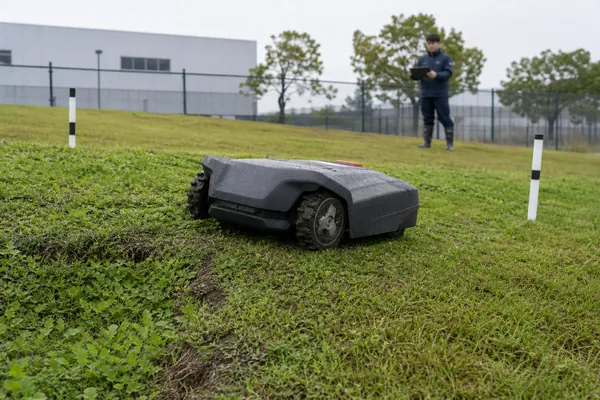
How Automatic Docking Requirements Affect Charging Design
An autonomous lawn mower battery must coordinate safely with automatic charging stations and the mower controller during every charging cycle.
Robotic lawn mower manufacturers should also evaluate system-level requirements such as IEC 60335-2-107, which covers battery-powered robotic lawn mowers, charging stations and lithium-ion charging considerations.
The battery pack should support:
- safe charging control
- accurate battery status monitoring
- protection during charging
- communication with the mower controller when required
A Smart BMS can provide important information such as:
- State of Charge (SOC)
- battery voltage
- current status
- temperature condition
- fault information
This allows the mower system to make better charging and operation decisions.
Key Battery Design Requirements for Autonomous Lawn Mower
| Engineering Requirement | Battery Pack Design Consideration | Battery Solution |
|---|---|---|
| Long mowing time | Energy capacity and cell configuration | Customized lithium battery pack |
| Frequent charging cycles | Cycle-life optimized cell selection | Suitable lithium-ion battery design |
| Outdoor temperature changes | Temperature monitoring and protection | Smart BMS integration |
| Rain and dust exposure | Enclosure and connector protection | Customized mechanical design |
| Uneven terrain vibration | Cell fixation and assembly reliability | Robust battery pack structure |
| Automatic charging | Charging compatibility and protection | Intelligent charging management |
| Smart control systems | Battery status communication | Smart BMS with communication functions |
| OEM product development | Size, voltage and connector requirements | OEM/ODM battery solution |
3. How Do Lithium Battery Packs and Smart BMS Improve Autonomous Lawn Mower Reliability?
For an autonomous lawn mower battery, lithium battery packs and Smart BMS technologies provide stable energy delivery, battery protection, condition monitoring and intelligent communication. For outdoor robotic equipment, the battery system must be designed as an integrated solution rather than simply combining individual lithium cells.
How Do Engineers Select Lithium Battery Configurations?
Selecting the right lithium battery configuration is an important step when developing an autonomous lawn mower battery.
The optimal battery design depends on multiple application requirements, including:
- required operating time
- mower size
- motor power demand
- charging frequency
- available installation space
- environmental conditions
Common lithium-ion battery pack design considerations include:
Energy Capacity
The battery must provide sufficient energy for the expected mowing operation without adding unnecessary weight or increasing product size.
Engineers typically evaluate:
- voltage requirements
- capacity (Ah)
- total energy (Wh)
- expected runtime
Cell Configuration
Cylindrical lithium-ion cells such as:
- 18650 cells
- 21700 cells
are commonly used in custom battery pack designs because they provide flexibility in:
- series connection for voltage requirements
- parallel connection for capacity requirements
- mechanical arrangement
The final configuration depends on the complete robotic mower system.
A professional battery manufacturer evaluates:
- electrical requirements
- mechanical structure
- thermal conditions
- production requirements
before selecting the appropriate pack architecture.
What Smart BMS Functions Are Required for Robotic Equipment?
A Smart BMS (Battery Management System) plays an important role in maintaining battery safety, reliability and performance.[4]
For autonomous lawn mower applications, the BMS may provide:
Cell Voltage Monitoring
The BMS monitors individual cell voltage to help detect abnormal conditions.
Important functions include:
- over-voltage protection
- under-voltage protection
- cell voltage balance monitoring
This helps prevent individual cells from operating outside safe limits.
Over-Current and Short-Circuit Protection
Robotic lawn mowers may experience changing loads caused by:
- cutting motor operation
- movement resistance
- terrain conditions
The BMS can monitor current conditions and provide protection against abnormal electrical events.
Temperature Monitoring
Temperature has a direct impact on lithium battery performance.
A Smart BMS can monitor temperature conditions and help manage:
- charging safety
- discharge protection
- abnormal temperature conditions
For outdoor robotic equipment, temperature monitoring is especially important because operating conditions can change significantly throughout the year.
Cell Balancing
Lithium battery cells in a series configuration may not remain perfectly identical during long-term operation.
Differences in:
- capacity
- voltage behavior
- internal resistance
can affect overall pack performance.
Cell balancing helps reduce differences between cells and supports more consistent battery operation.[5]
However, balancing does not replace proper cell selection and battery pack design.
High-quality battery packs should combine:
- suitable cell selection
- manufacturing control
- BMS management
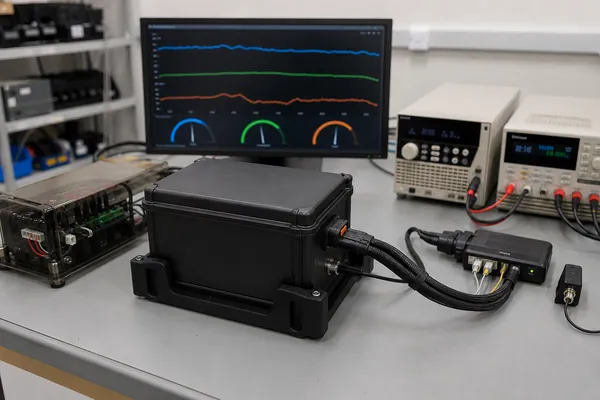
Why Does Battery Communication Matter in Smart Outdoor Systems?
Modern autonomous lawn mowers are intelligent robotic systems that may require communication between the battery pack and the main controller.
A communication-enabled BMS can provide information such as:
- State of Charge (SOC)
- State of Health (SOH)
- battery temperature
- charging status
- fault information
Depending on the system architecture, communication interfaces may include:
- CAN
- RS485
- UART[6]
For robotic equipment manufacturers, battery communication helps improve:
- system monitoring
- maintenance efficiency
- fault diagnosis
- product reliability
For more information about BMS communication interface selection, refer to:
4. How Can OEMs Select the Right Autonomous Lawn Mower Battery Partner?
Choosing the right battery partner is an important decision for autonomous lawn mower manufacturers because the battery system directly affects product reliability, customer experience and long-term maintenance costs.
A qualified battery supplier should provide not only battery cells, but also engineering support throughout the development process.
What Information Should OEM Customers Provide?
Before developing a custom battery pack, OEM customers should define their application requirements.
Important information includes:
Electrical Requirements
- operating voltage
- required capacity
- expected runtime
- charging requirements
- peak current demand
Mechanical Requirements
- available battery space
- mounting structure
- connector position
- enclosure requirements
System Requirements
- BMS communication requirements
- controller compatibility
- charging station integration
Providing these details helps battery engineers design a solution that matches the complete robotic system.
How Do Battery Manufacturers Validate Custom Packs?
A professional battery pack development process should include validation before mass production.[7]
Typical evaluation areas include:
Electrical Testing
- voltage verification
- capacity testing
- charging and discharging performance
Protection Testing
- over-voltage protection
- over-current protection
- temperature protection
Reliability Evaluation
- cycle performance
- temperature behavior
- mechanical reliability
For outdoor robotic applications, validation ensures that the battery pack can support long-term operation in real environments.
Why Do OEMs Need Custom Battery Solutions?
Autonomous lawn mower manufacturers often require customized battery solutions because every product has different:
- mechanical structures
- operating requirements
- power systems
- communication needs
A custom battery pack partner can support:
- lithium cell selection
- battery pack design
- BMS integration
- electrical testing
- OEM/ODM production
LONGSING provides rechargeable lithium battery solutions designed for industrial and smart equipment applications, including customized battery packs and intelligent battery management solutions.[8]
Conclusion
A reliable autonomous lawn mower battery is not simply a rechargeable power source. It is an integrated lithium battery pack designed around runtime, repeated charging cycles, environmental protection, mechanical reliability and intelligent battery management. By combining suitable cells, a Smart BMS and application-specific OEM engineering, manufacturers can develop safer and more dependable smart outdoor equipment.
Frequently Asked Questions about Autonomous Lawn Mower Batteries
Click to explore more information about Autonomous Lawn Mower Battery Solutions
Q: What battery does an autonomous lawn mower use?
A: Most autonomous lawn mowers use rechargeable lithium-ion battery systems because they provide suitable energy density, recharge capability and cycle performance for repeated outdoor operation. The exact battery configuration depends on factors such as mower size, runtime requirements, motor power and system design.
Q: Why does an autonomous lawn mower need a custom battery pack?
A: Autonomous lawn mowers often require custom battery packs because standard batteries may not match the required voltage, capacity, mechanical dimensions or communication requirements. A customized lithium battery pack can be designed around the mower’s operating environment and product architecture.
Q: How long does a robotic lawn mower battery last?
A: Battery lifetime depends on factors including battery chemistry, charging cycles, operating temperature, load conditions and battery management. Proper cell selection and Smart BMS integration can help maintain reliable performance during repeated operation.
Q: What does a BMS do in an autonomous lawn mower battery?
A: A Smart BMS monitors battery conditions such as cell voltage, current and temperature while providing protection functions including over-voltage, under-voltage, over-current and temperature protection. It can also support communication between the battery pack and the mower controller.
Q: Can lithium batteries be used in outdoor robotic equipment?
A: Yes. Lithium battery packs can be used in outdoor robotics when the complete battery system is properly designed. Protection considerations may include enclosure design, connector protection, temperature monitoring and mechanical reliability.
Q: How should OEMs choose a robotic lawn mower battery supplier?
A: OEM customers should evaluate whether a battery supplier can support the complete development process, including cell selection, custom pack design, BMS integration, testing and production capability. An experienced battery engineering partner can help create a solution matched to the final robotic system.