
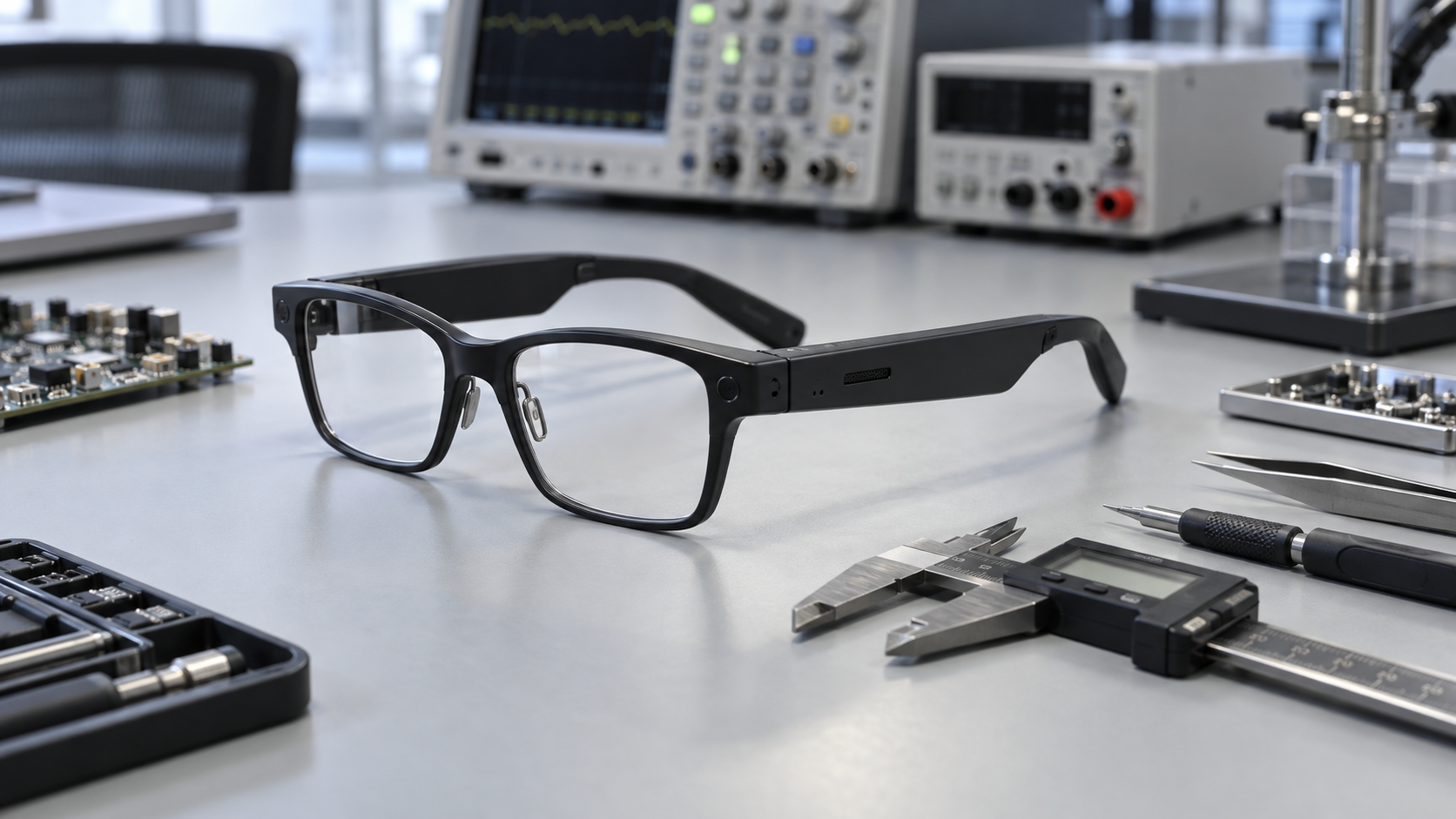
AI glasses are gaining more cameras, microphones, wireless connectivity, on-device processing and, in some designs, displays. Yet all of that hardware still has to fit inside a frame that remains light enough to wear.
That makes smart glasses battery design unusually difficult.
Adding energy to a smart glasses battery can improve runtime, but it also adds volume and mass. More processing capability can increase both peak power and heat. Thicker temples may create room for a larger battery, but they can also affect fit, balance and product styling.
For a smart-glasses OEM, the challenge is therefore not simply:
How large should the smart glasses battery be?
It is:
How much usable energy and peak power can the product carry without compromising geometry, weight, thermal behavior, charging or wearability?
The industry is already confronting this trade-off. Meta Engineering has described development work on ultra-narrow cells for AI glasses, while Samsung has discussed intelligent-eyewear engineering as a combined problem involving weight, battery efficiency and thermal management. Snap’s standalone SPECS illustrate an even more compute-intensive AR architecture. [1] [2]
Featured Snippet: What Type of Battery Is Used in Smart Glasses?
Smart glasses typically require a compact rechargeable lithium battery. Polymer lithium or pouch-cell formats can be suitable where thin dimensions and low weight are important, but no battery format is universally best. The correct smart glasses battery depends on system voltage, usable energy, peak power, frame geometry, weight distribution, temperature, charging method, protection requirements and the intended usage profile.
Table of Contents
1. Why Smart Glasses Create an Unusual Battery Design Challenge
A smart glasses battery has to deliver useful runtime inside one of the most mechanically constrained consumer-electronics products.
Unlike a phone, a smart glasses battery cannot occupy a large flat rectangular area behind a display. The available volume may be distributed through narrow temple arms or another highly constrained part of the frame. At the same time, the product is worn on the face, so battery mass and location influence the mechanical design of the entire device.
Smart Glasses Battery Volume Competes With Every Other Component
The same frame may also need to accommodate:
- Processor or SoC
- Camera modules
- Microphones
- Speakers
- Wireless antennas
- Sensors and storage
- Charging electronics
- Display or optical engine in AR products
- Structural components and hinges
Every additional millimeter assigned to the smart glasses battery is unavailable to another subsystem.
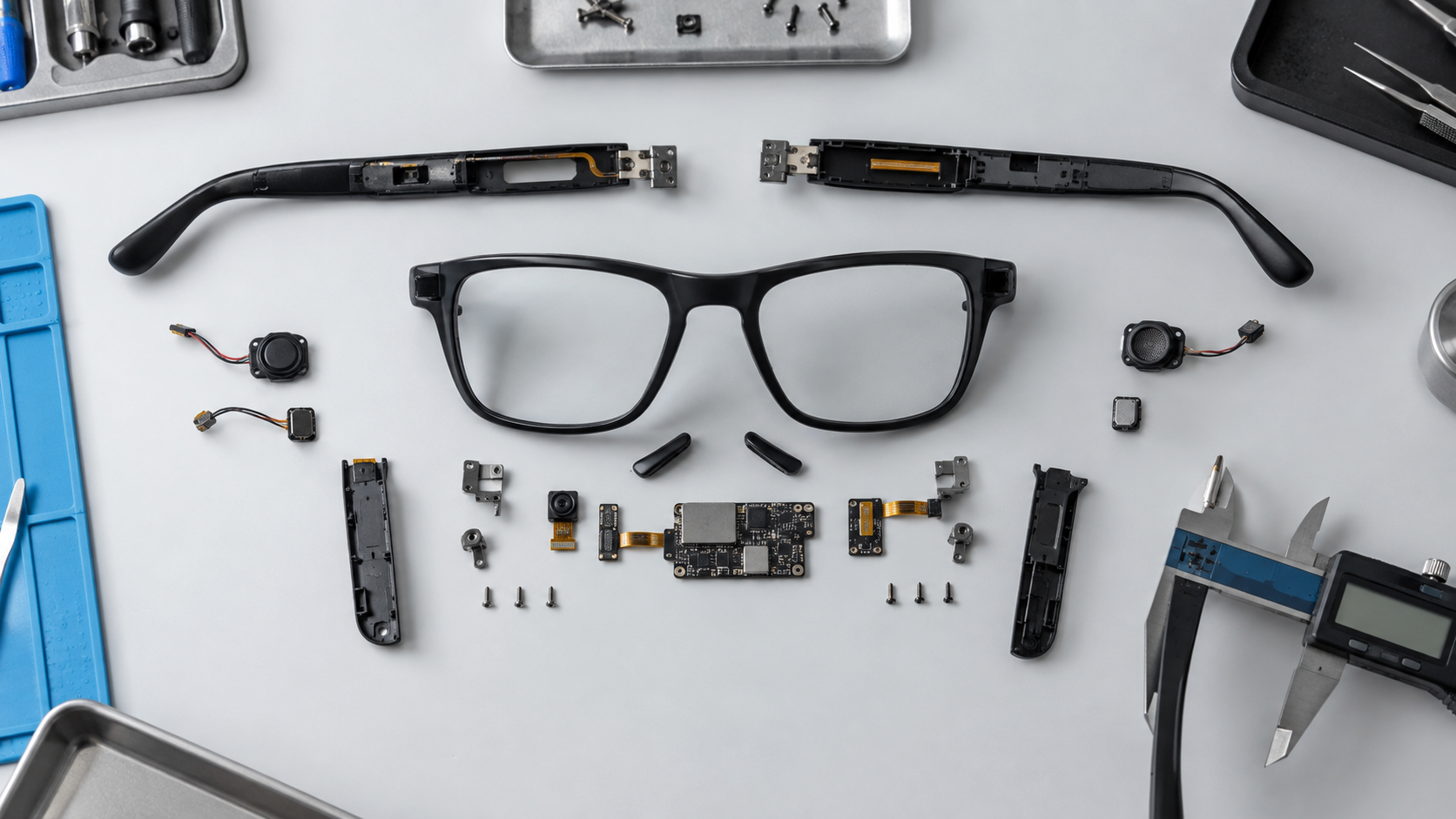
Samsung’s intelligent-eyewear engineering discussion makes this constraint explicit: small dimensional differences matter, and weight, thermal management and battery efficiency are interconnected design priorities. It also highlights left/right weight balancing across the frame.
That is why smart glasses battery dimensions should be defined during product architecture—not after the optical and electronic systems are already fixed.
More Capacity Means More Than More Runtime
The basic energy relationship is:
Nominal Energy (Wh) = Nominal Voltage (V) × Capacity (Ah)
Increasing stored energy can increase potential runtime. But extra smart glasses battery capacity can also mean:
- More cell volume and battery mass
- Greater temple thickness
- Different left/right weight distribution
- Less room for electronics
- Longer charging time at the same charging current
The useful target is therefore not maximum possible capacity. It is enough usable energy to satisfy the runtime target inside the permitted mass and geometry.
Smart-Glasses Loads Are Highly Architecture-Dependent
An audio/camera AI-glasses product may primarily power a processor, cameras, microphones, open-ear speakers, Bluetooth or Wi-Fi and storage. An AR product may add a display engine, display drivers, tracking sensors and additional computer-vision processing.
Qualcomm’s Snapdragon AR1 Gen 1 platform, for example, supports cameras, on-device AI, displays, Wi-Fi, Bluetooth and multi-microphone audio. That does not mean every glasses product uses every function, but it demonstrates why there is no universal smart-glasses power profile. [4]
The smart glasses battery must therefore be sized from the actual product usage profile, not the application name.
Energy and Peak Power Are Different Requirements
Average power mainly determines energy consumption and runtime. Peak power answers another question:
Can the smart glasses battery maintain enough voltage when several high-load functions operate at the same time?
Possible transient events can include camera activation, video recording, wireless transmission, AI-processing bursts, display activity and speaker output.
Meta’s engineering example links lower cell impedance to avoiding system brownouts when multiple functions operate simultaneously. That does not imply that steel-can construction is a default choice for smart glasses, or that LONGSING offers Meta’s ultra-narrow cell technology. It demonstrates a broader rule: cell format must follow the real geometry and power profile.
Core Smart Glasses Battery Trade-Offs
| Design Question | Battery Implication | System Trade-Off |
|---|---|---|
| Longer runtime | More usable Wh | Usually more volume and mass |
| Higher peak power | Lower impedance and adequate current capability | Cell, interconnect and protection constraints |
| Thinner temple | Tighter cell thickness and tolerance | Less energy volume and harder integration |
| Comfortable wear | Low mass and balanced placement | May limit capacity or require distributed architecture |
| Faster charging | Higher charge current where permitted | More heat and stricter thermal control |
2. How Should a Battery for AI Smart Glasses Be Designed?
Smart glasses battery development should start from the complete electrical and mechanical system. Voltage architecture, energy requirement, pulse power, cell geometry, protection, charging and temperature must all be considered together.
Start With Usable Energy, Not Capacity Alone
A first-order runtime relationship is:
Estimated Runtime ≈ Usable Battery Energy ÷ Average Device Power
Usable energy is more important than nominal energy. The amount that the glasses can actually use depends on:
- Battery discharge-voltage range
- Device minimum operating voltage
- DC/DC conversion efficiency
- Load profile
- Temperature
- Battery aging
- Protection cutoff and required reserve
If operating modes vary significantly, energy should be modeled by mode:
Erequired = Σ(Pmode × tmode)
Modes may include standby, audio playback, voice interaction, camera capture, video recording, AI processing, wireless streaming and display operation.
A useful OEM input is therefore not simply:
“We need eight hours.”
It is:
“This is the measured power profile, expected usage mix and target runtime.”
A 3.7V Architecture Can Be Suitable—but Is Not Universal
Single-cell lithium-ion or lithium-polymer systems can be attractive in compact electronics because they reduce series complexity. LONGSING’s 3.7V Battery Packs category describes 1S Li-ion or Li-polymer architectures for portable electronics and wearable applications.
However, this does not mean every smart-glasses product should use a 3.7V battery. A 3.7V / 1S configuration is an architecture option, not a smart-glasses standard.
The final voltage architecture depends on:
- Processor and PMIC requirements
- Camera and display rails
- Audio system
- Charger design
- Conversion efficiency
- Peak-power requirement
- Mechanical battery arrangement
The electronics architecture should determine the smart glasses battery voltage—not the other way around.
Polymer Lithium / Pouch Cells Can Be Useful Candidates
Polymer lithium batteries are relevant to smart wearables because they can support thin, lightweight packaging and customized dimensions. This makes a pouch-type architecture worth evaluating where:
- Thickness is tightly constrained
- A flat battery volume is available
- Low mass is important
- Standard cylindrical dimensions do not fit
But a LiPo battery for smart glasses should not be described as the universal solution.
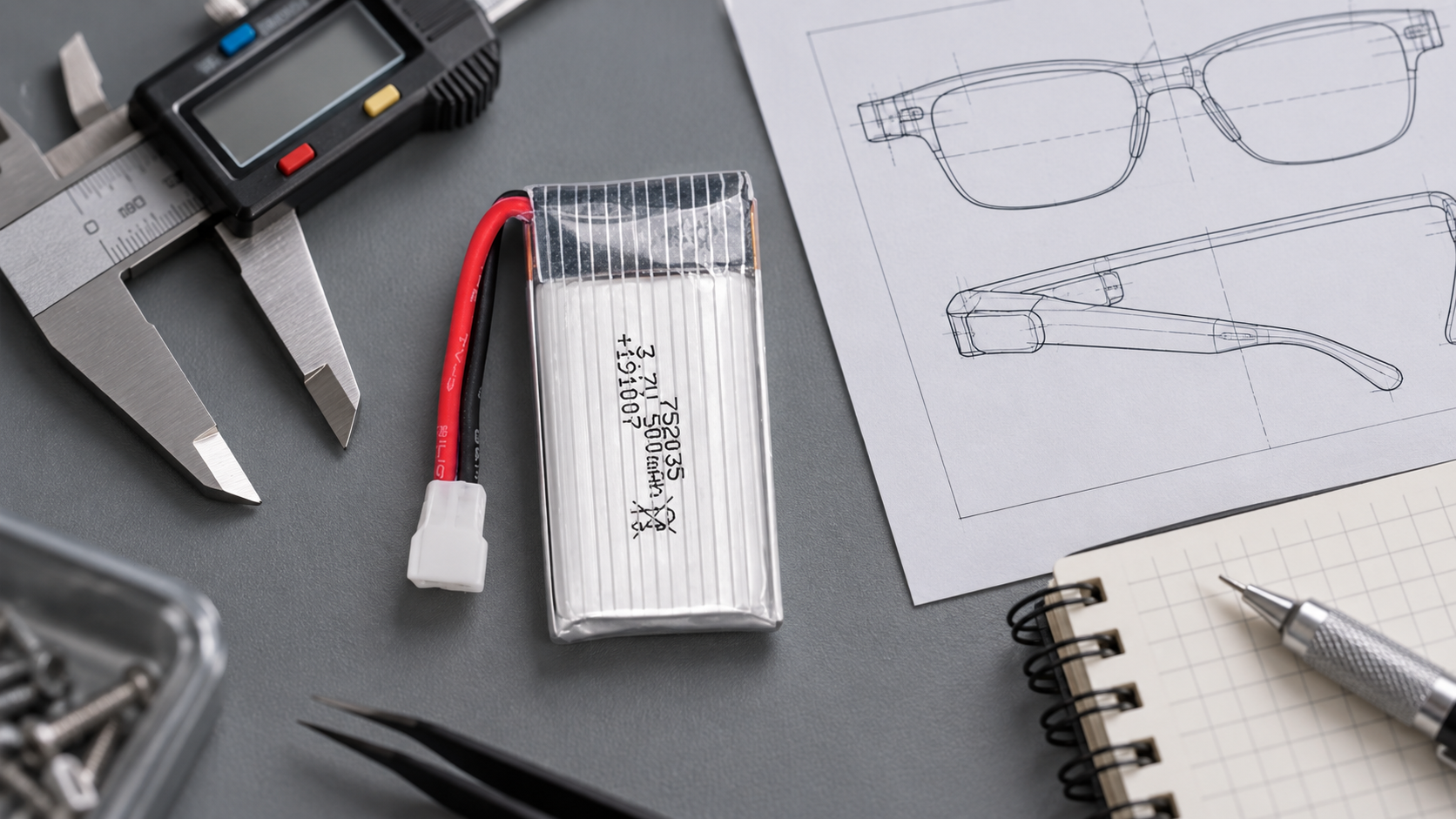
Meta’s industry case is a useful counterexample: its engineers reported moving away from conventional pouch construction for certain temple geometries and developing a rigid ultra-narrow architecture to improve dimensional control and peak-power behavior. The conclusion is not that rigid cells are always better. It is that:
Cell format should follow the actual product geometry and power requirement.
Smart Glasses Battery Geometry Must Be Specified as Part of the Frame
Battery drawings should include more than maximum length × width × height. Useful mechanical information includes:
- Available length, width and thickness
- Installation orientation
- Left or right temple location
- Whether one or multiple batteries are allowed
- Required mass per side
- Tab direction, connector location and cable exit
- Flex-cable or wire routing
- Clearance from hinges
- Clearance from processors and charging components
- Mechanical protection and swelling allowance where applicable
Weight distribution deserves special attention. A single heavier component on one side can affect balance and comfort. This is why a two-battery mechanical design is not automatically electrically simple: the cells may be mechanically symmetric while system loads are not.
Protection Should Match a Compact Wearable Architecture
A smart glasses battery still requires appropriate rechargeable-battery protection, but that does not mean installing a large industrial BMS.
Depending on the design, relevant functions may include:
- Overcharge and overdischarge protection
- Overcurrent and short-circuit protection
- Battery-temperature monitoring
- Voltage monitoring
- Fuel gauging where required
For a 1S wearable system, these functions may be implemented through compact protection and power-management circuitry. Industrial communication interfaces should not be added unless the host product actually requires them.
Charging Is Part of the Product Architecture
Smart glasses may use USB-connected charging, magnetic contacts, a dock, a charging case or another proprietary charging interface. The charging method influences connector space, charge current, charge time, power-path design, battery temperature, user interaction and whether the glasses can operate while charging.
Compact wearable power-management devices illustrate why charging design should include temperature sensing and thermal regulation rather than simply maximizing charge current. Texas Instruments’ BQ25150 wearable charger, for example, integrates battery-temperature monitoring, thermal regulation and power-path management for small single-cell Li-ion / Li-polymer systems. It is an engineering example, not a required component. [5]
Charge current should therefore be selected from the specific cell, thermal environment and product requirements—not from the shortest possible charging-time target.
Thermal Design Includes the Battery, Processor and Charger
In glasses, the smart glasses battery may be located close to an application processor, wireless electronics, camera circuitry, charging electronics or user-contact surfaces. The battery’s thermal environment is partly created by the device itself.
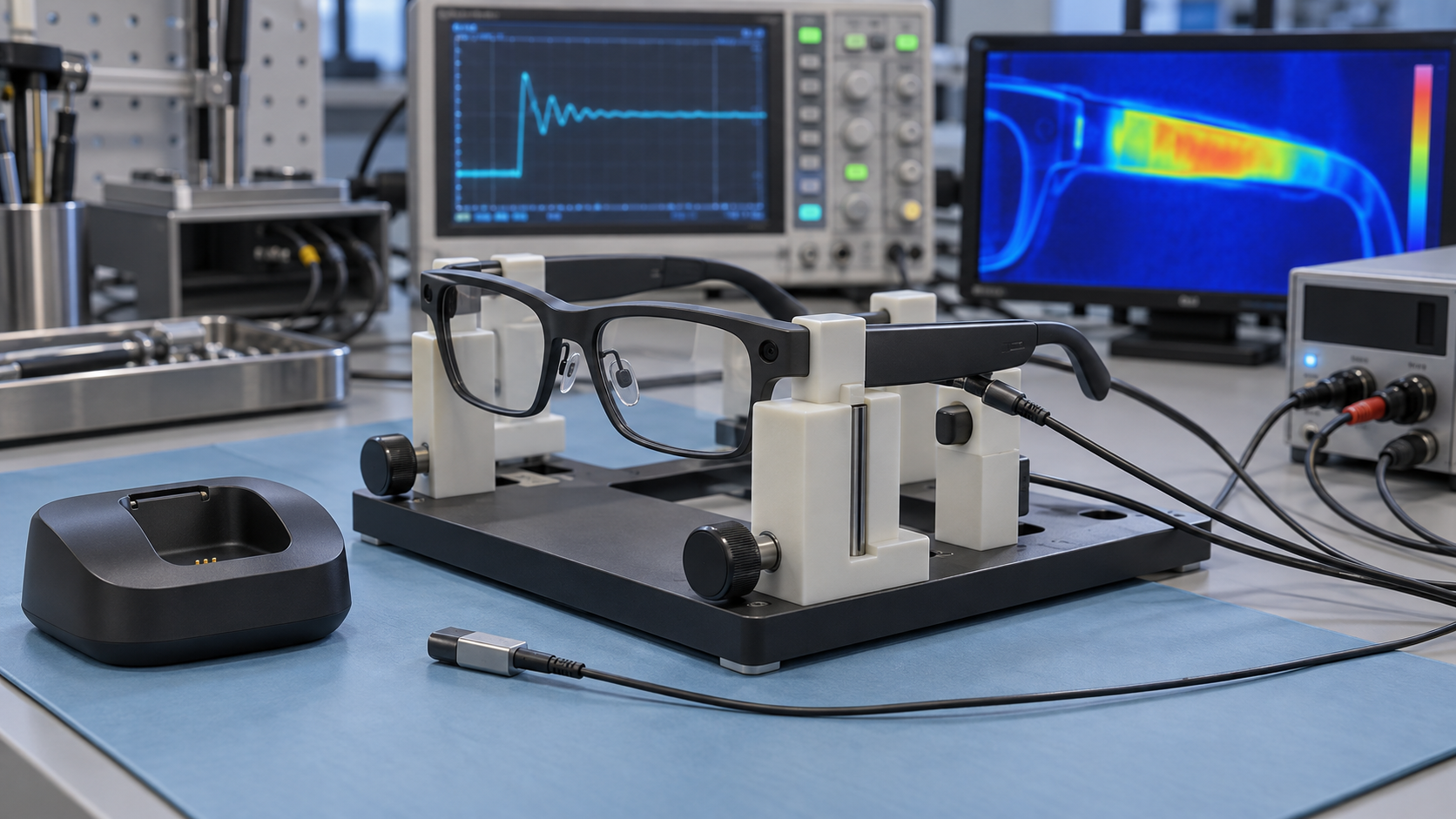
Samsung’s eyewear engineering example describes using thermal material to manage processor heat and prevent it from transferring toward the wearer. This illustrates why processor placement, frame architecture and thermal design are inseparable in this category.
OEM validation should consider:
- Battery temperature during normal use
- High-compute operating modes
- Camera and streaming modes
- Charging
- Simultaneous operation and charging if permitted
- High and low ambient temperatures
The important parameter is the temperature the smart glasses battery actually experiences inside the complete glasses, not only ambient room temperature.
Cycle-Life Targets Need Defined Conditions
A target such as “500 cycles” is incomplete unless charge rate, discharge rate, depth of discharge, temperature, end-of-life capacity and storage conditions are defined.
A 2025 Journal of Energy Storage review identifies temperature, C-rate, depth of discharge and state of charge among the external factors that influence lithium-ion aging. [8]
The OEM should specify the actual lifecycle target and test conditions rather than assume a generic cycle-life figure applies to every custom smart glasses battery.
Smart Glasses Battery Design Inputs
| Design Area | OEM Input | Why It Matters |
|---|---|---|
| Energy | Usage modes, time per mode and runtime target | Defines usable Wh |
| Peak load | Current or power waveform versus time | Defines voltage-sag and current requirements |
| Voltage | Operating window and device cutoff | Determines architecture and usable energy |
| Geometry | 3D envelope, orientation and mass per side | Guides cell format and integration |
| Charging | Input, interface, charge time and operation while charging | Defines charger and power-path behavior |
| Thermal | Battery-zone temperatures by operating mode | Affects performance, charging and aging |
| Lifecycle | Cycles, retention and test conditions | Enables meaningful validation |
3. Why Different Smart-Glasses Architectures Need Different Battery Strategies
“Smart glasses” is not one electrical architecture. Products with similar external shapes can have very different compute loads, duty cycles, displays, thermal limits and charging behavior.
This is why an OEM smart glasses battery should be selected from the product architecture rather than from a generic wearable category.
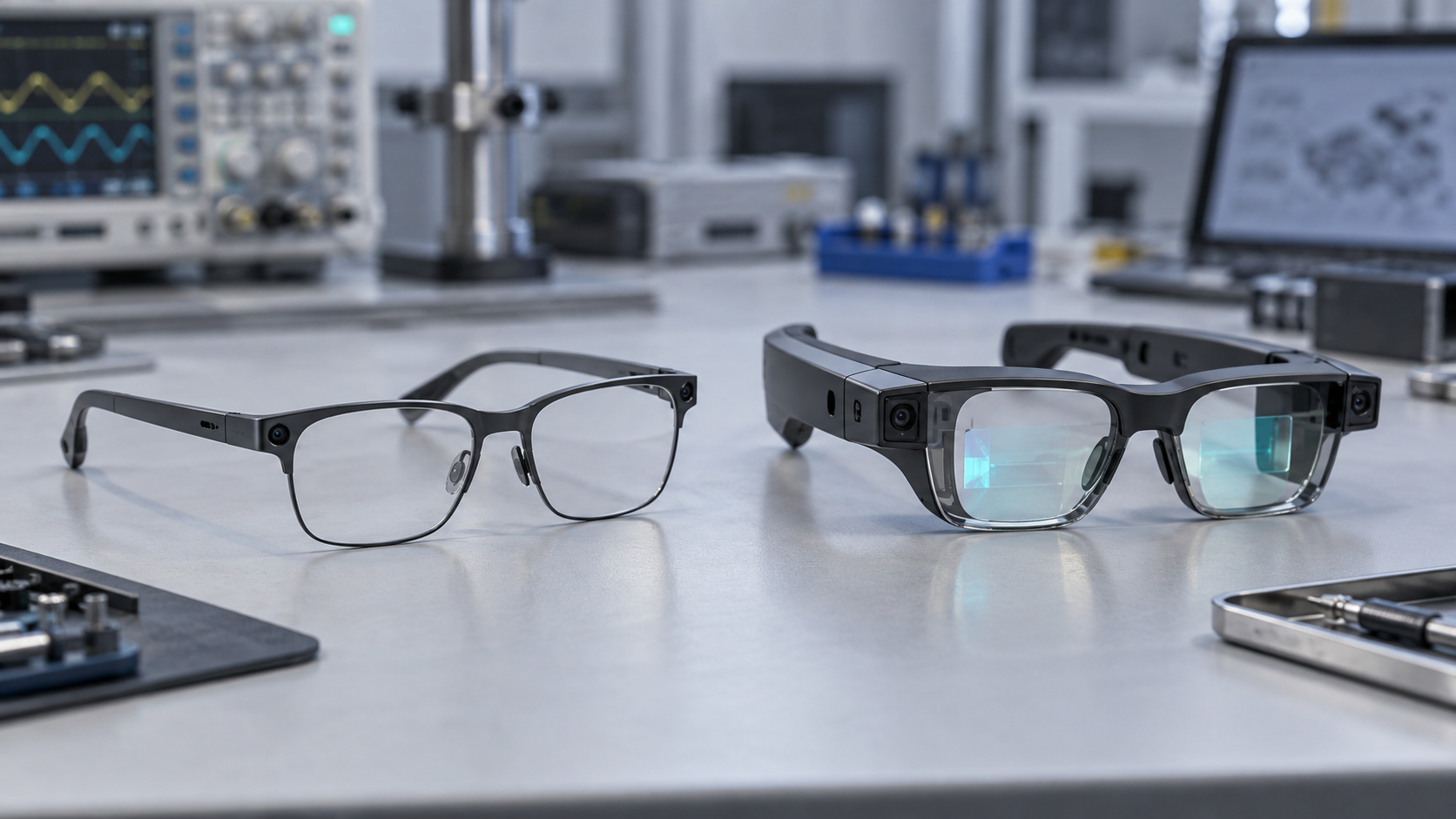
Audio and Camera AI Glasses
Glasses centered on voice interaction, camera capture and open-ear audio may operate through a mix of long low-power periods and shorter high-load events. Their design priorities can include:
- Low standby consumption
- Camera and recording bursts
- Wireless transmission
- AI-processing peaks
- Speaker output
- Low mass for daily wear
For these products, average energy and pulse performance must be evaluated separately. An apparently adequate nominal capacity does not guarantee that the loaded voltage will remain above the system threshold during simultaneous camera, wireless and AI activity.
Display-Based AR Glasses
AR glasses add sustained loads from displays, optics, tracking and additional processing. These loads can change both the average power budget and the thermal architecture.
Snap Inc.’s 2026 SPECS are a useful industry example of standalone AR glasses that integrate displays and substantial computing hardware directly into the wearable. [3]
This does not provide a universal battery specification. It shows why display-based AR products should not be sized from the power profile of audio-focused AI glasses.
Single-Battery and Distributed-Battery Layouts
A single battery can simplify electrical management but may create a concentrated mass on one side of the frame. A distributed design can help use available volume or improve mechanical balance, but it introduces additional questions:
- Are the cells connected or managed independently?
- Are the loads balanced between the two sides?
- How are startup, shutdown and fault conditions coordinated?
- Can current flow unintentionally between battery sections?
- How are cell matching, sensing and protection handled?
- What happens if one side ages differently?
The mechanical appearance of symmetry does not guarantee symmetrical electrical behavior. A distributed battery arrangement needs a complete system-level power strategy.
Charging Cases Change the Energy Boundary
A charging case can move some stored energy away from the glasses and support repeated recharging during the day. This can reduce the energy that must remain on the wearer’s face, but it creates a broader product architecture involving the glasses, case, contacts, charging control and user behavior.
The OEM should define whether the target is:
- Runtime per glasses charge
- Total mobile runtime including a charging case
- Time to a partial recharge
- Number of recharges from the case
- Operation while connected to an external power source
These are different requirements and should not be collapsed into a single runtime claim.
Architecture Comparison
| Product Architecture | Typical Battery Priorities | Important Validation Focus |
|---|---|---|
| Audio / camera AI glasses | Low mass, burst power, standby efficiency | Camera + AI + wireless peak events |
| Display-based AR glasses | Higher sustained power, thermal control | Display and compute modes over time |
| Single-battery frame | Electrical simplicity, concentrated placement | Balance, local temperature and usable volume |
| Distributed batteries | Volume utilization and weight distribution | Coordination, current paths and mismatch |
| Charging-case ecosystem | Lower on-face energy with mobile recharging | Contacts, thermal behavior and user duty cycle |
No architecture is automatically superior. The smart glasses battery strategy should follow the combination of functionality, duty cycle, frame geometry, thermal environment and user experience.
4. What Should OEMs Specify Before Developing a Custom Smart-Glasses Battery?
A meaningful custom battery project begins with a complete device specification. “3.7V, as much capacity as possible” is not enough to select a cell or design a reliable wearable battery pack.
Define the Electrical Requirement
The OEM should provide:
- Nominal system voltage
- Maximum and minimum operating voltage
- Device cutoff voltage
- Measured average power by operating mode
- Peak current or power waveform and duration
- Expected mode distribution and runtime target
- Charger input and charge-time target
- Whether operation while charging is permitted
- Required reserve at end of life
If measurements are not yet available, early prototypes should be instrumented before the battery specification is frozen.
Define the Mechanical Envelope
The mechanical package should include drawings or 3D data for:
- Maximum cell and pack dimensions
- Allowed tolerances
- Installation orientation
- Mass limit and left/right balance target
- Tab, connector and cable direction
- Hinge and flex-circuit clearances
- Mounting and retention method
- Mechanical protection requirements
- Swelling allowance where relevant
- Service or replacement strategy
The supplier should see the real smart glasses battery integration constraints early enough to compare cell formats rather than being asked to fit a pack into leftover space.
Define Protection, Monitoring and Host Interfaces
The OEM should identify the required protection behavior and distinguish it from state estimation. Useful inputs can include:
- Overcharge, overdischarge, overcurrent and short-circuit behavior
- Battery-temperature sensing
- Voltage and current monitoring
- State-of-charge or remaining-runtime reporting
- Low-battery warning behavior
- Connector and pinout
- Thermistor or digital interface requirements where needed
A compact wearable does not benefit from interfaces that the host never uses. The power-management design should match the actual electronics and software architecture.
Define Thermal and Lifecycle Conditions
Specify charging, discharging and storage temperature ranges separately. Also provide the expected battery-zone temperature during the most demanding operating modes.
For lifecycle, define:
- Target cycle count
- End-of-life retained capacity
- Charge and discharge rates
- Depth of discharge
- Upper charge voltage if project-specific
- Test temperature
- Expected storage state of charge and duration
This creates a testable requirement and avoids unsupported assumptions about runtime or cycle life.
Separate Battery Safety, Transport Testing and Finished-Product Compliance
IEC 62133-2:2017+A1:2021 specifies safety requirements and tests for portable sealed secondary lithium cells and batteries containing non-acid electrolyte under intended use and reasonably foreseeable misuse. It is relevant at the cell and battery level. It does not by itself certify a finished smart-glasses product. [6]
Subsection 38.3 of the UN Manual of Tests and Criteria addresses lithium-cell and battery transport testing. UN 38.3 is not a finished-device product certification. [7]
The complete compliance plan depends on the battery configuration, finished product, intended markets, charger and accessories. It should be defined with the relevant test laboratories and compliance specialists.
Plan Validation Around Worst-Case Use
Final validation should use the assembled glasses, not only an isolated cell. Relevant test cases may include:
- High-compute activity at low state of charge
- Camera, wireless and AI functions operating together
- Display and tracking modes for AR products
- Charging at defined ambient conditions
- Operation while charging, if allowed
- High and low ambient temperature
- Aged-battery conditions
- Repeated peak events with limited recovery time
- Connector and mechanical tolerance extremes
The final engineering question is:
Can the complete product meet runtime, voltage, temperature and safety requirements throughout the defined lifecycle and operating envelope?

OEM Smart Glasses Battery RFQ Checklist
| Requirement | Information to Provide |
|---|---|
| Product architecture | Audio/camera AI, display AR or other defined configuration |
| Voltage window | Nominal, maximum, minimum and device cutoff |
| Energy / runtime | Measured modes, usage mix and target runtime |
| Peak load | Current or power waveform, duration and repetition |
| Mechanical space | 3D envelope, tolerances, orientation and mass per side |
| Charging | Input, interface, charge time and power-path behavior |
| Protection | Fault thresholds and recovery behavior |
| Monitoring | Temperature, voltage, SOC and host data needs |
| Thermal | Battery-zone temperature by mode and environment |
| Lifecycle | Cycles, retention, rates, DoD, SOC and storage |
| Compliance | Target markets, battery safety and transport requirements |
| Validation | Worst-case complete-device test matrix |
Where LONGSING Fits
LONGSING Website B provides rechargeable product directions including Polymer Lithium Batteries, 3.7V Battery Packs and Lithium-ion Battery Packs with customizable mechanical, electrical and interface parameters.
These pages support the evaluation of candidate rechargeable architectures. They do not establish that LONGSING has an existing AI-glasses customer case, a dedicated ultra-narrow or curved smart-glasses cell, a Meta-style steel-can platform, or a predetermined runtime, cycle life, energy density or certification for a future project.
A custom smart glasses battery should therefore be developed from the OEM’s verified device requirements and then validated in the complete product.
Conclusion
A reliable smart glasses battery is not selected from capacity, voltage or cell format alone. It must be designed around usable energy, peak power, frame geometry, mass distribution, charging, temperature, lifecycle and the product’s real operating modes.
Polymer lithium and pouch cells can be useful candidates for thin, lightweight designs, but they are not a universal best choice. Likewise, a 3.7V / 1S battery can simplify some wearable systems, but it is an architecture option rather than an industry standard.
The correct sequence is:
Product Usage Profile → Usable Energy → Peak-Power Requirement → Voltage Architecture → Mechanical Envelope → Cell Format → Protection and Charging → Thermal and Lifecycle Validation → Compliance Plan
When those inputs are defined early, the OEM and battery supplier can compare realistic battery architectures without making unsupported assumptions about format, capacity or performance.
Discuss Your Smart Glasses Battery Requirements
Developing AI glasses, AR eyewear or another compact wearable electronic product?
Provide the operating modes, measured power profile, voltage window, peak-load waveform, runtime target, 3D battery envelope, mass distribution, charging method, battery-zone temperature, lifecycle target, intended markets and validation requirements.
These inputs allow candidate custom lithium-ion battery pack architectures to be evaluated against the real product rather than a generic smart-glasses label.
Frequently Asked Questions About Smart Glasses Batteries
Click to explore more information about smart glasses battery design
Q: What type of battery is used in smart glasses?
A: Smart glasses generally use a compact rechargeable lithium battery. Polymer lithium or pouch cells can be suitable for thin, lightweight designs, but no format is universally best. The correct choice depends on voltage, energy, peak power, geometry, mass, temperature and charging requirements.
Q: Is a LiPo battery always the best battery for smart glasses?
A: No. LiPo or pouch cells are useful candidates where thin dimensions and customized packaging are important. A different cell format may be preferable when dimensional tolerance, rigidity, peak power or another product constraint dominates.
Q: Is 3.7V the standard voltage for a smart glasses battery?
A: No. A 3.7V-class 1S lithium-ion or lithium-polymer architecture is one option for compact wearables. The correct voltage must follow the processor, PMIC, display, audio, charger, conversion-efficiency and mechanical requirements of the actual product.
Q: How should smart glasses battery runtime be calculated?
A: Calculate the energy consumed in each operating mode and combine it with the expected usage profile. Then account for device cutoff, conversion losses, temperature, battery aging, protection cutoff and the required end-of-life reserve. Nominal mAh alone is not sufficient.
Q: Why does peak power matter in AI glasses?
A: Cameras, wireless transmission, AI processing, displays and speakers can operate together and create short high-load events. The battery may contain enough total energy yet still cause a reset or brownout if loaded voltage falls below the system requirement.
Q: Can smart glasses use batteries in both temple arms?
A: Yes, but a dual-battery layout needs system-level design. The OEM must define electrical connection, load distribution, cell matching, protection, sensing, startup and shutdown sequencing, fault behavior and the effect of unequal aging.
Q: Which safety standards apply to a smart glasses battery?
A: IEC 62133-2 can be relevant to portable rechargeable lithium cells and batteries, while UN 38.3 addresses transport testing. Neither one alone certifies the finished smart-glasses product. The complete compliance plan depends on the product and target markets.
Q: What should an OEM provide for a custom smart glasses battery project?
A: Provide the voltage window, measured operating modes, runtime target, peak-load waveform, 3D mechanical envelope, mass limit and balance target, charging architecture, protection and monitoring requirements, battery-zone temperatures, lifecycle target, target markets and validation plan.