
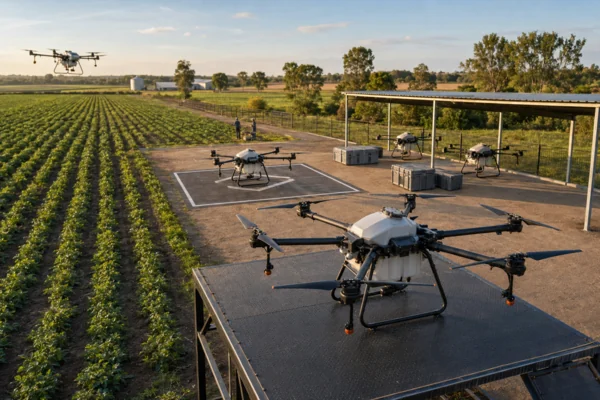
An unsuitable drone battery charger can overheat packs, interrupt operations, and shorten service life. For commercial UAV fleets, these failures multiply across batteries and charging bays. A correctly engineered charging system reduces these risks by matching electrical limits, communication, thermal control, and daily operating demands.
Selecting a drone battery charger requires matching the battery chemistry, series configuration, maximum charging voltage, approved charging current, BMS requirements, communication interface, and thermal limits. For commercial UAV fleets, charger compatibility must also cover connector design, multi-bay power allocation, charging records, turnaround targets, and validation under representative operating conditions.
The following sections explain how to evaluate each requirement and validate a dependable fleet-level solution.
Table of Content
- 1. What Makes a Drone Battery Charger Compatible with a Commercial UAV Battery Pack?
- 2. How Should Charging Voltage, Current, and C-Rate Be Matched?
- 3. Which Safety, Communication, and Multi-Bay Features Matter for Commercial UAV Fleets?
- 4. How Should UAV OEMs Validate a Charger–Battery System Before Fleet Deployment?
1.What Makes a Drone Battery Charger Compatible with a Commercial UAV Battery Pack?
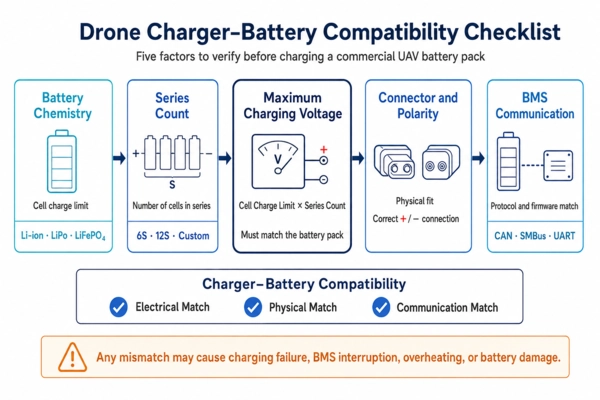
A drone battery charger is compatible when its charging profile, output limits, connector, polarity, and communication functions match the approved specifications of the battery pack. Compatibility also requires the charger to recognize or safely operate with the pack’s BMS, remain within thermal limits, and terminate charging correctly. A matching plug alone does not establish electrical or functional suitability.
Chemistry and Series Configuration
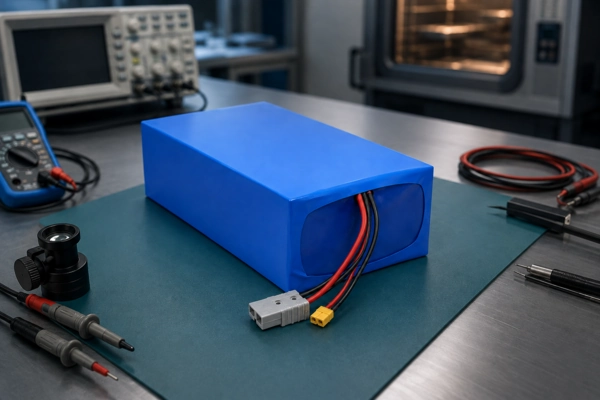
Battery chemistry determines the cell-charging profile and upper voltage. Series count establishes the pack maximum: a 12S lithium-ion pack using 4.2 V cells reaches 50.4 V. A charger configured for another chemistry or series count may undercharge the pack or exceed its safe voltage. Pack specifications and BMS settings should agree before connection.
Voltage, Output, and Connector Matching
The drone battery charger must match the pack’s maximum voltage and approved current range. Its connector needs the correct rating, pin layout, polarity, locking method, and environmental robustness. Mechanical fit without matching power and signal pins can damage the system. Cable gauge and contact resistance also matter because high current creates local heating.
Communication Compatibility
Some packs accept predefined voltage and current control; intelligent packs may require a communication handshake. CAN, SMBus, or UART systems can use different messages despite identical physical interfaces. Charger compatibility therefore includes protocol, data fields, firmware, battery identification, and fault behavior. The UAV battery charging system should enter a safe state if communication is lost or data exceeds approved limits.
| Compatibility factor | What to confirm | Risk if mismatched |
|---|---|---|
| Chemistry and series count | Cell profile and pack maximum voltage | Undercharge or overvoltage |
| Charging current | Pack, cell, BMS, and connector limits | Heating or protection trips |
| Power connector | Polarity, rating, pinout, and locking | Arcing, overheating, or damage |
| Communication | Interface, protocol, messages, and firmware | Rejected charge or unsafe control |
2.How Should Charging Voltage, Current, and C-Rate Be Matched?
Voltage should equal the approved full-charge voltage for the chemistry and series count. Current should remain within the lowest applicable limit set by the cells, pack construction, BMS, connector, cooling conditions, and operating plan. The charging C-rate is calculated from current divided by rated capacity, but the resulting value is acceptable only when the battery manufacturer has approved it.
Maximum Charging Voltage
Maximum pack voltage equals the approved maximum cell voltage multiplied by the series count. A conventional 12S lithium-ion pack with a 4.2 V cell limit requires a 50.4 V ceiling, but this cannot be assumed for other variants[1].The drone battery charger should follow the approved constant-current/constant-voltage process without overshoot.[2]
Current and Charging C-Rate
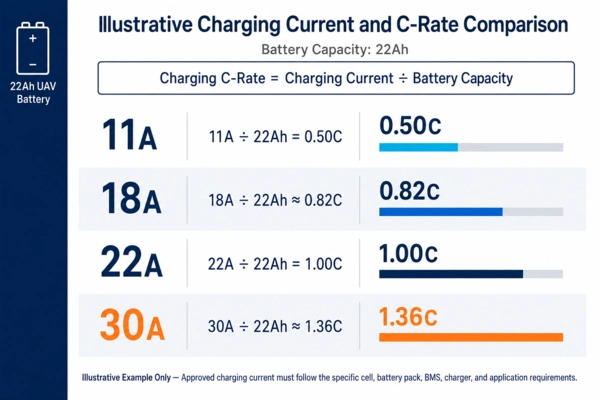
Charging current affects turnaround, heat, and available balancing time. For a 22 Ah pack charged at 11 A:
Charging C-rate = 11 A ÷ 22 Ah = 0.5C
This ratio does not prove that 0.5C is suitable. Approved specifications must reflect the cells, completed pack, BMS, and operating environment.
Fast-Charging Trade-Offs
Higher current shortens charging time but increases resistive heating and may accelerate degradation, especially when cells remain warm after flight[3]. It can also expose differences in impedance, cooling, and connector resistance. A properly configured drone battery charger may need temperature-based current reduction, cooldown periods, or scheduled charging within the commercial drone charging system.
Balancing and BMS Protection
Near full charge, the BMS may balance cells or request lower current[4]. Ignoring that request can increase voltage spread or trigger an interruption. Protection thresholds are boundaries, not routine operating targets. Coordinated charger–battery compatibility lets the charger respond correctly while the BMS remains the final protective layer.
| Strategy | Typical objective | Engineering considerations |
|---|---|---|
| Conservative | Lower heat and reduced stress | Longer turnaround; useful when batteries are warm |
| Standard | Balance time, temperature, and availability | Follow the approved routine charging profile |
| Fast | Maximum fleet turnaround | Requires explicit approval, thermal control, and closer monitoring |
3.Which Safety, Communication, and Multi-Bay Features Matter for Commercial UAV Fleets?
Commercial UAV fleets need layered electrical protection, temperature monitoring, reliable BMS communication, controlled multi-bay power distribution, and traceable charging data. The selected drone battery charger should handle abnormal packs safely, identify compatible batteries, limit facility demand, and support the operational tempo of the mission rather than merely charge one pack successfully under ideal conditions.
Electrical and Thermal Protection
UAV battery charging safety should include overvoltage, overcurrent, short-circuit, reverse-polarity, and overtemperature protection. Pack sensors, charger probes, or both can supply temperature data. Charging should stop outside approved limits or when temperature rises abnormally. Clear fault codes help distinguish thermal, wiring, cell, communication, and charger faults.
BMS Communication, Identification, and Firmware
BMS communication through CAN, SMBus, UART, or a project-specific interface can provide identity, limits, temperatures, state of charge, and faults[5]. Charger firmware must interpret these values and reject unsupported batteries when required. Firmware changes can alter timing, limits, or identification rules and should trigger compatibility regression testing.
Single-Channel and Multi-Bay Operation
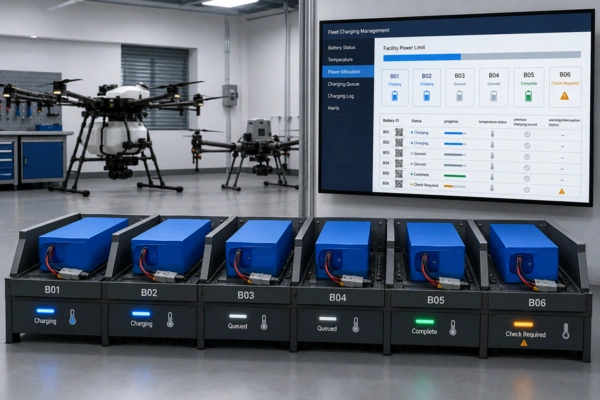
A single-channel unit is simple but may create queues. A multi-bay drone charger can increase throughput, yet “four bays” does not always mean four packs charge simultaneously at full current. The input supply, power modules, cooling, and facility circuit establish real capacity. Fleet charging management within the UAV battery charging system should allocate power across bays, stagger demand, and prevent the charging area from exceeding circuit or generator limits[6].
Records, Traceability, and Mission Requirements
Records can associate battery ID with charge time, energy, maximum temperature, faults, and maintenance. These logs support battery pack validation and early removal of abnormal packs. Agricultural fleets may prioritize field turnaround; mapping teams may value portability; delivery fleets need repeatable throughput; emergency-response operators need readiness and operation from constrained power sources[7].
| System type | Best fit | Key limitation or requirement |
|---|---|---|
| Single-channel charger | Low-volume testing or small operations | Limited throughput |
| Multi-bay charger | Parallel fleet turnaround | Verify simultaneous output and input-power demand |
| Intelligent fleet system | Managed commercial UAV fleets | Requires integration, battery identification, and data governance |
4.How Should UAV OEMs Validate a Charger–Battery System Before Fleet Deployment?
UAV OEMs should validate the drone battery charger and battery together under normal, boundary, and fault conditions. Testing should verify output accuracy, current control, temperature, cell balance, BMS protection, communications, repeated-cycle behavior, post-charge capacity, and internal resistance. Representative ambient conditions, recently flown packs, facility power, and simultaneous bay loading should be included.

Electrical, Thermal, and Protection Tests
Engineers should measure charger output voltage with calibrated equipment and log current throughout the charge cycle. Cell-voltage difference should be recorded at meaningful points, especially near charge termination. Temperature logging or thermal imaging can identify hot cells, cables, connectors, or charger components. Controlled BMS protection tests should confirm that overvoltage, overcurrent, overtemperature, and communication faults produce the intended safe response without using protection limits as routine controls.
Communication and Repeated-Cycle Tests
Protocol messages, battery identification, requested current, fault codes, and firmware combinations should be checked systematically. Repeated charge-cycle testing can reveal intermittent problems that one successful cycle misses. After charging, capacity and internal-resistance checks help determine whether the process remains consistent and whether accelerated heating or imbalance is developing. This validation should cover every approved pack revision and relevant charger configuration in the UAV battery charging system.
Illustrative Failure Analysis and Engineering Case Study
The following is an illustrative engineering example only. It is not a real customer project, independently verified field data, or a claim about a specific fleet.
Consider an Australian commercial agricultural spraying operation using 12S 22 Ah lithium-ion UAV battery packs and multi-bay 50.4 V chargers. The initial charger setting was approximately 30 A, equivalent to about 1.36C. During simulated fleet charging, several packs reached excessive temperatures, end-of-charge cell balancing was inconsistent, and the BMS occasionally interrupted charging.
The validation team first verified the drone battery charger’s 50.4 V ceiling and checked for overshoot. Current was logged at each bay while multiple packs charged. Pack sensors and thermal imaging tracked cell-area, cable, and connector temperatures, while cell-voltage difference was monitored near full charge. Communication frames and firmware behavior were reviewed, followed by 20 repeated charging tests under the same illustrative conditions.
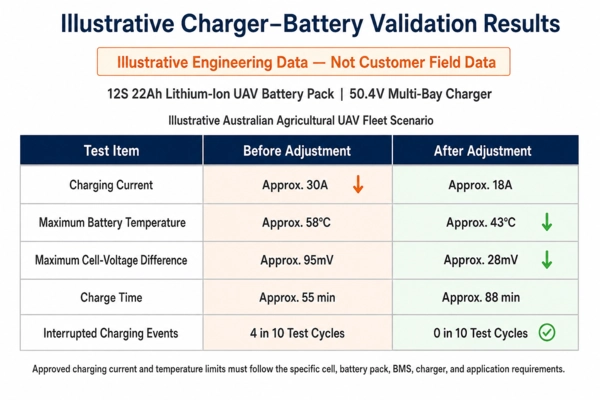
Corrective action reduced current to approximately 18 A, or 0.82C, confirmed BMS communication settings, and validated an updated charger firmware configuration. In this example, maximum temperature fell from 58°C to 43°C, end-of-charge cell difference decreased from 87 mV to 24 mV, and interruptions fell from four events to zero across 20 tests. Charge time increased from about 43 to 70 minutes, demonstrating the throughput-versus-thermal trade-off.
These figures are illustrative, not universal acceptance criteria. Appropriate current, voltage, temperature limits, and termination behavior must always follow the specific battery cell, completed pack, BMS, charger, and application requirements. Fleet deployment should proceed only after the final configuration passes documented testing.
| Illustrative test measure | Before corrective action | After corrective action |
|---|---|---|
| Charging current | Approximately 30 A (1.36C) | Approximately 18 A (0.82C) |
| Maximum pack temperature | 58°C | 43°C |
| End-of-charge cell difference | 87 mV | 24 mV |
| Approximate charge time | 43 minutes | 70 minutes |
| Interrupted events in 20 tests | 4 | 0 |
Frequently Asked Questions
Click to explore more information about Drone Battery Chargers for Commercial UAV Fleets
Q: How do I know whether a drone battery charger is compatible with a UAV battery pack?
A: Confirm that the charger matches the battery chemistry, series configuration, maximum charging voltage, approved charging current, connector pinout, polarity, and BMS communication requirements. A connector that physically fits does not guarantee electrical or functional compatibility.
Q: What charging voltage does a commercial UAV battery pack require?
A: The required maximum charging voltage depends on the battery chemistry and number of cells connected in series. For example, a conventional 12S lithium-ion pack with a 4.2 V per-cell limit requires a 50.4 V maximum charging voltage. Always follow the approved battery-pack specifications rather than assuming that all lithium-ion batteries use the same voltage limit.
Q: What charging C-rate is suitable for a UAV battery pack?
A: The suitable charging C-rate must remain within the limits approved for the cells, completed battery pack, BMS, connector, cooling design, and operating environment. Charging C-rate is calculated by dividing charging current by battery capacity. A higher C-rate may reduce charging time, but it can also increase heat and accelerate battery degradation.
Q: Why is BMS communication important during UAV battery charging?
A: BMS communication can provide the charger with battery identity, voltage, temperature, current limits, state of charge, and fault information. Intelligent systems may use CAN, SMBus, UART, or a project-specific interface. The charger firmware and battery BMS must use compatible protocols and message definitions to control charging safely.
Q: Can a multi-bay drone charger charge every battery at full current simultaneously?
A: Not always. The number of charging bays does not automatically equal the number of packs that can charge at full power. Simultaneous output depends on the charger power modules, cooling system, input supply, facility circuit, and power-allocation strategy. UAV fleet operators should verify total input demand and per-bay output under full loading.
Q: Which safety protections should a drone battery charger include?
A: A commercial drone battery charger should include overvoltage, overcurrent, short-circuit, reverse-polarity, and overtemperature protection. It should also monitor battery temperature, respond safely to communication loss, display clear fault information, and stop or reduce charging when operating conditions exceed the battery manufacturer’s approved limits.
Q: How can commercial UAV fleets reduce battery overheating during charging?
A: Allow hot batteries to cool after flight, use an approved charging current, maintain airflow around the charger and packs, monitor temperature, and inspect connectors for excessive resistance or damage. Temperature-based current reduction and staggered multi-bay charging can further reduce thermal stress during high-throughput fleet operations.
Q: How should UAV OEMs validate a charger–battery system before fleet deployment?
A: Validation should verify charger output voltage, charging-current control, cell-voltage difference, pack temperature, BMS protection, communication, firmware compatibility, and repeated charge-cycle performance. Post-charge capacity and internal-resistance checks should also be completed under representative ambient conditions, facility power limits, and simultaneous multi-bay loading.
Conclusion
Choosing a drone battery charger for commercial UAV fleets depends on electrical compatibility, charging control, BMS communication, thermal protection, multi-bay operation, and system validation. LONGSINGX can support customized UAV battery packs, Pack/BMS development, sample testing, and charger–battery compatibility validation based on project requirements. A validated charger compatibility plan helps operators balance safety, charging time, battery condition, and dependable fleet availability.
Reference:
[2]Learn how constant-current and constant-voltage stages control lithium-ion battery charging.↪