
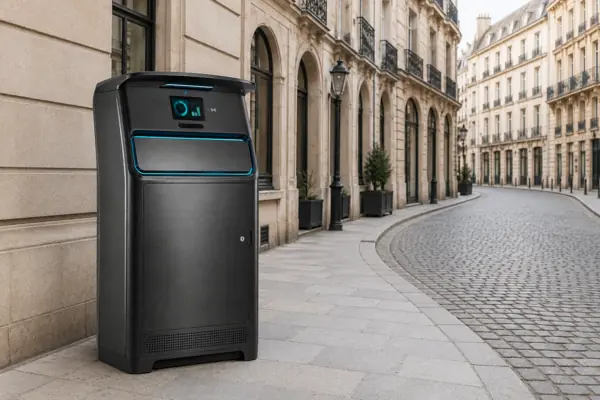
Fixed collection schedules can send vehicles to half-empty containers while overlooked bins overflow. This mismatch wastes operational attention and increases service risk. Real-time fill-level monitoring helps teams prioritize collections using measured conditions instead of schedules alone.
A smart waste bin measures the occupied space or remaining empty space inside its container. A controller compares the reading from a fill-level sensor[1] with calibrated empty and full reference points, then expresses the result as a percentage. Sensor selection depends on bin geometry, waste type, environment, installation position, and required accuracy.
The following sections explain the sensing, connectivity, data-processing, and battery systems behind smart waste management.
Table of Contents
- How Does a Smart Waste Bin Detect Fill Level?
- How Does IoT Turn Fill-Level Data into Smarter Waste Collection?
- Why Does Battery Design Affect Smart Waste Bin Reliability?
- When Does a Smart Waste Bin Need a Standard or Custom Battery Pack?
1.How Does a Smart Waste Bin Detect Fill Level?
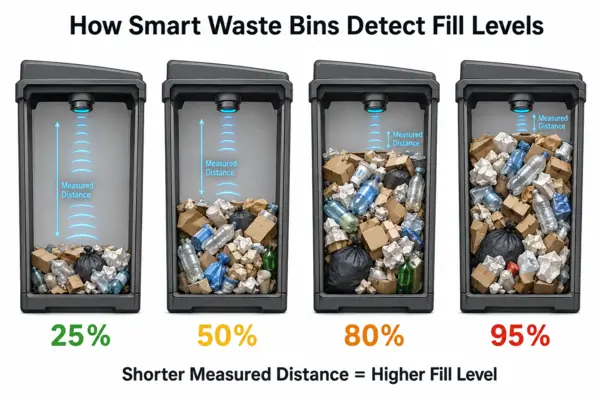
A smart waste bin measures the occupied space or remaining empty space inside its container. A controller compares the reading from a fill-level sensor with calibrated empty and full reference points, then expresses the result as a percentage. Sensor selection depends on bin geometry, waste type, environment, installation position, and required accuracy.
Sensor Position and Measurement
An ultrasonic waste sensor is commonly mounted beneath the lid or roof, facing the waste surface. It emits an acoustic pulse and measures the returning echo. The simplified relationship is distance = signal speed × travel time ÷ 2. If the internal reference depth is known, the controller can estimate fill percentage from the measured empty distance. The mounting angle must keep the sensing cone inside the container and away from walls or structural features.
Alternative Sensing Technologies
Different materials and enclosures call for different methods. No single fill-level sensor is universally best.
| Technology | Principle | Advantages | Limitations |
|---|---|---|---|
| Ultrasonic | Times an acoustic echo | Non-contact; practical for many bins | Soft surfaces, obstruction, temperature, or angled waste may disturb echoes |
| Time-of-Flight | Times reflected light | Compact; narrow measurement area | Dust, dark surfaces, sunlight, or contamination may affect readings |
| Radar | Measures reflected radio waves | Can tolerate some dust and changing light | Higher cost and integration complexity may be unsuitable for simple devices |
| Infrared | Detects reflected infrared energy | Simple proximity or threshold detection | Surface color, ambient light, and dirt can influence response |
| Weight | Measures load through force sensors | Measures mass rather than surface height | Requires structural integration and does not directly show volume |
Reducing False Readings
Irregular waste surfaces, plastic bags, soft materials, dust, moisture, bin tilt, and blocked sensors can create outliers. A smart waste bin fill-level sensor can improve measurement stability by taking multiple samples, rejecting implausible changes, and calibrating the empty and full reference points. Cross-checking tilt or weight may further improve confidence. Installation testing should include different waste profiles rather than one flat target.
2.How Does IoT Turn Fill-Level Data into Smarter Waste Collection?
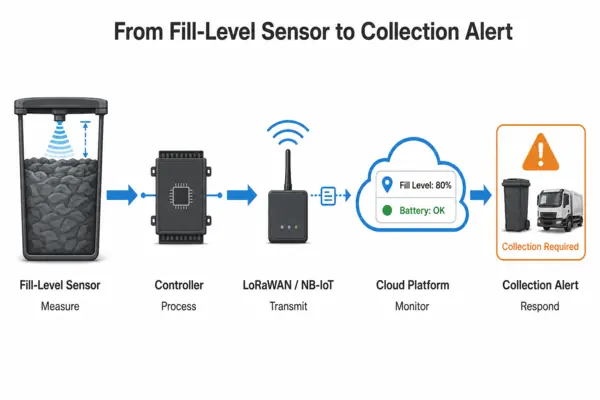
After measurement, a microcontroller packages the fill estimate with device information and sends it through LoRaWAN, NB-IoT, LTE-M, 4G, Wi-Fi, or Bluetooth. A cloud platform then associates the data with the bin location, displays status, and applies configured alert rules. The chosen network depends on coverage, payload, latency, infrastructure, and energy budget.
From Measurement to Cloud Platform
A battery-powered IoT device often sleeps between scheduled events. It wakes, powers the sensor, filters the result, stores or uploads a payload, and returns to sleep. LoRaWAN[2] is designed for battery-operated devices and can suit small, infrequent messages where gateway coverage exists. Cellular options can suit geographically dispersed sites, but poor signal and retries may significantly increase wireless communication power consumption.Wi-Fi and Bluetooth are useful where nearby infrastructure or service access is available.
Cloud software may show location, fill percentage, battery status, temperature, tilt, and abnormal conditions. In smart waste management, “real-time waste monitoring” usually means timely updates for operations—not continuous second-by-second transmission. The appropriate interval reflects how quickly conditions change and how much energy and network capacity are available.
Alerts and Route Planning
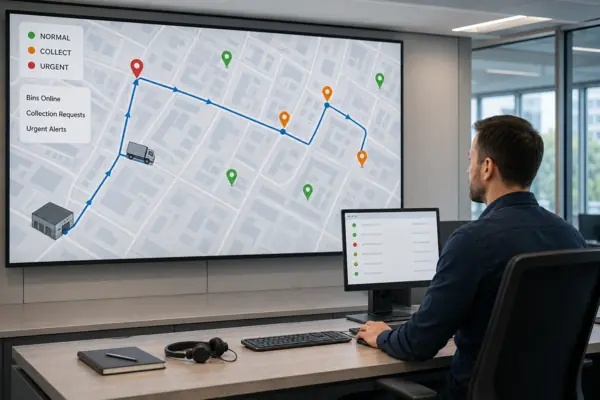
Configurable thresholds can turn measurements into normal, collection-request, or urgent states. Verified data can support waste collection route optimization by prioritizing bins that need attention. This use of smart waste management data complements broader objectives described by the European Commission[3] and the U.S. EPA[4]. A smart waste bin normally detects and reports conditions; it does not physically transport waste.
Illustrative Engineering Case Study: A Smart Recycling Station in Germany
This is an illustrative engineering scenario, not a confirmed LONGSINGX customer project. A German municipal waste management operator evaluates an outdoor multi-compartment smart recycling station containing fill-level sensing, a control board, wireless communication, status indicators, a display, and an automatic lid.
| Example Fill Level | System Status | Suggested Action |
|---|---|---|
| 25% | Normal | Continue scheduled monitoring |
| 50% | Normal | Continue scheduled monitoring |
| 80% | Collection request | Add to collection planning |
| 95% | Urgent overflow-risk warning | Prioritize inspection or collection |
These are example values, not customer data. Engineering evaluation includes repeated distance measurements, upload tests, signal-retry tests, peak-load simulation, temperature monitoring, connector continuity inspection, and runtime estimation. Verified readings could help prioritize compartments for collection without implying a specific saving or service-life outcome.
3.Why Does Battery Design Affect Smart Waste Bin Reliability?
The battery may support long periods of low-power standby plus short high-power events. Scheduled sensing and data storage may need little current, while cellular uploads, retries, display activation, lighting, lid movement, or a motor can create peaks. The battery in a smart waste bin fill-level sensor must support long periods of low-power standby and short periods of higher communication demand.
One Device, Different Power States
| Operating State | Relative Demand | Battery-Design Impact |
|---|---|---|
| Sleep mode | Very low | Quiescent current accumulates over long periods |
| Sensing mode | Low to moderate | Measurement frequency affects average use |
| Communication mode | Moderate to high | Peak current, signal quality, and retries matter |
| Display mode | Moderate | Brightness and active time affect energy use |
| Lid or motor operation | High, brief peaks | Voltage stability and peak capability are critical |

Estimating Runtime
Capacity alone does not determine runtime. Designers need system voltage, average daily energy, peak current, measurement and upload frequency, sleep current, signal quality, temperature, battery aging, and safety margin. A first estimate is:
Estimated runtime (days) = usable battery energy (Wh) ÷ average daily energy consumption (Wh/day).
Real designs also allow for cold conditions, retries, protection-circuit consumption, aging, self-discharge, and unexpected duty cycles. Logging current across representative operating states gives a better battery life estimation than relying on component datasheets alone.
Designing the Complete Power System
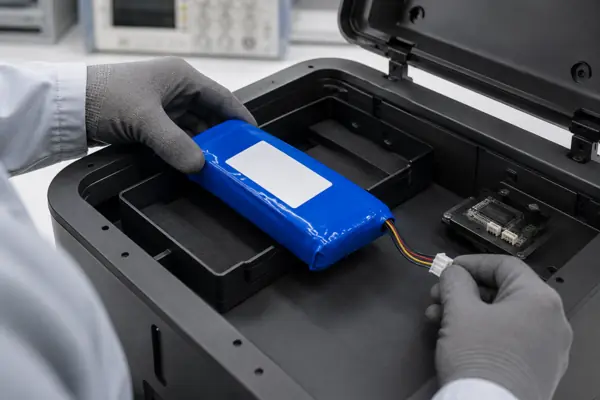
Battery protection, temperature monitoring, wiring, connectors, insulation, mechanical protection, and installation space all affect reliability. Outdoor battery solution design must also consider moisture, dust, heat, cold, vibration, and maintenance access. For rechargeable equipment, the battery, BMS, charger, and host device should be evaluated as one system. Project details may describe the battery only as a rechargeable battery pack with integrated protection, temperature monitoring and a project-specific connection interface.
4.When Does a Smart Waste Bin Need a Standard or Custom Battery Pack?
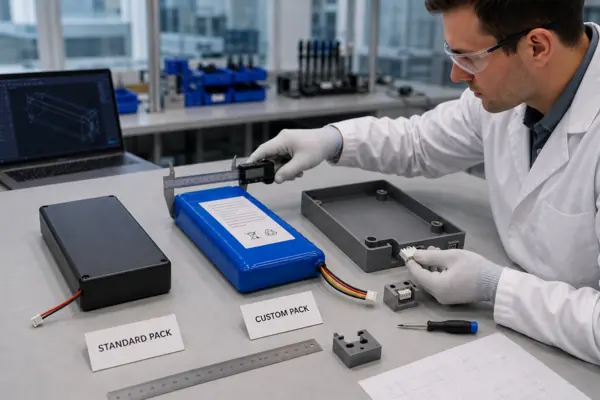
A standard pack may suit common voltage, current, runtime, connector, and dimensional requirements. A custom battery pack may be needed when the smart waste bin has unusual peak loads, restricted installation space, a project-specific interface, environmental constraints, or a duty cycle that existing products cannot support.
Selecting the Battery-System Type
Primary systems can reduce charging complexity for low-power sensing but require battery replacement. Rechargeable lithium-ion or lithium iron phosphate systems may better support displays, frequent communication, automatic lids, and other higher-power functions. Solar assistance may extend autonomy where irradiance, panel area, charging electronics, weather, and maintenance conditions are suitable.
When Customization Becomes Necessary
Customization may cover voltage, usable capacity, peak current, cable length, connector, enclosure, temperature monitoring, BMS settings, or mounting dimensions. The choice should follow the complete device load profile and environment—not chemistry preference alone.
Project Inputs, Testing, and Compliance
Equipment manufacturers should provide input-voltage range, state-by-state current measurements, peak duration, operating schedule, charging method, available space, connector and cable needs, temperature range, environmental exposure, target market, and service expectations. Samples should be tested with the actual sensor, radio, display, and motor loads.
Compliance is project-specific. Depending on the battery, device, transport route, and target market, evaluation may include UN 38.3 transport testing[5], IEC 62133-2[6], applicable UL battery safety requirements[7], and the EU Battery Regulation 2023/1542[8]. These requirements do not automatically apply to every smart recycling station in the same way.
Conclusion
Reliable smart waste monitoring depends on the interaction of sensing accuracy, data filtering, communication strategy, cloud software, and battery design. A well-integrated system turns fill measurements into usable collection alerts while managing energy and peak loads. LONGSINGX can support existing battery options or customized development based on voltage, runtime, peak current, space, communication duty cycle, temperature, wiring, and connection requirements.
Frequently Asked Questions
Click to explore more information about Smart Waste Bin Fill-Level Monitoring
Q: How does a smart waste bin know when it is full?
A: A smart waste bin uses a fill-level sensor to measure the occupied or remaining space inside the container. The controller compares the reading with calibrated empty and full reference points, converts it into a fill percentage, and sends an alert when the configured threshold is reached.
Q: Which sensor is commonly used in a smart waste bin?
A: Ultrasonic sensors are commonly used because they provide non-contact distance measurement. However, Time-of-Flight, radar, infrared, and weight sensors may be more suitable depending on the waste type, container shape, installation environment, and required measurement accuracy.
Q: Can a fill-level sensor work with LoRaWAN or NB-IoT?
A: Yes. The sensor normally connects to a controller that processes and transmits the measurement data. LoRaWAN can support small, periodic data transmissions where gateway coverage is available, while NB-IoT can be suitable for widely distributed installations using cellular networks.
Q: How often should a smart waste bin transmit data?
A: The reporting interval should be determined by the expected filling speed, collection urgency, network conditions, and available energy. Many smart waste monitoring systems use scheduled updates together with threshold-triggered alerts instead of transmitting data continuously.
Q: What affects the battery life of a smart waste sensor?
A: Battery life depends on usable energy, sleep current, sensing frequency, data transmission frequency, radio peak current, network signal quality, failed connection retries, temperature, battery aging, protection circuitry, and the required design safety margin.
Q: When does a smart waste bin need a custom battery pack?
A: A custom battery pack may be required when a standard battery cannot meet the device’s voltage, operating time, peak-current, installation-space, connector, mounting, environmental, or monitoring requirements. Long Sing develops battery solutions based on the smart waste device’s actual power profile and operating conditions.
Reference:
[1] Review peer-reviewed research on sensor-based solid waste handling systems.↪
[2] Learn how LoRaWAN supports battery-powered IoT end devices.↪
[3] Understand the EU legal framework for waste prevention and management.↪
[4] Explore the U.S. EPA waste management hierarchy for non-hazardous materials.↪
[5] Review UN 38.3 transport testing requirements for lithium cells and batteries.↪
[6] Read IEC 62133-2 safety requirements for portable rechargeable lithium batteries.↪
[7] Explore UL battery safety testing and applicable standards.↪