
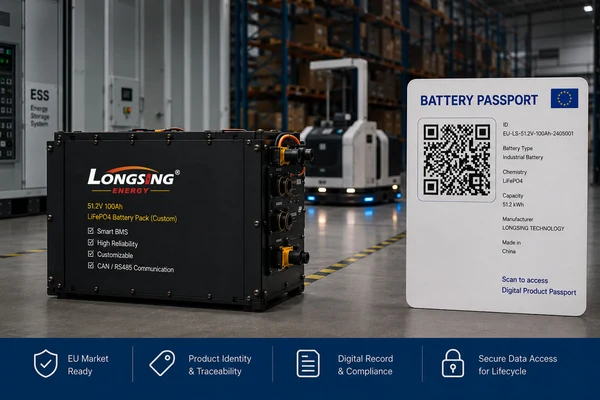
An industrial battery can be technically ready for Europe yet still face a market-access problem if its passport data is incomplete. Waiting until the QR-code stage may expose missing supplier records, test data, identifiers or BMS information when the battery design is already frozen.
From 18 February 2027, each LMT battery, EV battery and industrial battery with a capacity greater than 2 kWh must have a battery passport when placed on the EU market or put into service. For industrial battery OEMs, preparation is therefore a data-readiness, traceability and systems-integration project—not simply a QR-code project.
The key question is not only how to create a Digital Product Passport, but whether the required battery data can be traced from suppliers, engineering, manufacturing, compliance systems and applicable BMS records before the finished product reaches the EU market.
Table of Contents
- Which Industrial Batteries Need an EU Battery Passport from February 18, 2027?
- What Data Must an Industrial Battery Passport Contain?
- Why Is Battery Passport Preparation a Data and BMS Engineering Problem?
- What Should Battery OEMs Prepare Before February 18, 2027?
1. Which Industrial Batteries Need an EU Battery Passport from February 18, 2027?
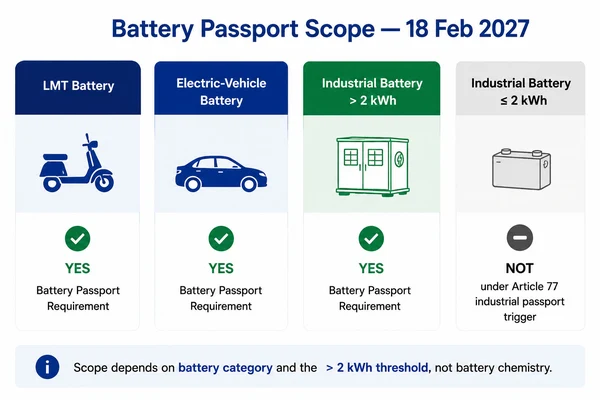
From 18 February 2027, Regulation (EU) 2023/1542 requires a battery passport for each LMT battery, each electric-vehicle battery and each industrial battery with a capacity greater than 2 kWh. [1]The 2 kWh threshold is therefore an important first screening question for industrial lithium battery and energy-storage projects.
The requirement should not be simplified to “all industrial batteries need a battery passport.” For industrial batteries, Article 77 specifically applies the passport requirement to batteries with a capacity greater than 2 kWh. Batteries outside that passport threshold may still be subject to other requirements under the EU Batteries Regulation.
Which Batteries Need an EU Battery Passport in 2027?
| Battery Type | Battery Passport from 18 Feb. 2027? | Main Scope Point |
|---|---|---|
| LMT battery | Yes | Category-based requirement |
| Electric-vehicle battery | Yes | Category-based requirement |
| Industrial battery >2 kWh | Yes | Industrial-battery capacity threshold applies |
| Industrial battery at or below 2 kWh | Not under the Article 77 industrial >2 kWh passport trigger | Other EU battery obligations should still be assessed separately |
Does a LiFePO₄ or ESS Battery Automatically Need a Passport?
No. LiFePO₄ chemistry by itself does not determine Battery Passport scope.
A LiFePO₄ battery can be used in a small industrial device, a customized industrial battery pack or a large stationary energy-storage system. Whether a battery needs a passport depends on its regulatory category and the applicable capacity threshold—not simply its chemistry.
This makes the regulation particularly relevant to larger custom lithium-ion battery packs and LiFePO₄ energy storage systems that may fall within the industrial-battery scope.
Before beginning a Battery Passport project, an OEM should first confirm:
- What is the regulatory battery category?
- What is the rated energy capacity in kWh?
- Will the finished battery be placed on the EU market or put into service in the EU?
- Which economic operator is responsible for that market placement?
Who Is Responsible for Creating the Battery Passport?
The obligation to create and maintain the Battery Passport is associated with the economic operator placing the finished battery on the EU market, rather than automatically with the supplier of an individual cell, module or component. [2]
This distinction is important for international OEM supply chains.
Cell Supplier
↓
Provides upstream cell, chemistry and material information
Battery Pack Manufacturer
↓
Provides pack engineering, manufacturing, test and traceability information
EU Economic Operator
↓
Carries the applicable responsibility for placing the finished battery on the EU market and maintaining the required Battery Passport
The exact legal responsibility depends on the commercial and regulatory structure of the project. However, even where a European customer or importer is the responsible economic operator, the battery supplier may still need to provide much of the technical information required to create the passport.
Legal responsibility for the Battery Passport and responsibility for supplying Battery Passport data are not necessarily the same thing.
2. What Data Must an Industrial Battery Passport Contain?
An industrial Battery Passport can include information covering product identity, manufacturing, materials, performance, durability, conformity, safety, parts and applicable lifecycle data. The European Commission‘s August 2026 guidance organises the current Battery Passport framework into 71 numbered data points, but it does not treat every field as equally mandatory for every battery on 18 February 2027. [3]
For OEM preparation, it is more useful to group the requirements according to where the information is generated inside the battery supply chain.
Battery Identity and Manufacturing Data
Depending on the applicable industrial-battery requirements, Battery Passport data can include items such as:
- Unique product or battery identifier
- Responsible passport entity
- Manufacturer information
- Battery category
- Battery model
- Batch, serial or product identification
- Manufacturing location
- Manufacturing date
- Battery weight
- Capacity
- Battery chemistry
These requirements create an immediate traceability challenge.
A battery manufacturer may already use:
- Internal engineering model numbers
- Customer model numbers
- ERP product codes
- MES serial numbers
- Production batch numbers
- Finished-product label numbers
The challenge is not simply creating another identifier. The different identifiers must consistently resolve to the correct physical battery and its manufacturing record.
Material, Safety and Compliance Data
Battery Passport information can also involve areas such as:
- Hazardous substances
- Critical raw materials
- Battery composition information
- Component identification
- Safety information
- Replacement or spare-part information where applicable
- Dismantling information
- Relevant compliance records
- EU Declaration of Conformity where required
Battery Passport data does not normally live in one department.
For example:
- Material information may come from cell or component suppliers
- Component numbers may come from BOM or PLM systems
- Manufacturing records may come from MES
- Product identity may come from ERP
- Test evidence may be controlled by quality engineering
- Safety and conformity documents may be maintained by compliance teams
Battery Passport preparation is therefore a cross-functional data project rather than a single form completed by the compliance department.
Performance, Durability and Lifecycle Data
For industrial battery projects, relevant Battery Passport information can also involve technical data such as:
- Minimum, nominal and maximum voltage
- Capacity
- Power capability and power limits where applicable
- Internal battery or pack resistance
- Expected lifetime where applicable
- Reference cycle-life information where applicable
- Applicable temperature information
- Round-trip efficiency for relevant batteries
- Relevant C-rate information
This means a specification such as:
51.2 V / 100 Ah / LiFePO₄
is not, by itself, a complete Battery Passport data architecture.
Published technical values may also need controlled definitions and supporting test conditions so that the battery’s digital information can be traced back to engineering evidence.
Annex XIII and the Commission’s current guidance also include battery-specific lifecycle information for applicable batteries, such as remaining capacity, battery status, resistance-related information, cycle data, operating conditions and State of Charge. [4]
Are All Battery Passport Fields Mandatory on February 18, 2027?
No. This is one of the most important distinctions in preparing for EU battery passport 2027.
The European Commission‘s current guidance distinguishes between information that is:
- Mandatory
- Optional
- Required only if applicable
- Covered through another data point
- Not required to be filled or displayed as of February 2027
71 Battery Passport data points do not mean that every industrial battery must populate 71 mandatory fields on 18 February 2027.
For example, the Commission’s August 2026 guidance notes that certain carbon-footprint information is not to be filled or displayed as of February 2027 under the current implementation timetable.
Battery due-diligence timing should also not be confused with the Battery Passport deadline. Regulation (EU) 2025/1561 moved the application date for the relevant battery due-diligence obligations in Article 48 to 18 August 2027. [8]
Other sustainability requirements can also follow their own delegated-act or implementation timelines.
18 February 2027 is the Battery Passport start date, but it is not automatically the applicability date for every future Battery Passport data field.
OEMs should therefore separate:
Day-one February 2027 requirements
from:
Later Battery Regulation data obligations that may eventually feed into the same passport architecture.
3. Why Is Battery Passport Preparation a Data and BMS Engineering Problem?
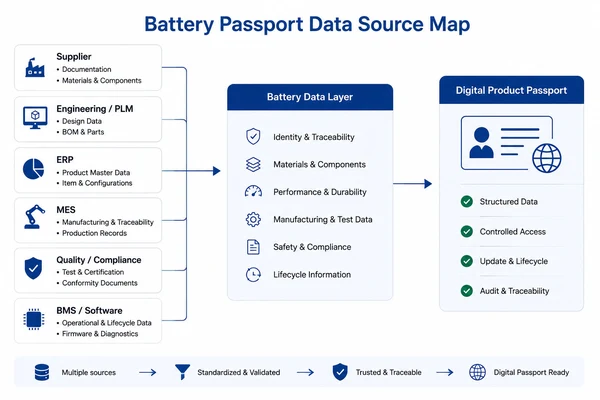
Battery Passport preparation is an engineering and data-integration problem because the required information is generated throughout the battery lifecycle. Supplier information, pack design, manufacturing traceability, compliance records, test systems and applicable BMS data must eventually connect to one controlled digital product identity.
Where Does Battery Passport Data Actually Come From?
Cell / Component Supplier
↓
Chemistry, materials, technical characteristics and supplier documentation
Pack Engineering / PLM
↓
Electrical architecture, parts, pack specification, safety and dismantling information
Manufacturing / MES / ERP
↓
Plant, production date, batch, model and serial-number traceability
Quality / Compliance
↓
Testing, conformity evidence and regulatory documentation
BMS / Embedded Software
↓
Applicable operational and lifecycle information
DPP Infrastructure
↓
Structured Battery Passport data, identifier and access management
Physical Battery
↓
QR code or other data carrier connects the battery with its digital record
Because these data originate from different systems, an OEM may need to integrate:
- Supplier documentation
- PLM
- ERP
- MES
- Laboratory test records
- Quality-management systems
- BMS or cloud data
- DPP infrastructure
What Role Does the BMS Play?
The BMS is important for Battery Passport readiness, but the BMS is not the Battery Passport itself.
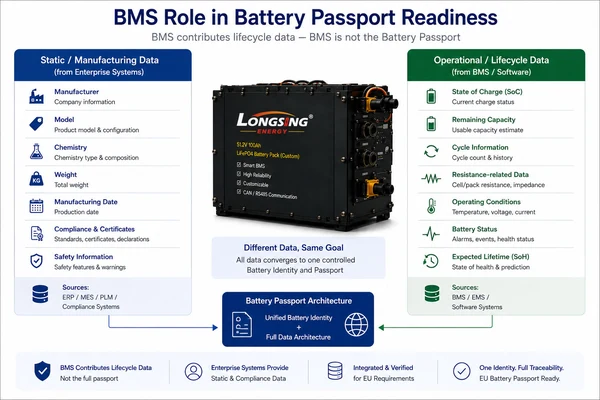
Many passport fields are static or manufacturing-related, such as:
- Manufacturer identity
- Model
- Manufacturing location
- Chemistry
- Weight
- Parts
- Safety information
- Compliance evidence
A BMS does not create these records.
However, the BMS can become important where battery-specific operational or lifecycle information is required.
Article 14 of Regulation (EU) 2023/1542 requires relevant state-of-health and expected-lifetime information to be contained in the battery management systems of stationary battery energy-storage systems, LMT batteries and EV batteries. [5]This creates an important connection between battery electronics and the wider EU battery-data framework.
Depending on battery category and applicability, relevant information can include:
- State of Charge
- Remaining capacity
- Resistance-related information
- Cycle information
- Operating conditions
- Battery status
- Expected-lifetime or health-related parameters
Which required or applicable lifecycle data does this battery system generate, where is it stored and can it be linked to the correct Battery Passport identity?
For ESS projects, this question may influence BMS firmware, data logging, EMS integration and long-term information management.
For related communication architecture, see LONGSING’s CAN vs RS485 BMS integration guide.
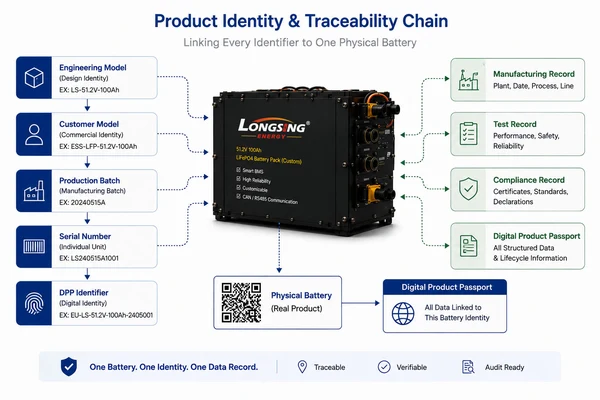
Why Serial Numbers and Unique Identifiers Matter
Digital traceability becomes unreliable if the physical battery and its digital record cannot be consistently matched.
| Identity Layer | Example Purpose |
|---|---|
| Engineering model | Defines the battery design and configuration |
| Customer model | Customer-facing product identification |
| Production batch | Manufacturing traceability |
| Individual serial number | Unit-level traceability |
| DPP / product identifier | Links the product identity with its Digital Product Passport |
The physical battery, manufacturing record, compliance evidence and Digital Product Passport must refer to the correct product identity.
The QR Code Is the Access Point, Not the Passport
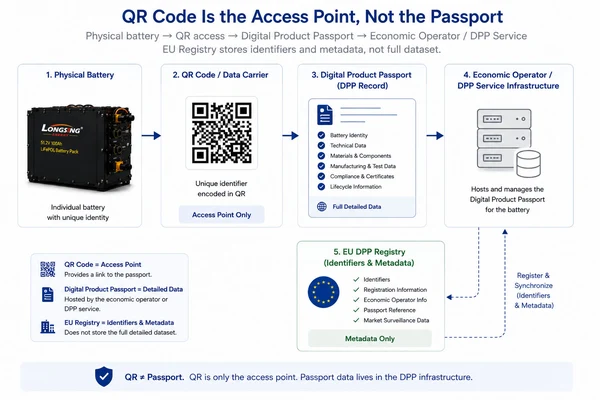
The EU Battery Passport is not simply a QR code and it is not a single PDF stored in one central EU database.
The Digital Product Passport uses a decentralised architecture. [6]Detailed product information remains under the responsibility of the relevant economic operator and may be hosted directly or through a DPP service provider. The EU-level Registry stores unique identifiers, registration information and required metadata rather than automatically storing the complete detailed product dataset.
Physical Battery
↓
QR code / data carrier
Digital Product Passport
↓
Required battery information
Economic Operator / DPP Service Infrastructure
EU DPP Registry
↓
Unique identifiers and registration metadata
The QR code is the access point—not the compliance system.
OEMs should therefore first establish the battery data and traceability architecture, and only then implement the physical data carrier that provides access to it.
4. What Should Battery OEMs Prepare Before February 18, 2027?
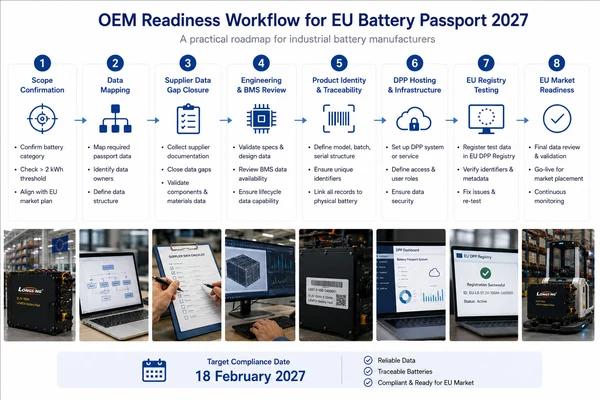
Battery OEMs should prepare by confirming regulatory scope and legal responsibility, mapping required data, closing supplier and engineering gaps, reviewing applicable BMS information, establishing traceable identifiers and testing the Digital Product Passport workflow.
The greatest risk is not generating the QR code too late—it is discovering too late that the data behind it does not exist.
Step 1: Confirm Scope and Legal Responsibility
Create a written scope record for every battery family intended for the EU market.
Confirm:
- Battery category
- Rated capacity in kWh
- Whether an industrial battery exceeds 2 kWh
- Intended EU market
- Economic operator placing the finished battery on the market
- Importer / manufacturer / authorised-representative structure
- Who will create and maintain the passport
For a non-EU battery OEM, the commercial project should also define which Battery Passport data must be supplied to the responsible EU economic operator.
Step 2: Build a Battery Passport Data Gap Map
Do not begin with the QR code.
Begin with a controlled data map:
Required Data → Available? → Source → Owner → Format → Evidence → Update Requirement
What Industrial Battery OEMs Should Prepare Before February 2027
| Data / System Area | Example Information | Likely Internal Source |
|---|---|---|
| Product identity | Model, batch, serial, unique identifier | MES / ERP |
| Manufacturing | Plant, manufacturing date, weight | MES / Manufacturing |
| Battery specifications | Chemistry, capacity, voltage, power | Engineering |
| Materials | Composition, critical materials, hazardous substances | Supplier / Engineering |
| Compliance | Declarations and applicable test evidence | Quality / Compliance |
| Pack architecture | Parts, safety and dismantling information | Pack Engineering / PLM |
| Lifecycle data | Applicable capacity, resistance, cycles, SoC and operating information | BMS / Software |
| Digital infrastructure | DPP hosting, identifier, QR/data carrier, Registry | IT / Compliance |
Typical gaps can include:
- Material information exists only in supplier PDFs
- Published performance values are not linked to controlled test conditions
- MES and ERP use different product identities
- Serial numbers cannot be traced to the correct compliance records
- BMS data is not linked to the same individual battery identity
- The European buyer and battery supplier have not defined who maintains passport updates
Step 3: Review Supplier and BMS Data Before Production
Battery Passport requirements should be considered before sourcing, engineering and firmware are frozen.
For upstream suppliers, OEMs may need information supporting:
- Battery chemistry and composition
- Critical raw-material information
- Hazardous-substance reporting
- Component identification
- Technical characteristics
- Traceability
Pack engineering should also establish controlled definitions for applicable values such as:
- Nominal, minimum and maximum voltage
- Capacity
- Power capability
- Internal resistance
- Cycle-life test conditions
- Efficiency metrics
- Temperature reference conditions
For ESS and other applicable battery systems, review BMS data availability before firmware freeze. If lifecycle information must be recorded, associated or exposed later, it is significantly easier to design that capability before production than to retrofit it afterwards.
Step 4: Test the Digital Passport and EU Registry Workflow
The EU Digital Product Passport Registry and testing environment are already operational. [7]Economic operators can enrol organisations, test workflows and prepare DPP registration before the February 2027 battery deadline.
A practical preparation sequence is:
- Confirm the responsible economic operator
- Enrol and verify the organisation
- Create the product/passport identity
- Prepare and host required DPP data
- Register the DPP and identifier
- Associate the physical QR code or data carrier
- Verify that the identifier resolves correctly
- Test required access and permissions
- Define lifecycle-update responsibilities
- Validate the complete process before EU market placement
The preparation timeline can be viewed as:
Scope
↓
Which battery models are affected?
Data Mapping
↓
Which required information already exists?
Supplier Gap Closure
↓
Which information must come from cells, components or external partners?
Engineering Review
↓
Are test definitions, product data and applicable BMS information sufficient?
Traceability
↓
Can model, batch, serial and digital identity be linked?
DPP Infrastructure
↓
Where is passport information hosted and maintained?
Registry Testing
↓
Does the passport register and resolve correctly?
18 February 2027
↓
Qualifying batteries are placed on the EU market with the required Battery Passport.
OEMs that wait until early 2027 may discover that the difficult part is not generating the QR code—it is reconstructing missing engineering and supply-chain data behind it.
Prepare Battery Data Before Freezing the Pack
For EU-targeted industrial battery projects, Battery Passport preparation should become an input to battery development alongside:
- Voltage
- Capacity
- Power
- Cell chemistry
- BMS
- Communication
- Mechanical design
- Thermal management
- Testing
- Certification and compliance
The additional requirement is:
Structured and traceable product data across the battery lifecycle.
For related rechargeable battery engineering, review LONGSING‘s custom battery pack solutions and LiFePO₄ energy storage systems.
Conclusion
The EU battery passport 2027 deadline is 18 February, but industrial battery OEM preparation needs to begin earlier. For qualifying industrial batteries above 2 kWh, readiness involves more than a QR code: legal responsibility, supplier information, engineering data, product identity, applicable BMS records, DPP hosting and Registry integration must work together.
The strongest approach is to build traceability and passport data into battery development before production is frozen.
Frequently Asked Questions about EU Battery Passport 2027
Click to explore more information about EU Battery Passport 2027
Q: When does the EU Battery Passport become mandatory?
A: The Battery Passport becomes mandatory from 18 February 2027 for each LMT battery, each electric-vehicle battery and each industrial battery with a capacity greater than 2 kWh covered by Article 77 of Regulation (EU) 2023/1542.
Q: Do all industrial batteries need an EU Battery Passport in 2027?
A: No. The Article 77 passport requirement applies to industrial batteries with a capacity greater than 2 kWh. Industrial batteries outside that threshold may still be subject to other requirements under the EU Batteries Regulation.
Q: Does every LiFePO₄ ESS battery need a Battery Passport?
A: Not simply because it uses LiFePO₄ chemistry. Battery Passport scope depends on the battery category and applicable capacity threshold. Industrial batteries above 2 kWh fall within the Article 77 passport scope.
Q: Who is responsible when an industrial battery is manufactured outside the EU?
A: The relevant Battery Passport responsibility is linked to the economic operator placing the finished battery on the EU market. A non-EU battery manufacturer may nevertheless need to provide extensive technical, manufacturing, material and traceability data to the responsible economic operator.
Q: Are all 71 Battery Passport data points mandatory in February 2027?
A: No. Current European Commission guidance distinguishes between mandatory, optional, if-applicable, duplicated and not-yet-required data points. The exact requirements should be checked against the applicable battery category and the latest EU implementation guidance.
Q: Does the EU Battery Passport require BMS data?
A: Some applicable passport information can involve battery lifecycle and operational data. The exact BMS-related requirements depend on battery category and applicability. Static passport information such as manufacturer identity, chemistry and manufacturing records comes from other systems rather than the BMS.
Q: Is the EU Battery Passport just a QR code?
A: No. The QR code or other data carrier provides access to the Digital Product Passport. The passport relies on a wider decentralised data architecture, while the EU Registry stores identifiers, registration information and required metadata rather than automatically storing the complete detailed product dataset.
Q: What should an industrial battery OEM prepare first?
A: Start by confirming whether the battery is in scope and identifying the responsible economic operator. Then map required passport data against existing supplier, engineering, MES/ERP, quality, compliance and BMS information before selecting the final QR, hosting and Registry workflow.
Reference: