
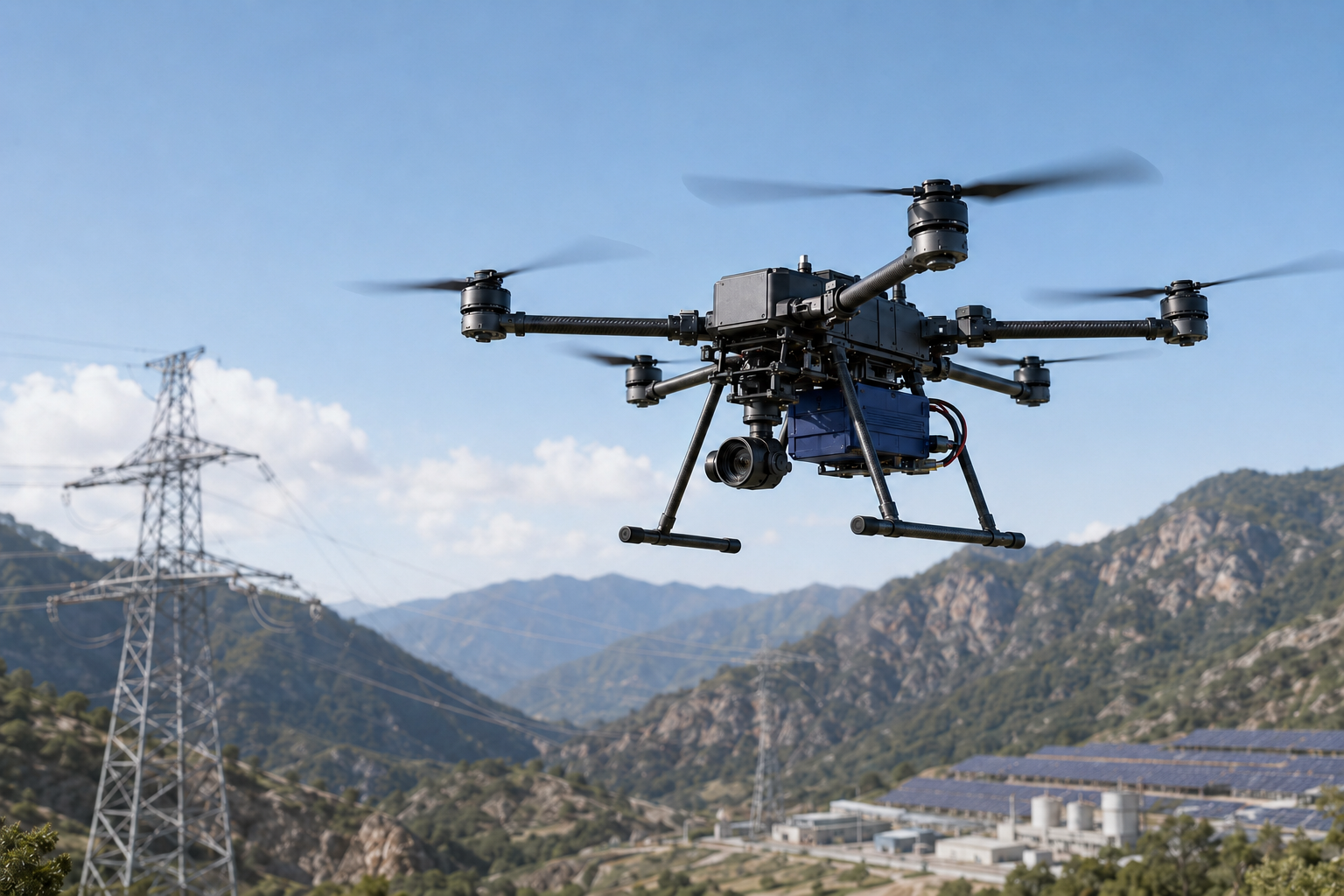
An overweight or underpowered drone battery pack can shorten flight time, trigger voltage sag, or overheat during takeoff. These failures can ground an otherwise capable UAV. A systematic selection process—built around mission load, electrical demand, pack design, BMS functions, and validation testing—reduces integration risk.
Choosing the right drone battery pack requires evaluating the UAV application, battery chemistry, voltage, capacity, C-rate, peak current, weight, dimensions, BMS, operating temperature, and testing requirements. The selection should match the propulsion system and mission profile rather than rely only on nominal capacity or energy density.
The following sections connect chemistry and mission requirements with electrical sizing, BMS architecture, and validation before aircraft integration.
Table of Contents
- What Factors Determine the Right Drone Battery Pack for a UAV?
- How Should Voltage, Capacity, and C-Rate Be Calculated for a UAV Battery Pack?
- What BMS and Safety Functions Does an Industrial UAV Battery Pack Require?
- How Should a Drone Battery Pack Be Tested Before UAV Integration?
1. What Factors Determine the Right Drone Battery Pack for a UAV?
The right drone battery pack is determined by the UAV’s application, power demand, target flight time, payload capacity, available battery space, weight limit, operating temperature, charging method, and expected cycle life. Battery chemistry must then be selected according to the required balance between energy density, discharge capability, durability, thermal stability, and pack weight.[1]
Mission Requirements and Physical Limitations
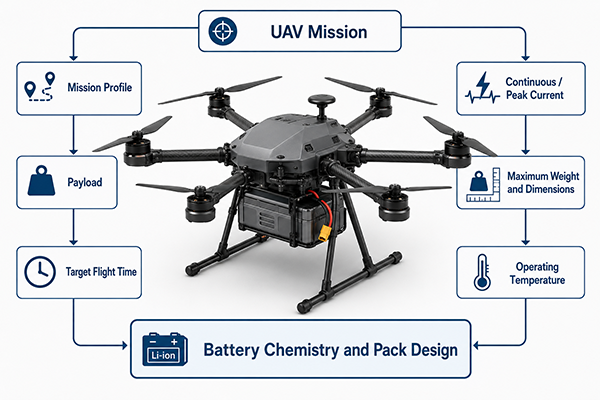
Battery selection should begin with the aircraft rather than an individual cell specification. An inspection drone carrying cameras may prioritize flight endurance and moderate weight, while an agricultural or logistics UAV may need substantially higher discharge capability to lift a heavy payload. Emergency-response aircraft may also require reliable operation across a wider temperature range.
The target flight time must be considered together with average propulsion power, payload, reserve energy, wind conditions, and expected maneuvering. Increasing drone battery capacity may extend endurance, but the additional battery weight can increase motor power consumption. Beyond a certain point, adding capacity may provide only a limited flight-time benefit.
Engineers should define the following before developing a UAV battery pack:
- Aircraft type and mission profile
- Propulsion-system voltage range
- Average, continuous, and peak current
- Target flight time and reserve requirement
- Maximum battery dimensions and weight
- Payload capacity and possible payload changes
- Operating and storage temperature
- Charging time and charging infrastructure
- Required cycle life and maintenance plan
These parameters help determine whether a standard pack is suitable or whether a custom drone battery pack is required.
Comparing Li-ion, LiPo, and LiFePO4 Chemistries
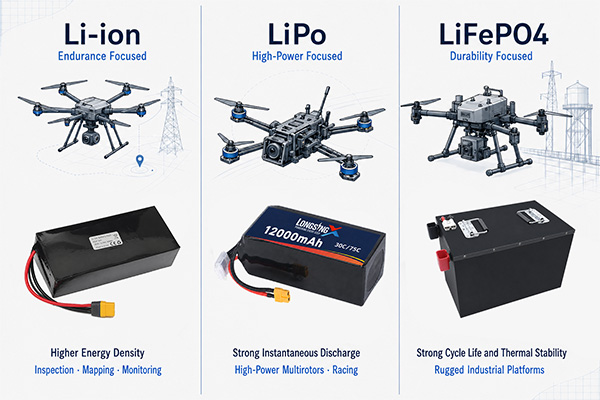
Li-ion, LiPo, and LiFePO4 cells have different performance characteristics. Actual results depend on the cell model, pack structure, discharge rate, operating temperature, charging method, and test conditions.
| Chemistry | Energy Density | Discharge Capability | Cycle Life | Weight | Thermal Stability | Typical UAV Applications |
|---|---|---|---|---|---|---|
| Li-ion | Generally high | Moderate to high, depending on the cell | Application-dependent | Suitable for weight-sensitive designs | Requires appropriate protection and thermal control | Long-endurance inspection, mapping, and surveillance UAVs |
| LiPo | Moderate to high | Often suitable for high-power discharge | Strongly affected by discharge and charging conditions | Flexible pack formats are available | Requires careful charging, handling, and temperature monitoring | Multirotors, racing platforms, and high-power aircraft |
| LiFePO4 | Generally lower than Li-ion and LiPo | Good power capability in suitable designs | Often selected when longer service life is important | Usually heavier for the same energy | Relatively strong thermal stability | Industrial platforms prioritizing durability and stability |
A UAV lithium-ion battery may be appropriate when endurance and weight are primary concerns. A LiPo drone battery may suit aircraft with demanding takeoff or maneuvering loads. A LiFePO4 drone battery may be considered when cycle life and thermal stability are more important than minimum weight.
No chemistry is suitable for every UAV. The final decision depends on power demand, payload, operating temperature, mission duration, charging conditions, and the aircraft’s allowable battery mass.
Pack-Level Performance and Service Conditions
Cell specifications alone do not define pack performance. Cell holders, busbars, wiring, connectors, insulation, enclosure design, and thermal management all influence resistance, temperature rise, and reliability.
Cell consistency is particularly important in series-connected packs. Differences in capacity, internal resistance, or state of charge can cause individual cells to reach voltage limits earlier than the rest of the pack. Charging requirements must also match the chemistry, series count, maximum charging voltage, and required communication functions.
A high-discharge lithium battery may deliver the necessary current, but its weight or available energy may not meet the mission objective. Battery selection therefore requires a system-level balance rather than maximizing one specification.
2. How Should Voltage, Capacity, and C-Rate Be Calculated for a UAV Battery Pack?
Voltage should match the propulsion system, capacity should be calculated from required energy, and C-rate should support continuous and peak current with an appropriate margin.[3] Series connections increase voltage, while parallel connections increase capacity and current capability. Practical UAV battery pack sizing must also account for efficiency, usable discharge depth, aging, temperature, payload changes, and transient loads.
Voltage and Pack Configuration
Drone battery voltage must remain within the permitted range of the motors, electronic speed controllers, power distribution system, avionics, and charger. Nominal voltage represents normal operating voltage, while maximum charging voltage and end-of-discharge voltage define the upper and lower limits.
In a series configuration, cell voltages add while capacity in ampere-hours remains unchanged. In a parallel configuration, capacity and current capability increase while voltage remains unchanged.[2] The battery pack configuration is commonly described as “S” for series groups and “P” for parallel cells or groups.
For example, a 12S2P pack contains 12 series groups, with two cells connected in parallel within each group. Engineers must verify that the resulting minimum, nominal, and maximum drone battery voltage are compatible with every connected component.
Calculating Energy, Capacity, and C-Rate
Voltage, capacity, energy, current, and C-rate describe different electrical characteristics:
- Voltage (V) represents electrical potential.
- Capacity (Ah) indicates how much charge the pack can deliver.
- Energy (Wh) combines voltage and capacity.
- Current (A) represents the rate of electrical flow.
- C-rate relates discharge current to battery capacity.
- Continuous discharge current is the current the pack can sustain under defined conditions.
- Peak discharge current is the short-duration current required during events such as takeoff or high-load climbing.
Required energy can be estimated using:
Required Energy (Wh) = Average Power (W) × Target Flight Time (h) ÷ System Efficiency
Average power is the expected average electrical load. Target flight time must be expressed in hours; minutes should be divided by 60. System efficiency represents losses in the propulsion and electrical systems.
Required drone battery capacity can then be estimated using:
Required Capacity (Ah) = Required Energy (Wh) ÷ Nominal Voltage (V)
The available discharge capability is:
Discharge Capability (A) = Battery Capacity (Ah) × C-rate
For example, a 20 Ah pack rated at 5C theoretically corresponds to 100 A under the specified rating conditions. However, drone battery C-rate should not be selected from the label alone. Cell temperature, voltage sag, cooling, pack resistance, connector rating, discharge duration, and manufacturer test conditions must also be evaluated.
Final drone battery capacity should include an engineering margin for usable depth of discharge, low-temperature performance, battery aging, motor startup current, climbing loads, wind, and payload changes. Capacity alone cannot confirm that a pack can safely supply the required current.
Illustrative Engineering Case: Voltage Sag in an Inspection UAV
Consider a hypothetical industrial multirotor used for power-line inspection in Germany. All values below are illustrative and do not represent a LONGSINGX customer project or actual test results.
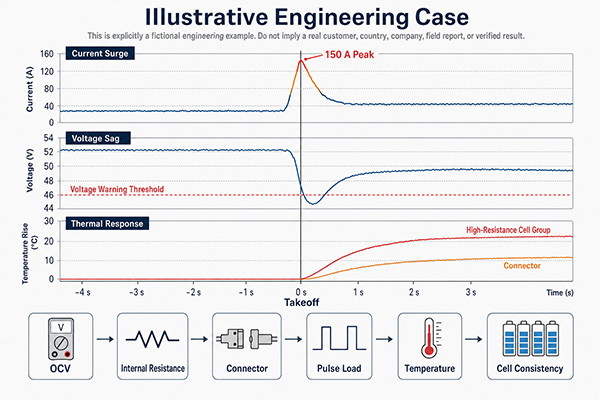
The aircraft requires a nominal 44.4 V, 12S UAV battery pack with an illustrative capacity of 22 Ah. Its expected continuous demand is 75 A, while takeoff and high-load climbing may briefly require 150 A. During testing, the fully charged pack shows an acceptable open-circuit voltage, but pack voltage drops sharply during takeoff. The controller issues a low-voltage warning, and climbing performance becomes unstable.
The engineering review follows this sequence:
- OCV testing: Pack and series-group voltages are measured before loading.
- Internal resistance testing: Several parallel groups show higher resistance than the others.
- Connector inspection: Contact resistance is found to increase under vibration and high current.
- Load testing: The pack cannot maintain the required voltage during the illustrative 150 A pulse.
- Temperature monitoring: Higher-resistance groups and the connector heat faster than expected.
- Cell consistency analysis: Differences in resistance and loaded voltage indicate inadequate cell matching.
The hypothetical root causes include an unsuitable C-rate, excessive internal resistance, cell inconsistency, connector resistance, and insufficient peak discharge current capability.[4] An incorrect series or parallel design could create similar symptoms.
Corrective actions include recalculating peak-current duration, selecting appropriate high-discharge cells, improving cell matching, optimizing the parallel configuration, and reducing connector resistance. The revised drone battery pack must then undergo simulated flight-load testing using the aircraft’s continuous and peak-current profile. Verification should confirm loaded voltage, temperature rise, group consistency, connector performance, and BMS response.
3. What BMS and Safety Functions Does an Industrial UAV Battery Pack Require?
An industrial UAV battery pack requires protection against abnormal voltage, current, temperature, and short-circuit conditions, together with cell balancing, charge and discharge control, status monitoring, fault recording, and communication.[5] The BMS should match the series count, current profile, operating environment, charger, and UAV control protocol.
Essential Protection and Control Functions
A smart BMS can monitor pack conditions and respond when defined limits are reached. Its thresholds and response times must be coordinated with the cell chemistry, current demand, and aircraft operating profile.
| BMS Function | What It Monitors or Controls | Why It Matters for UAV Operation |
|---|---|---|
| Overcharge and over-discharge protection | Cell and pack voltage limits | Prevents operation outside specified voltage ranges |
| Overcurrent and short-circuit protection | Abnormal charge or discharge current | Responds to electrical faults and excessive loads |
| Cell balancing | Voltage differences between series groups | Supports consistent charging and usable pack capacity |
| Temperature monitoring | Cell, connector, or pack temperature | Supports charge and discharge control under thermal limits |
| State of Charge and State of Health monitoring | Remaining energy and estimated battery condition | Supports flight planning and maintenance decisions |
| Fault recording | Protection events and abnormal conditions | Provides diagnostic information for engineering analysis |
| Charge and discharge control | Current paths and operating permissions | Coordinates pack operation with defined safety limits |
| Low-voltage warning | Pack or cell voltage during discharge | Allows the flight controller to initiate a managed response |
| CAN or RS485 communication | Battery data exchanged with the UAV or charger | Enables status reporting, warnings, and system coordination |
Communication and Thermal Management
CAN or RS485 communication may transmit voltage, current, temperature, State of Charge, State of Health, warnings, and fault codes. Communication definitions—including data format, update rate, node addressing, and fault behavior—must be agreed upon during development.
Thermal management support may include multiple temperature sensors, charge restrictions at low temperatures, current reduction at elevated temperatures, or commands to external cooling equipment. Sensor placement matters because surface temperature at one location may not represent the hottest part of the pack.
Integrated Battery System Design
A BMS cannot compensate for unsuitable cells, insufficient C-rate, undersized conductors, high-resistance connectors, or an incorrect pack structure. Protection settings that interrupt power during normal takeoff loads can also create an operational risk.
Cells, connectors, busbars, enclosure, insulation, BMS, and thermal management should therefore be engineered as one system. For a custom drone battery pack, LONGSINGX can support cell selection, customized Pack/BMS solutions, and sample testing according to defined project requirements.
4. How Should a Drone Battery Pack Be Tested Before UAV Integration?
Before integration, a drone battery pack should undergo visual, electrical, load, thermal, BMS, charging, communication, and simulated mission testing. Test conditions must reflect the UAV’s voltage range, continuous and peak current, flight profile, operating temperature, charging method, and connector system. Basic testing cannot guarantee performance under every possible flight condition.
Incoming and Functional Testing
Testing should begin with visual inspection for damaged insulation, incorrect polarity, loose connections, enclosure defects, and connector problems. OCV testing, internal resistance testing, and cell consistency testing can identify abnormal cells or series groups before high-current testing begins.[6]
The validation plan may include:
- Visual and dimensional inspection
- OCV and cell consistency testing
- Capacity verification
- Continuous load testing
- Peak load testing
- Temperature monitoring
- Connector and cable verification
- Charging compatibility testing
- BMS protection and fault-response testing
- CAN or RS485 communication testing
- Cycle testing when required
Acceptance limits should be defined before testing. They should reflect the cell specification, pack design, UAV requirements, measurement method, ambient temperature, and expected service conditions.
Simulated Flight-Load Testing
Simulated flight-load testing should reproduce relevant portions of the mission, including motor startup, takeoff, hovering, climbing, cruising, payload operation, and landing reserve. Engineers should record pack voltage, group voltage, current, temperature, delivered capacity, communication status, and protection events.[7]
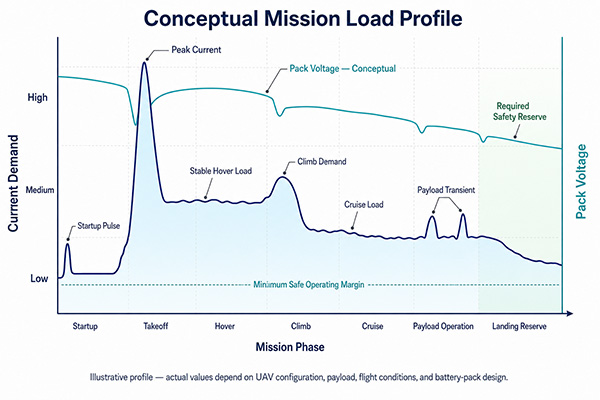
Repeated pulse testing can reveal voltage sag or connector heating that may not appear during a low-current capacity test. Low-temperature or elevated-temperature testing may also be required when the aircraft operates outside normal indoor conditions.
The completed UAV battery pack should then be evaluated on an integration platform under controlled procedures. Any design change to cells, connectors, firmware, pack structure, or BMS settings may require partial or complete revalidation.
Project Information Required for Battery Development
Customers should provide the following technical information when planning a new battery system:
| Information Category | Required Project Details |
|---|---|
| UAV and mission | Drone type, application, target flight time, payload, and mission profile |
| Electrical requirements | Nominal voltage, maximum charging voltage, required capacity in Ah or Wh, average current, continuous current, and peak current |
| Mechanical limits | Maximum battery dimensions, weight limit, mounting method, and connector type |
| System interface | Communication protocol, charger, charging method, and required battery data |
| Operating conditions | Minimum and maximum temperature, vibration conditions, and environmental exposure |
| Project planning | Required certifications, sample quantity, validation requirements, and expected annual demand |
These parameters allow a battery supplier to plan cell selection, series and parallel configuration, BMS design, pack structure, connector sizing, and sample testing. They also make it possible to evaluate whether an existing battery or a customized solution is more appropriate.
Conclusion
Choosing a drone battery pack requires balancing chemistry, drone battery voltage, capacity, C-rate, peak current, weight, BMS functions, operating conditions, and test results. The highest drone battery capacity or energy density does not automatically provide the required flight time or power capability. A suitable UAV battery pack must be evaluated as an integrated electrical, mechanical, thermal, and communication system.
UAV manufacturers, system integrators, engineers, and industrial project teams can contact LONGSINGX to discuss UAV cells, custom battery packs, Pack/BMS development, cell selection, and sample testing based on their project requirements.
Frequently Asked Questions
Click to explore more information about Drone Battery Packs
Q: What is a drone battery pack?
A: A drone battery pack is a rechargeable power system consisting of battery cells, electrical connections, insulation, connectors, and, where required, a BMS. It supplies the voltage, energy, and discharge current needed by the UAV’s propulsion and onboard systems. Its configuration must match the aircraft’s power demand, weight limit, dimensions, operating environment, and communication requirements.
Q: What type of battery is commonly used in UAVs?
A: UAVs commonly use LiPo or lithium-ion batteries, while some industrial platforms use LiFePO4 batteries. LiPo batteries are often selected for high discharge capability, lithium-ion batteries for higher energy density and endurance, and LiFePO4 batteries for thermal stability and cycle life. The appropriate chemistry depends on the UAV’s payload, power demand, flight time, temperature range, and weight restrictions.
Q: Can I use a higher-mAh battery in my drone?
A: A higher-mAh battery may provide more capacity, but it should only be used if its voltage, dimensions, weight, connector, discharge capability, and charging requirements are compatible with the UAV. Additional capacity also increases battery weight, which may raise motor power consumption and reduce payload capacity. Therefore, a higher mAh rating does not automatically produce a proportional increase in flight time.
Q: How long will a drone battery last?
A: Drone battery life can refer to flight time or service life. Flight time depends on usable energy in Wh, aircraft power consumption, payload, weather, temperature, and reserve requirements. Service life depends on battery chemistry, depth of discharge, charging method, discharge rate, operating temperature, and storage conditions. Actual performance should be confirmed under the UAV’s intended mission profile.
Q: Which type of battery is better for drones, 18650 or 21700?
A: Neither cell format is suitable for every drone. A 21700 cell may provide greater capacity or current capability per cell, while an 18650 cell may offer more flexibility for compact battery pack configurations. The decision should be based on the specific cell model, energy density, internal resistance, discharge capability, pack dimensions, weight, thermal performance, and UAV operating requirements.
Q: What happens if a drone battery loses power while flying?
A: If battery voltage falls below the UAV’s operating threshold, the flight controller may issue a warning, reduce performance, initiate a return-to-home function, or begin an emergency landing, depending on the system design. A sudden power interruption can cause loss of propulsion. Battery capacity, low-voltage thresholds, BMS settings, and reserve energy should therefore be coordinated during integration.
Q: Can all types of UAVs use batteries as their only power source?
A: No. Battery-only systems are widely used in small and medium UAVs because of their controllability, compact structure, and relatively simple power architecture. However, long-endurance, heavy-payload, or specialized UAVs may use hybrid engines, fuel cells, or other power systems. The appropriate energy source depends on endurance, payload, operating environment, maintenance, and mission requirements.
Reference:
[1]Learn dbp1how energy density and battery chemistry affect UAV flight time and payload capacity.↪
[2]Understand how series and parallel configurations determine drone battery voltage, capacity, and current capability.↪
[4]Learn about the causes of voltage sag during UAV takeoff and high-load climbing.↪