
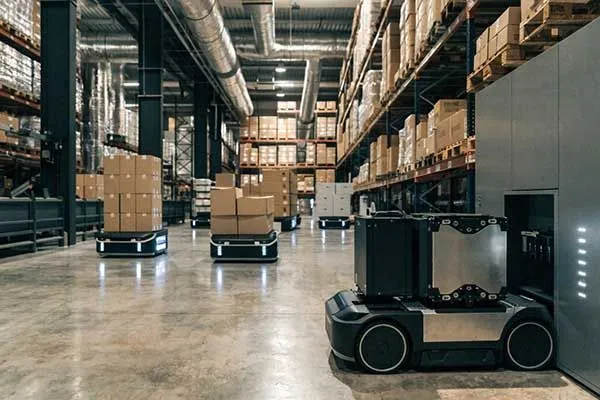
Is your warehouse automation stalling due to frequent battery failures and long charging cycles?
Inefficient power management leads to costly downtime and reduced throughput. Long Sing Energy provides high-performance lithium ion battery for robot systems that eliminate these bottlenecks, ensuring your autonomous fleet remains operational 24/7.
To maximize AMR robot battery uptime, operators must implement a combination of high-rate fast-charging, opportunity charging, or swappable battery systems. Utilizing a high-quality LiFePO4 AMR battery with an integrated smart BMS allows for rapid energy replenishment without compromising cycle life.
Selecting the correct voltage (24V vs 48V AMR battery) and accurately calculating load requirements ensures the battery pack for robot applications provides consistent, long-term performance in demanding industrial environments.
Transitioning to advanced lithium technology is the most effective engineering solution for modern logistics. By optimizing your AMR robot battery configuration, you can achieve superior reliability and lower total cost of ownership. Let us explore how professional battery design transforms your automation efficiency.
Table of Contents
- What Defines an AMR Battery System?
- How to Calculate AMR Battery Capacity?
- What is the Best Battery Pack Architecture?
- What is the Cost and ROI Analysis of AMR Batteries?
1. What Defines an AMR Battery System?
An AMR battery system is a specialized power solution comprising high-density cells, a sophisticated Battery Management System (BMS), and robust structural housing. Unlike a simple battery, an AMR battery system integrates communication protocols and thermal management to support the high-drain, continuous operation of an autonomous mobile robot battery.
It is engineered to handle the specific vibration, shock, and environmental demands of industrial automation while providing reliable, long-term energy storage.
The distinction between a standalone battery and a comprehensive system is critical for engineering success. When we design an AMR lithium battery at Long Sing Energy, we focus on the synergy between the chemical cells and the electronic control layer.
A basic robot battery pack might provide power, but a true system ensures safety and communication with the robot’s main controller. This integration allows for real-time monitoring of State of Charge (SoC)[1] and State of Health (SoH)[2], which are vital for predictive maintenance and uptime optimization.
Key Performance Requirements for AMR Batteries
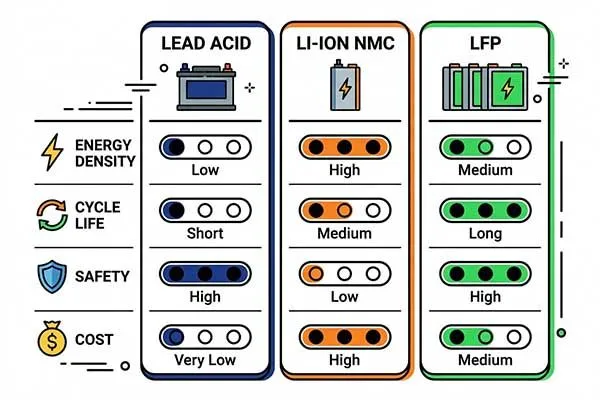
For an AMR robot battery to be effective, it must excel in energy density, cycle life, and safety.
High energy density allows for a smaller amr batteries footprint, leaving more space for cargo. Cycle life is equally important; a LiFePO4 AMR battery can provide over 3,000 to 5,000 cycles, significantly outperforming traditional lead-acid options. Safety is non-negotiable, especially in indoor environments where thermal runaway could lead to catastrophic warehouse fires.
Optimize Your AMR Battery System Design
High efficiency, longer runtime, safer operation.
Battery Chemistry Comparison for AMRs
Choosing the right chemistry is a fundamental engineering decision. While lead-acid was once the standard, it lacks the depth of discharge and fast-charging capabilities required for modern amr batteries.
Lithium-ion, particularly Lithium Iron Phosphate (LFP), has become the preferred choice for an AMR lithium battery due to its thermal stability and high discharge rates.
| Feature | Lead Acid | Lithium Ion (NMC) | Lithium Iron Phosphate (LFP) |
|---|---|---|---|
| Cycle Life | 300 – 500 | 1,000 – 2,000 | 3,000 – 6,000+ |
| Energy Density | Low | Very High | High |
| Charging Speed | Slow (8-10 hours) | Fast (1-2 hours) | Very Fast (0.5-1 hour) |
| Safety | High (Ventilation needed) | Moderate | Very High |
| Maintenance | High | Low | None |
2. How to Calculate AMR Battery Capacity?
AMR battery capacity calculation is performed by multiplying the average power consumption of the robot (in Watts) by the required runtime (in hours), then dividing by the nominal voltage and the depth of discharge (DoD)[3].
For example, if a robot consumes 200W and needs to run for 8 hours with a 20% safety margin, the calculation would be (200W * 8h) / (0.8 DoD) = 2000Wh. This ensures the amr robot battery provides sufficient energy for the entire shift.
Engineering an amr robot battery requires a deep understanding of the load vs. consumption profile. It is not enough to look at the peak power of the motors; one must account for the sensors, LIDAR, onboard computers, and auxiliary systems.
In a logistics AMR, the load varies significantly between “empty” and “loaded” states. We recommend using a conservative AMR battery capacity calculation to account for environmental factors like floor friction and incline navigation, which can spike consumption by up to 30%.
| Component | Average Power (W) | Duty Cycle (%) | Weighted Power (W) |
|---|---|---|---|
| Drive Motors | 150 | 60% | 90 |
| LIDAR & Sensors[4] | 30 | 100% | 30 |
| Onboard PC | 50 | 100% | 50 |
| Actuators/Lifts | 100 | 10% | 10 |
| Total Weighted | – | – | 180W |
Real-World Engineering Calculations
When calculating the amr robot battery requirements, we use the following formula:
The efficiency factor typically ranges from 0.85 to 0.95, depending on the BMS and inverter efficiency. For a 24V vs 48V AMR battery choice, the higher voltage system often yields better efficiency due to lower current draw and reduced heat loss in the wiring.
Environmental Impact on Runtime
The operating environment significantly impacts the amr robot battery performance. In cold storage warehouses, lithium ion battery for robot performance can drop by 20% if not properly insulated or heated.
Conversely, in high-temperature manufacturing plants, an IP67 waterproof battery with advanced thermal dissipation is required to prevent capacity fade. We ensure that our custom robot batteries are tested against these extremes to guarantee uptime.
IP67 Waterproof Battery for AMR
Engineered for harsh environments, delivering sealed protection, stable output, and extended lifecycle in demanding industrial AMR applications.
3. What is the Best Battery Pack Architecture?
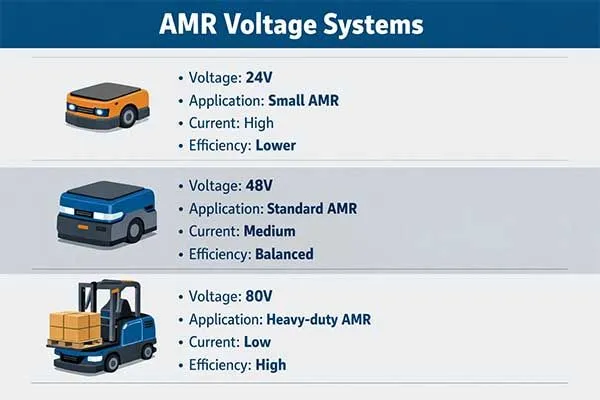
The best battery pack architecture for AMRs typically involves a modular design using either 24V or 48V systems, depending on the robot’s payload and motor requirements.
- Voltage Standards: 24V or 48V configurations to align with standard industrial motor controllers.
- High-Rate Cell Integration: Cells capable of 1C-3C fast charging to support “opportunity charging” during idle periods.
- Mechanical Resilience: An IP67-rated aluminum enclosure with internal vibration damping to withstand 24/7 floor operations.
- Scalability: A Parallel-Ready Design that allows multiple packs to be linked for increased capacity without hardware redesign.
A 48V system is often preferred for heavy-load AMR applications as it reduces current flow, minimizes heat, and allows for thinner wiring. The architecture must include a robust BMS for cell balancing and a high-current charging interface to support opportunity or fast-charging strategies.
At a system level, AMR battery design shares significant overlap with electric mobility ecosystem.
Selecting between a 24V vs 48V AMR battery architecture is a pivotal moment in the design of a robot battery pack. While 24V systems are common for smaller logistics AMR units, 48V has become the industry standard for autonomous mobile robot battery systems requiring higher torque and efficiency.
At Long Sing Energy, we specialize in modular custom robot batteries that allow for easy scaling of capacity by adding parallel modules, ensuring the AMR robot battery can be tailored to specific operational needs.
Build Scalable AMR Battery Architecture
Flexible voltage design for any AMR platform.
Charging Strategies for AMRs
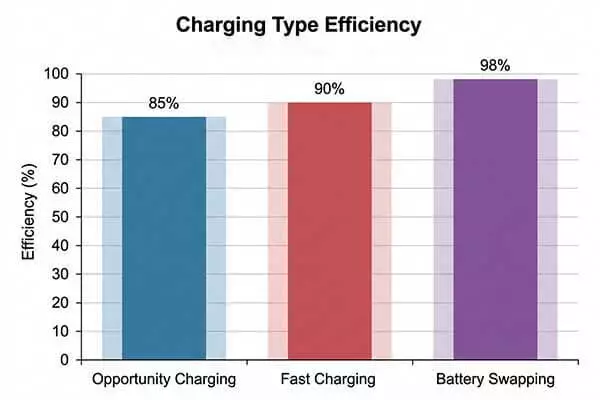
Uptime is directly linked to how energy is replenished.
Opportunity charging[5] — where the robot docks for 5-10 minutes during idle periods — is the most common method for an amr robot battery.
For mission-critical tasks, swappable lithium battery systems allow for near 100% uptime by replacing a depleted pack with a fresh one in seconds. Wireless charging is also gaining traction as it reduces mechanical wear on charging contacts for an amr battery.
BMS & Communication
A sophisticated BMS with excellent thermal management is the brain of the lithium ion battery for robot. It must support protocols like CANbus, RS485 or Bluetooth/Wi-Fi to communicate seamlessly with the robot’s controller. This ensures that the amr batteries can report their status accurately.
Our chief engineer, Jack Song, emphasizes that the BMS strategy should prioritize safety and longevity, implementing cell-level monitoring to prevent overcharge and deep discharge, which are the primary causes of capacity degradation in an autonomous mobile robot battery.
| Architecture Type | Voltage | Common Application | Pros | Cons |
|---|---|---|---|---|
| Low Power | 24V | Small Warehouse AMR | Low cost, simple | High current losses |
| Standard | 48V | Logistics & Manufacturing | High efficiency, balanced | Moderate complexity |
| Heavy Duty | 80V+ | Outdoor & Heavy-Load AMR | Maximum power delivery | High safety requirements |
4. What is the Cost and ROI Analysis of AMR Batteries?
The ROI of AMR batteries is calculated by comparing the Total Cost of Ownership (TCO) of lithium systems against traditional lead-acid or manual labor.
While the initial cost of a lithium ion battery for robot is higher, the ROI is realized through a significantly lower cost per cycle and cost per hour. Over a 5-year period, a LiFePO4 AMR battery typically costs 40-60% less than lead-acid due to its longer lifespan and zero maintenance requirements.
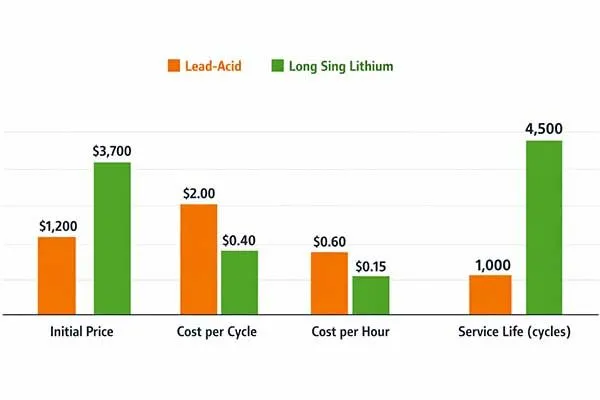
When evaluating the financial impact of an amr robot battery, we look at the cost per hour of operation.
A lead-acid battery might be cheaper upfront, but its limited depth of discharge and slow charging mean you need two or three batteries to cover a 24-hour period.
In contrast, a single AMR lithium battery from a professional lithium ion battery manufacturer can handle continuous shifts with short opportunity charges. This reduces the number of spare batteries needed and eliminates the labor cost associated with battery maintenance.
| Metric | Lead-Acid System | Long Sing Lithium System |
|---|---|---|
| Initial Purchase Price | $800 | $2,500 |
| Service Life (Cycles) | 500 | 3,500 |
| Usable Capacity (DoD) | 50% | 90% |
| Maintenance Cost (Annual) | $200 | $0 |
| Cost per Cycle | $1.60 | $0.71 |
| Cost per Hour (Estimated) | $0.45 | $0.18 |
ROI Case Study: Lead-Acid to Lithium Transition
For our clients in Japan’s precision manufacturing sector, we ensured a runtime greater than the theoretical value of 90% by optimizing the amr battery system specifically for their 24/7 duty cycle.
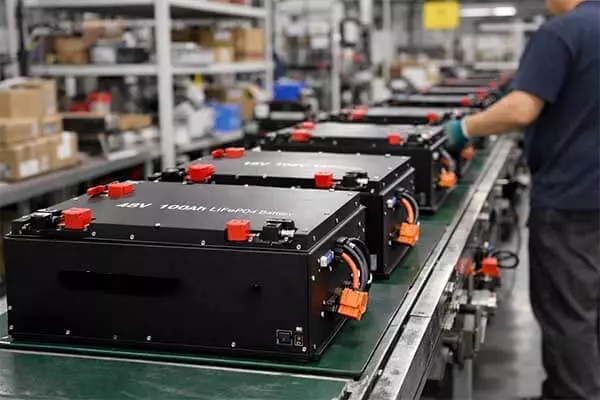
We used a 48V 100Ah LFP configuration with a custom BMS that managed thermal loads in a 25°C environment. By avoiding the temptation to only pursue high energy density and instead focusing on stable discharge rates, we prevented premature capacity fade. The transition from lead-acid to lithium resulted in a 35% reduction in operational costs within the first two years.
Preventing Capacity Fade and Long-Term Value
To maximize the lifespan of your robot battery, we recommend avoiding constant 1C charging if not required. While fast-charging is a feature, regular moderate charging preserves the chemical structure of the amr batteries.
Our sales manager, Luke Liu, often points out that the true value of an AMR lithium battery lies in its reliability. A failed battery doesn’t just cost the price of a replacement; it costs the lost productivity of the entire robot.
Reduce Total Cost of Ownership
Lower cost, longer lifecycle, faster ROI.
Conclusion
Maximizing AMR robot battery uptime requires a holistic approach that balances chemistry, architecture, and charging strategy. By selecting a high-quality lithium ion battery for robot and implementing a rigorous AMR battery capacity calculation, businesses can achieve 24/7 operational efficiency.
Long Sing Energy, as a leading lithium ion battery manufacturer, is committed to providing custom robot batteries that deliver superior ROI and reliability. Investing in the right battery pack for robot today ensures your automated future is powered by the most efficient and durable technology available.
Frequently Asked Questions
Click to explore more information about AMR Robot Battery
Q: What is an AMR robot?
A: An AMR (Autonomous Mobile Robot) navigates dynamically using sensors and software, enabling flexible material handling without fixed paths.
Q: What is an AMR battery?
A: An AMR battery powers mobile robots, typically lithium-based, designed for high energy density, long cycle life, and stable output.
Q: How to change robot battery?
A: Power off the system, disconnect safely, replace with a compatible battery, and ensure proper connection before restarting the robot.
Q: What’s the lifespan of a robot?
A: Industrial robots typically last 8–15 years, depending on usage, maintenance, and battery replacement cycles.
Q: What type of battery do robots use?
A: Most robots use lithium-ion or LiFePO4 batteries due to high efficiency, long lifespan, and lightweight design.
Q: Which is better, AGV or AMR?
A: AMRs offer greater flexibility and adaptability, while AGVs are suitable for fixed, repetitive routes in controlled environments.
Q: What is the battery technology for robotics?
A: Advanced lithium battery technologies, including NMC and LiFePO4, provide high energy density, safety, and long operational life.
Q: What software and hardware are used in industrial Robots AGV/AMR?
A: Systems include navigation software, sensors (LiDAR, cameras), controllers, motors, and battery management systems for efficient operation.
Q: How do you choose a battery for an AMR system?
A: Consider voltage, capacity, cycle life, discharge rate, temperature range, and safety features based on application requirements.
Reference:
[4]Learn how powering LIDAR and sensors adds to load profiles and battery sizing for AMRs.↪
Keep Reading