
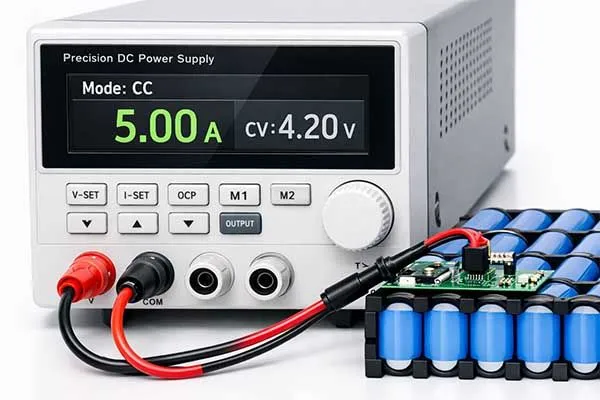
Many industrial projects fail because lithium batteries are charged incorrectly. Poor charging design causes overheating, shortened lifespan, and safety risks. Engineers need a reliable lithium ion battery charging framework to prevent these failures.
Lithium ion battery charging relies primarily on the CC-CV method, where constant current charging is followed by constant voltage regulation.
This method controls lithium battery charging voltage, battery charging current C rate, and temperature limits to ensure safety, maximize cycle life, and maintain battery charging efficiency for OEM solutions in industrial systems such as energy storage, electric mobility, and RV power systems.
Engineers who understand lithium ion battery charging principles can design safer battery systems and integrate industrial battery charging hardware with fewer compatibility issues.
Table of Contents
- What Is the CC-CV Charging Method in Lithium Ion Battery Charging?
- What Safety Limits Control Lithium Ion Battery Charging Systems?
- How Do Engineers Optimize Lithium Ion Battery Charging for Industrial Projects?
What Is the CC-CV Charging Method in Lithium Ion Battery Charging?
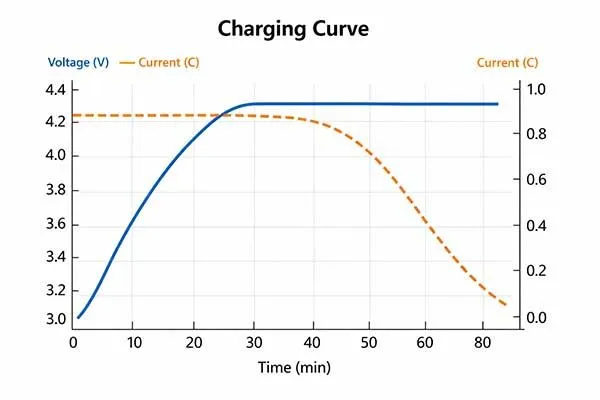
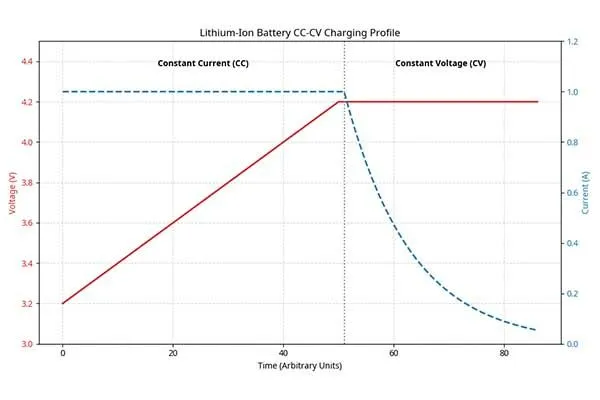
The CC-CV charging lithium battery method first applies constant current until the battery reaches its voltage limit, then switches to constant voltage until the charging current drops to a safe termination level.
This lithium ion charging method prevents overcharging, maintains lithium battery charging voltage stability, and ensures controlled energy transfer during lithium ion battery charging.
Understanding How Lithium Batteries Charge
We were frequently asked how lithium batteries charge and why CC-CV dominates nearly every Li-ion battery charging profiles used in modern electronics and industrial equipment. The answer lies in electrochemical stability.
Lithium ion cells cannot tolerate uncontrolled voltage increases. When voltage exceeds safe limits, lithium plating[1] and thermal stress begin to occur. Therefore, cc cv charging lithium battery protocols maintain strict voltage and current regulation.
CC-CV Charging Phases
Lithium ion battery charging normally contains three distinct phases.
| Charging Phase | Description | Typical Control Parameter |
|---|---|---|
| Constant Current (CC) | Battery receives fixed current until voltage threshold is reached | battery charging current C rate |
| Constant Voltage (CV) | Charger holds maximum voltage while current gradually decreases | lithium battery charging voltage |
| Termination | Charging stops when current drops to cutoff value | safety cutoff threshold |
During the constant current phase, the battery absorbs most of the energy. Engineers usually select a 0.5C–1C battery charging current C rate depending on thermal design and cell chemistry.
The constant voltage phase protects the battery from over-voltage. Current gradually decreases as internal resistance increases. This stage ensures full capacity while protecting cycle life.
Tips
Switch from CC to CV exactly at 4.2V – this single step prevents lithium plating and adds up to 500 extra cycles in industrial packs.
Lithium Battery Charging Basics in Industrial Systems
Many engineers misunderstand lithium battery charging basics because they compare them with lead-acid systems. Lithium batteries behave differently.
| Parameter | Lead Acid Charging | Lithium Ion Charging |
|---|---|---|
| Charging stages | Multi-stage | CC-CV |
| Voltage tolerance | Wide | Strict |
| Temperature impact | Moderate | Critical |
| Charging efficiency | Lower | High |
Proper lithium ion battery charging best practices require voltage monitoring, current control, and temperature feedback.
Industrial systems that ignore these limits often experience reduced battery life or safety failures.
For example, industrial battery charging systems used in energy storage cabinets or power tools must integrate BMS communication[2] and charger feedback loops. These features ensure safe charging lithium ion batteries in large battery packs.
The CC-CV method therefore forms the foundation of most Li-ion battery charging profiles used in electric vehicles, energy storage, and unmanned aerial vehicles.
Master CC-CV Charging Efficiency
Boost speed and lifespan instantly.
What Safety Limits Control Lithium Ion Battery Charging Systems?
Lithium ion battery charging systems rely on strict safety limits including maximum voltage thresholds[3], current limits, and temperature monitoring. These limits prevent overcharge, thermal runaway[4], and lithium plating, which are the most common risks during lithium ion battery charging in industrial equipment.
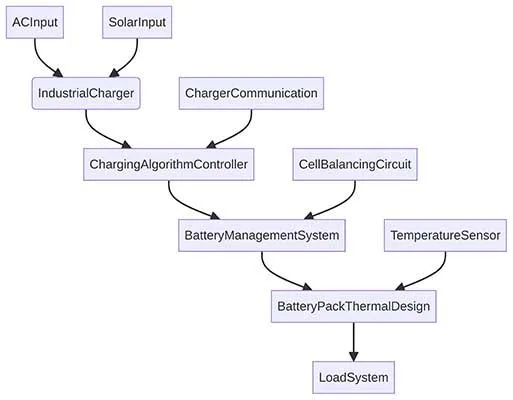
Engineers designing industrial battery charging hardware must monitor multiple safety constraints simultaneously.
Voltage Limit and Current Control
The most important parameter is lithium battery charging voltage.
| Battery Chemistry | Typical Max Voltage |
|---|---|
| NMC | 4.2V |
| LFP | 3.65V |
| High-voltage NMC | 4.35V |
If the charger exceeds this threshold during lithium ion charge, the cell experiences irreversible chemical damage.
Current control also matters. High battery charging current C rate reduces charging time but increases thermal stress.
Temperature Protection
Temperature monitoring is another key element of lithium ion battery charging best practices.
| Temperature Range | Charging Status |
|---|---|
| <0°C | Charging restricted |
| 0–45°C | Normal charging |
| >50°C | Charging shutdown |
A BMS typically stops charging when temperatures exceed safety limits.
Tips
Keep cell temperature under 45°C during CC phase; exceeding this limit triggers thermal runaway and voids warranty on most cells.
These controls explain why advanced charging technologies for lithium batteries include thermal sensors, smart charging algorithms, and communication between charger and battery pack.
Common Charging Problems in Industrial Systems
Large systems frequently encounter charging compatibility issues.
| Problem | Cause | Engineering Solution |
|---|---|---|
| Charger mismatch | Incorrect voltage profile | Define Li-ion battery charging profiles |
| Overheating | High current | Thermal design optimization |
| Slow charging | Low current | Adjust lithium ion charging method |
| Incomplete charge | Early termination | Improve charger algorithm |
We sometimes observe these issues when working with energy storage integrators.
As a lithium ion battery manufacturer, Long Sing Energy recently helped a U.S. commercial energy storage customer validate fast CC‑CV profiles on large LFP racks. Our engineers led by Jack Song built sample modules in our factory, then tested at 0.5C, 1C, and 1.5C charge rates: roughly two‑hour, one‑hour, and forty‑minute CC‑stage equivalents, respectively, before CV taper.
We combined pack thermal simulations[4] with chamber testing to confirm that 0.5C yielded cycle life in the several‑thousand range, while 1.5C was reserved for occasional peak‑demand events due to higher temperature rise and faster aging.
| Charging Rate | Charge Time | Estimated Cycle Life |
|---|---|---|
| 0.5C | ~2.5 hours | ~4000 cycles |
| 1C | ~1.3 hours | ~2500 cycles |
| 1.5C | <1 hour | ~1800 cycles |
During that program, we also matched OEM chargers to pack characteristics instead of forcing a generic unit, which reduced cable losses and let the BMS communicate dynamic current limits over CAN. This co‑design approach, where charger firmware understands the same Li-ion battery charging profiles as the BMS, simplified safety validation and shortened the path from prototype to certified product.
In similar projects, such coordination supports safe yet aggressive lithium ion battery charging in e‑mobility and industrial fleets.
How Do Engineers Optimize Lithium Ion Battery Charging for Industrial Projects?
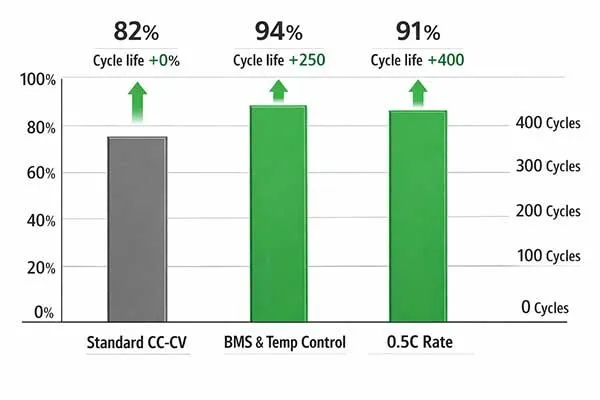
Engineers optimize lithium ion battery charging by integrating smart charging algorithms, efficient battery pack architecture, thermal management, and charger compatibility testing[5]. These factors improve battery charging efficiency for OEM solutions and ensure reliable industrial battery charging performance.
Smart Charging Algorithm Design
Modern chargers use adaptive algorithms instead of fixed profiles.
| Algorithm Type | Function |
|---|---|
| CC-CV optimization | Adjust current dynamically |
| Temperature-adaptive charging | Reduce current in hot environments |
| SOC-based charging[6] | Modify charge rate by battery level |
These strategies represent advanced charging technologies for lithium batteries. They allow engineers to balance fast charging with long cycle life during lithium ion charge operations.
Battery Pack Design Considerations
Pack architecture directly affects battery charging efficiency for OEM solutions.
| Design Factor | Impact |
|---|---|
| Cell matching | Ensures balanced charging |
| BMS architecture | Protects against overcharge |
| Thermal path design | Controls heat during charging |
A well-designed battery pack design for industrial use reduces voltage imbalance between cells and improves safety during charging lithium ion batteries.
Charger Compatibility in Industrial Applications
Engineers must also evaluate charger compatibility.
| Application | Charging Challenge |
|---|---|
| RV systems | Variable power input |
| Off-grid storage | Solar charging fluctuations |
| UAV batteries | High C-rate demand |
| Power tools | Rapid charging requirement |
Each application demands a unique lithium ion charging method and compatible charger hardware.
In RV or off-grid installations, solar controllers must communicate with the battery pack. Without correct Li-ion battery charging profiles, systems may undercharge or overcharge batteries.
Engineers therefore combine charger firmware, BMS design, and pack architecture to guarantee stable lithium ion battery charging.
Optimizing Industrial Lithium Battery Charging?
Custom battery pack solutions available.
Conclusion
Lithium ion battery charging relies on precise control of current, voltage, and temperature. The CC-CV method forms the core charging framework, while safety limits prevent overcharge and thermal risks.
Engineers must integrate BMS protection, charging algorithms, and charger compatibility testing to build reliable systems. When properly designed, lithium ion battery charging delivers high efficiency, long cycle life, and stable performance for industrial applications such as RV systems, electric mobility, and energy storage equipment.
Frequently Asked Questions
Click to explore more information about lithium ion battery charging
Q: How to charge lithium ion battery?
A: To charge a lithium-ion battery, use a charger specifically designed for lithium-ion batteries. Connect the battery to the charger, ensuring correct polarity. The charger should provide constant current until the battery reaches its peak voltage (usually 4.2V per cell), then constant voltage until the current drops to a low level. Avoid overcharging and charging at high temperatures.
Q: What are the rules for charging lithium-ion batteries?
A: Key rules: Use a dedicated lithium-ion charger. Do not exceed maximum voltage. Charge within temperature range (typically 0°C to 45°C). Avoid deep discharges (below 2.5V per cell). Do not leave batteries unattended while charging. Store partially charged (40-60%) if not used for long periods.
Q: Is it okay to leave a lithium-ion battery on the charger overnight?
A: It is generally not recommended to leave a lithium-ion battery on the charger overnight. While most modern chargers have overcharge protection, continuous trickle charging can stress the battery and reduce its lifespan. It’s safer to unplug once fully charged.
Q: Should you charge a lithium-ion battery to 100%?
A: Charging to 100% is acceptable occasionally but regularly charging to full capacity can accelerate battery aging. For longer lifespan, it’s better to charge to 80-90% and avoid deep discharges. Some devices allow you to set a charge limit.
Q: What is the best way to charge a lithium-ion battery?
A: The best way is to use a smart charger with CC/CV profile (constant current/constant voltage). Charge at a moderate rate (0.5C to 1C). Keep the battery cool during charging. Avoid full discharges; charge when it reaches 20-30%. Store at partial charge if not in use.
Q: Is it okay to trickle charge a lithium-ion battery?
A: No, trickle charging is not suitable for lithium-ion batteries. Unlike lead-acid, lithium-ion does not tolerate continuous overcharging. Trickle charging can cause lithium plating and safety risks. Use a charger that stops when full.
Q: Can a normal battery charger charge a lithium battery?
A: No, a normal charger (e.g., for lead-acid) cannot be used for lithium batteries. Lithium batteries require specific charging algorithms (CC/CV with precise voltage cut-off). Using an incompatible charger can damage the battery or cause fire.
Q: Common lithium-ion battery charging mistakes in industrial systems?
A: Common mistakes include: using incorrect chargers, overcharging, charging at extreme temperatures, ignoring cell balancing, poor ventilation, and neglecting regular maintenance. These can lead to reduced battery life, safety hazards, and system downtime.
Reference:
[3]Clarifies safe caps like 4.2V and chemistry-specific limits to prevent irreversible damage.↪
[5]Ensures chargers match packs and BMS, preventing safety issues and performance losses.↪
[6]Describes adaptive charging based on remaining capacity to improve life and efficiency.↪