
Designing battery systems often leaves engineers struggling with mismatched power ratings. Incorrect voltage or current calculations lead to system failures and wasted budgets.
We resolve these engineering bottlenecks by applying accurate electrical unit conversions involving amps, volts, watts, and ohms to build robust, high-performance battery packs.
Power system design uses volts, amps, and watts to determine the exact capacity and discharge limits of a battery pack.
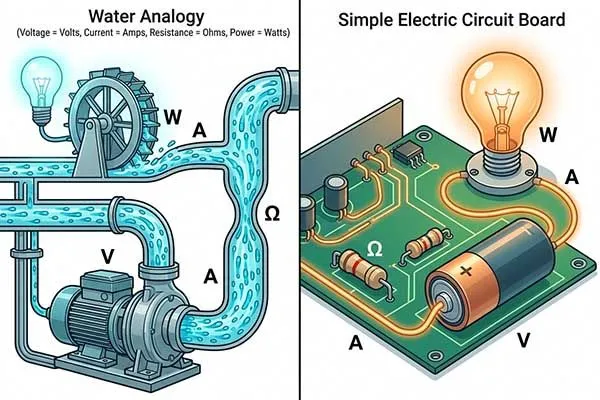
Volts measure pressure, amps measure current flow, watts measure total power, and ohms slow the current down. Engineers multiply volts and amps to watts to calculate the power formula electricity requires, ensuring the battery system safely drives the intended motor or electronic application.
Our engineering team relies on precise technical solutions to optimize these variables. We invite you to explore how you can master these metrics for your next power architecture project.
Table of Content
- 1. What Are Amps, Volts, Watts, and Ohms?
- 2. What Are The Electrical Relationships Engineers Must Know?
- 3. How Do These Units Affect Lithium Battery Systems?
- 4. How to Calculate Power Requirements for Battery Systems?
- 5. How Do Amps vs Watts Compare in Battery Selection?
- 6. What Are Common Mistakes in Electrical Calculations?
1. What Are Amps, Volts, Watts, and Ohms?
Amps means Ampere (A), it represents electrical current, which is the physical rate at which a volume of electrons flows past a specific point in a circuit per second.
Volts means Voltage (V), it is the electrical pressure that pushes pushes an electric charge(current) through a conducting loop.
Watts means Wattage (W), it standards for total electrical power, which is the rate at which energy is consumed or produced. The load power calculation by voltage and current: P = V x I.
Example
A 12V lithium battery powering a device that draws 10A will deliver 120W of power (P= V x I = 12 x 10 = 120W). It instant power helps our engineer size the battery output, match loads of sensor and select correct inverter.
Ohms means Resistance (Ω), it measures the electrical resistance of the opposition to the flow of current within a material or component.
Understanding amps volts watts ohms explained is critical for any foundational power system design.
The Water Analogy[1] for Electrical Flow
When our engineers explain foundational concepts to non-technical partners, we always use the water pipe analogy.
Volts represent the water pressure inside the pipe. Amps represent the volume of water flowing past a point. Ohms represent the pipe’s narrowness or resistance, which restricts the water. Finally, watts represent the total power of the water hitting a waterwheel.
We must define these basic components before we understand their structural relationships.
| Unit | Symbol | Water Analogy | Engineering Role |
|---|---|---|---|
| Voltage (Volts) | V or E | Water Pressure | System potential energy |
| Current (Amps) | I or A | Water Flow Rate | Current draw speed |
| Resistance (Ohms) | R or Ω | Pipe Restriction | Heat generation limit |
| Power (Watts) | W or P | Total Water Power | Work output rate |
As a reliable lithium ion battery manufacturer, we always measure these parameters carefully. Whether we look at amps or volts, each metric plays a distinct role in our product testing phase. We must convert volts and amps to watts to see the true power capability of any module.
When we analyze amps, volts, watts, and ohms, we optimize the power architecture comprehensively. We use volt ampere watt calculations[2] to build better systems for our clients. Many engineers confuse watts and amps during early design stages, leading to severe architectural flaws.
Clarifying volts vs amps vs watts can prevent system overloads.
Need Help Understanding Battery Power Basics?
Get expert battery guidance.
2. What Are The Electrical Relationships Engineers Must Know?
The primary electrical relationships rely on Ohm’s Law and the Power Equation.
Ohm’s Law[3] states that voltage equals current multiplied by resistance (V = I x R).
Example
If a circuit draws 5A through a resistance of 2Ω, the voltage required is 10V (V =I x R=5 x 2=10V). It helps our engineer design wiring, calculate voltage drop and find the way to stablize the battery system.
The Power Equation[4] states that watts equal volts multiplied by amps (W = V x A). Engineers use these formulas to calculate load limits and ensure battery energy efficiency[5] in industrial applications.
Example
A 24V lithium battery supplying 3A produces 72 watts (W = V x A = 24 x 3 = 72W). This is another way to express power using amps instead of current symbol (I).
Mastering Ohm’s Law and Power Equations
Our engineering team understands that mastering relationships is more important than memorizing numbers. The structure of our design logic always follows a strict path from definition to relationship to formula. We need ohm’s law explained properly to balance our internal circuits.
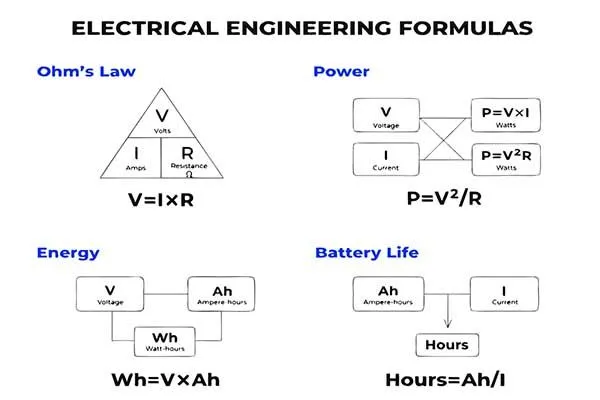
The basic battery power calculation relies on multiplying the current by the voltage to find the total output. When we connect a circuit, the electrical units interact directly. The standard equation dictates that a system drawing high current at low voltage will generate more heat than a high-voltage, low-current system.
We frequently calculate ampere watt loads to properly size our cables. Every time we convert volts and amps to watts, we ensure the battery capacity matches the maximum discharge rate. We analyze amps, volts, watts, and ohms to systematically lower current loss across our modules.
Whether we use amps or volts as our primary constraint, we need to balance the volt ampere watt triangle. We consistently evaluate watts and amps to maintain critical safety in our global e-mobility products.
| Relationship Concept | Mathematical Formula | Application Example |
|---|---|---|
| Ohm’s Law | V = I × R | Calculating cable resistance drop |
| Power Equation | W = V × A | Sizing a motor controller |
| Energy Equation | Wh = V × Ah | Determining total runtime |
Example
A 48V 100Ah lithium battery stores 4800Wh (4.8kWh) of energy (Wh = V x Ah = 48 x 100 = 4800Wh). This formula calculates total stored energy, not instant power. It helps our engineer to estimate backup time, and size up the energy system.
3. How Do These Units Affect Lithium Battery Systems?
These electrical metrics directly determine lithium battery voltage, current draw, and total capacity requirements. System designers must match the battery pack voltage to the equipment’s operating voltage, while ensuring the continuous amp rating handles the maximum load.
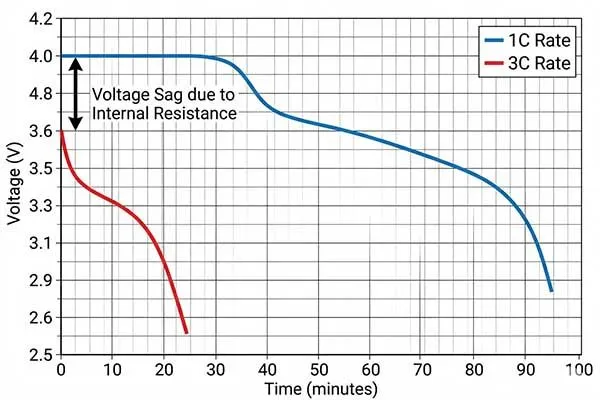
If the watts supplied do not meet the power requirements of industrial equipment, the system will shut down or suffer severe voltage sag.
Solving High Current Draw in RV Applications
At Long Sing Energy, we recently solved a critical power system design failure for a North American recreational vehicle (RV) manufacturer. The client requested a 12V 400Ah LFP battery pack. During our initial factory sample testing, the system failed because the RV air conditioner demanded a massive inrush current.
Our Sales Manager, Luke Liu, coordinated with the engineering team to investigate the root cause. We discovered the initial BMS Over-Current Protection (OCP)[6] delay time was too short. Our Chief Engineer, Jack Song, adjusted the BMS parameters, extending the OCP delay from 2 seconds to 5 seconds.
This specific adjustment allowed the battery to safely release 350 amps for short-term discharge. We also improved the cell connection methods, lowering the Direct Current Internal Resistance (DCIR)[7] test data from 18mΩ down to 10mΩ.
Tips
Internal resistance is the effective resistance inside a real battery (or any voltage source like a cell) that opposes the flow of current. It exists in every battery.
By analyzing amps, volts, watts, and ohms, we optimized the power architecture. We managed the volt ampere watt balance precisely. This project proved that properly configuring components saves commercial projects from failure. We always ensure our designs maintain structural integrity under load.
| Parameter | Initial Factory Sample | Adjusted Production Unit |
|---|---|---|
| Nominal Voltage | 12.8V | 12.8V |
| Peak Discharge (Amps) | 200A (System Fail) | 350A for 5s (System Pass) |
| Pack DCIR Value | 18mΩ | 10mΩ |
| BMS OCP Delay | 2 seconds | 5 seconds |
4. How to Calculate Power Requirements for Battery Systems?
To calculate power requirements, engineers first identify the continuous and peak wattage of the load. They divide the total required watts by the system voltage to determine the required amps.
Engineers then multiply the current draw by the required runtime to find the total amp-hour capacity. This exact sequence guarantees that the battery system operates reliably without exceeding thermal limits.
System-Level Logic for Power Calculations
We calculate loads using a highly systematic approach. You must determine the power architecture before selecting internal cells.
For example, if a household solar inverter requires 3000 watts, and you choose a 48V system, you divide 3000W by 48V to get 62.5 amps. If you chose a 12V system instead, the current draw jumps to 250 amps.
We always advise upgrading the voltage system to lower the current loss and optimize system efficiency. We evaluate power metrics closely during this early phase. We map out lithium battery voltage vs capacity to find the absolute sweet spot for the application.
You must convert volts and amps to watts accurately.
| Application Type | Assumed Load (Watts) | System Voltage | Calculated Current (Amps) |
|---|---|---|---|
| Household Electronics | 500W | 12V | 41.6A |
| Solar Storage ESS | 5000W | 48V | 104.1A |
| Industrial UPS | 10000W | 96V | 104.1A |
By comparing amps or volts, we decide whether to use series or parallel configurations. We map out the ampere watt ratios for different industrial equipment cases, such as UPS battery systems and EV battery modules.
Understanding amps, volts, watts, and ohms ensures our engineers select the correct BMS MOSFETs for the final build.
Need Accurate Power Consumption Estimates?
Improve runtime predictions.
5. How Do Amps vs Watts Compare in Battery Selection?
Amps define the thickness of cables and the rating of safety components, while watts define the total work the battery can perform.
Engineers prioritize amps when designing thermal management and circuit protection to prevent overheating. Conversely, they prioritize watts when calculating total energy storage and estimating how long a device will run on a single charge.

Evaluating Capacity and Discharge Rates
The distinction between current and power dictates every hardware choice we make in the factory. When we look at a commercial industrial battery, the continuous discharge rate relies heavily on the amp rating. We must size the BMS and the cables to handle the heat generated by the current.
Engineering Explanation
Battery Discharge Current: The current drawn from a battery during operation, typically measured in amps (A). It tells you how fast the battery is being drained.
Discharge rate (C-rate): Current relative to capacity, calculated as C-rate = I ÷ Capacity. For example, 0.5C means the battery will be fully discharged in 2 hours. That helps our engineer to design the battery lifespan and set up required BMS protection.
However, when the client asks how long the machine will run, we look strictly at the watt-hours. We constantly balance the electrical units in our daily designs. Then comparing ampere watt specifications to ensure the internal copper busbars do not melt under stress. If we ignore how power conversions function, we risk catastrophic failure in the field.
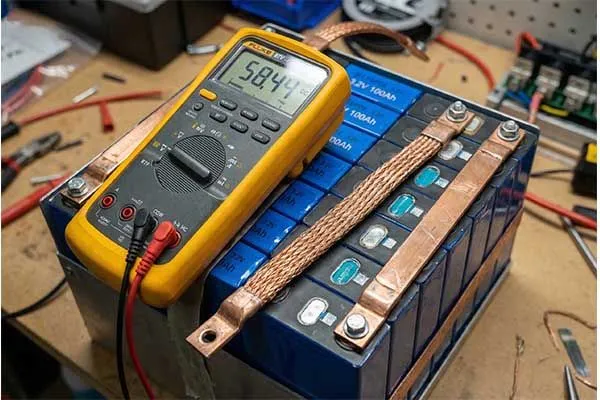
Our team utilizes precision monitoring tools in our testing labs. We must balance these variables to achieve optimal pack efficiency, tracking amps, volts, watts, and ohms meticulously. We always prioritize power metrics based on the specific application, whether it is an unmanned aerial vehicle or a heavy industrial power tool.
| Design Priority | Focus Metric | Engineering Impact |
|---|---|---|
| Thermal Management | Amps (Current) | Dictates wire gauge and heat sink size |
| Work Output | Watts (Power) | Determines motor torque and speed |
| Runtime Duration* | Watt-hours (Energy) | Defines total battery pack capacity |
*Note: Battery life runtime estimation using “Runtime = Capacity (Ah) ÷ Current (A)”.
6. What Are Common Mistakes in Electrical Calculations?
The most common mistake engineers make is neglecting voltage drop under heavy loads, which skews watt calculations. Another frequent error is mixing up amp-hours (capacity) with continuous amps (discharge rate), leading to undersized battery management systems.
Designers also frequently fail to account for inverter inefficiency[9], assuming that 100% of the DC battery power perfectly translates to AC output power.

Preventing Catastrophic Engineering Errors
Critical thinking reveals that theoretical mathematics often clash with real-world physics. Many novice designers simply multiply their nominal voltage by their rated capacity and assume the job is completely done. They forget that as a battery discharges, the working voltage drops.
If the voltage drops but the equipment still demands the same power, the current draw must increase.
This phenomenon completely changes the system mathematics midway through the discharge cycle. We educate our partners on these electrical units to prevent thermal events and fires. You cannot assume a static power relationship.
| Common Mistake | Root Cause | Corrective Action |
|---|---|---|
| Ignoring Voltage Sag[8] | Assuming static voltage | Calculate power using loaded voltage |
| Confusing Ah and A | Misunderstanding terms | Separate capacity from discharge rate |
| Neglecting Efficiency | Assuming perfect conversion | Add 10-15% margin for inverter loss |
You must measure dynamic current curves under physical load. We teach our clients to respect amps, volts, watts, and ohms at every single state of charge.
When engineers miscalculate watts and amps, the BMS shuts the system down prematurely. We analyze these metrics closely during our final quality control phase.
We ensure our custom systems meet the highest global manufacturing standards.
Avoid Costly Electrical Design Mistakes
Improve system reliability.
Conclusion
Mastering amps, volts, watts, and ohms guarantees the safety and longevity of any custom energy system. By accurately calculating current flow, voltage pressure, and total power, engineers build resilient architectures for demanding industrial applications.
We focus on optimizing every cell connection, minimizing internal resistance, and selecting the proper components to handle peak loads. Understanding these fundamental principles ensures that our robust lithium packs deliver consistent, reliable performance for electric mobility and energy storage systems across global markets.
Frequently Asked Questions
Click to explore more information about amps, volts, watts, and ohms
Q:What are amps, volts, and watts?
A:Amps measure electrical current, volts measure electrical pressure, and watts measure total power. For example, a 3.6V battery delivering 1A produces 3.6W of power. In industrial devices, these units determine how much energy a system consumes and how long a battery will last.
Q:How do volts, amps, ohms, and watts work together?
A:Volts, amps, ohms, and watts are connected through Ohm’s Law and the power equation. Voltage drives current through resistance (ohms), and power (watts) equals voltage multiplied by current. These relationships help engineers design efficient battery-powered systems.
Q:What is the 3 formula of power?
A:The three main power formulas are: P = V × I, P = I² × R, and P = V² ÷ R. These equations allow engineers to calculate power based on voltage, current, or resistance in electrical and battery systems.
Q:What kills you, amps or volts?
A:Amps (current) are what cause harm, but voltage is what drives the current through the body. Even low voltage can be dangerous if it produces enough current. In industrial systems, proper insulation and current control are critical for safety.
Q:What does 100 watts into 8 ohms mean?
A:It means a device delivers 100W of power to an 8-ohm load. Using formulas, this corresponds to specific voltage and current levels. This concept is important in designing circuits and matching loads with power sources.
Q:How many amps is 2000 watts at 240 volts?
A:Using I = P ÷ V, 2000W ÷ 240V equals approximately 8.33 amps. This calculation is essential for sizing power systems and selecting the correct battery or power supply.
Q:How many ohms are in 1 volt?
A:Ohms cannot be determined from voltage alone. Resistance depends on both voltage and current using Ohm’s Law (R = V ÷ I). Without current, the resistance value cannot be calculated.
Q:What is 20 amps in volts?
A:Amps cannot be directly converted to volts without knowing resistance or power. According to Ohm’s Law, voltage equals current multiplied by resistance (V = I × R). Additional information is required for calculation.
Reference:
[1]Visualize electrical flow using the intuitive water analogy.↪
[2]Quickly calculate watts from volts and amps for system design.↪
[3]Master Ohm’s Law for accurate circuit analysis.↪
[4]Learn how power is calculated in electrical systems.↪
[5]Explore how energy efficiency impacts battery performance.↪
[6]Understand how BMS protects batteries from overcurrent risks.↪
[7]Discover how internal resistance impacts battery efficiency.↪
[8]Understand how voltage sag affects system performance.↪
[9]Learn why inverter efficiency impacts real output power.↪